

Aid agencies are falling around the world. Why?

The Death of Aid Was Political Suicide
English
The Trump administration’s dismantling of USAID was sudden, strange, intense and, at best, questionably legal. It raised a host of America-specific issues: the limits of executive power, the role of Congress, the potential negative consequences of very sudden stops in government programs and the power of the judiciary to prevent or remediate organizational damage.
But USAID isn’t the only aid agency to have suffered major upheaval.
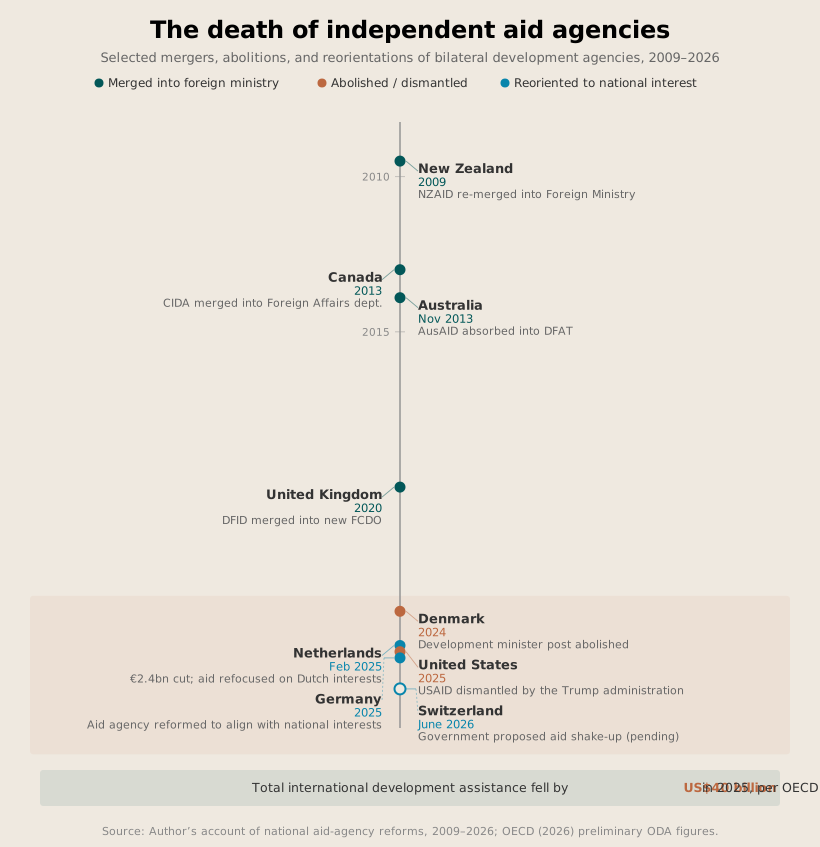
Since 2009, many countries have eliminated or downgraded their historically free-standing, semi-autonomous or ministerial-level development agencies. In 2009 the semi-autonomous New Zealand aid agency, NZAID, was (re)merged into the Ministry of Foreign Affairs and Trade and downgraded to department status. In 2013-14, the Australian aid agency, AusAID, was, summarily and without any consultation, merged into the Department of Foreign Affairs and Trade. In 2013, Canada’s development agency, CIDA, was merged into the Department of Foreign Affairs, Trade and Development. And in 2020, the British Department for International Development (DfID) was merged into the new Foreign, Commonwealth and Development Office.
Changes to development assistance are not just a feature of the Anglosphere. Denmark’s separate Minister for Development Cooperation was abolished in 2024. The Dutch government issued a policy statement on February 20, 2025, that announced a structural budget cut of €2.4 billion and a major shift in the purposes and content of aid, with a declared focus on promoting Dutch interests. The German coalition government recently reformed its aid agency to be more aligned with national interests. In June 2026, the Swiss government proposed a shake-up in their aid structure with the objective of more effectively promoting Swiss economic interests.
The OECD reported that preliminary figures suggest international development assistance in constant dollars fell by $48.7 billion from 2023 to 2025, a 29 percent drop, the largest in history.
Discussing the events around USAID in isolation misses the bigger picture. I argue that for the last few decades, the national organizations of foreign assistance have pursued a fundamentally misguided political strategy. Aid agencies narrowed the focus of bilateral assistance to just direct actions — rather than actually assisting developing countries in making progress on their broader national development goals.
This had the positive effect of making their contribution to specific outcomes more legible and hence easier to sell. But this narrower focus also weakened core elements of political support, which eventually resulted in organizational downgrading and budget cuts.
By cutting off their political support — their lifelines — they committed assisted suicide.
Why Development Aid?
The field of “development” arose as a geopolitical response to the formal decolonization of the post-World War II period. It was widely acknowledged that the world as a whole would benefit if the newly independent states could become “developed” as well.
Initial approaches focused on structural transformation and growth, under the assumption that countries that have achieved higher levels of national development — more productive economies, more capable administration, more responsive polities — would also improve the wellbeing of their citizens.
This assumption was largely correct. In general, countries that have experienced the structural transformations of national development have seen enormous progress in material well-being, essentially eliminating extreme poverty, achieving universal schooling, increasing life expectancy and limiting their burden of disease.
Over time, though, this structural transformation approach fell out of favor. It was perceived as ineffective, difficult to evaluate and benefiting the elite of developing countries. In the decades since 1990, aid has instead focused on mitigating specific, direct harms to human well-being that are the result of a lack of national development. This shifted development assistance from the broad, systemic transformation of countries — what Fukuyama calls “getting to Denmark” — to projects focused on the targeted (at countries and individuals within countries) mitigation of specific harms (e.g., health/nutrition/education/access to credit/lack of skills).
I call this alternative approach to the provision of development assistance the Projectized and Targeted Countering of Harms (PATCH). I use this jargony acronym as it comes with no baggage (like labeling development assistance as “charity”) and it encompasses both “humanitarian” work responding to crises (earthquake, weather, conflict) and the more routine programmed assistance of this type (e.g. health clinics, schools, job training, micro-finance).
The PATCH approach had three big political advantages in donor countries.
First, you can take a picture of PATCH. I am not being facetious when I claim this as a benefit. Channeling bilateral assistance into specific projects allows agencies to claim attribution for impact. They can literally show taxpayers a picture of a particular smiling child sitting in a classroom or a woman and her enterprise after getting micro-credit. This is vastly more photogenic and at least seems more concrete and tangible than actions to strengthen the capacity of a central bank to manage inflation or of ministries to choose, plan and implement their own projects.
Second, it is legible. PATCH responds to the old saying that “international aid transfers money from poor people in rich countries to rich people in poor countries.” Agencies can show an accounting paper trail of their transfers to specific beneficiaries, who are not rich.
Third, in countries that lag in national development, there really are urgent harms to be addressed. By targeting pressing needs in hard-pressed places, the modest resources provided by the donor can “make a difference.” One need not get a country to the GDP per capita of a development success like South Korea or create government-wide gains in state capability. For PATCH to be accounted a success it would suffice to just achieve limited project goals against serious harms.
But this also lowers expectations — rather than striving for an education system that produces world-class scientists, the donor could help achieve the last mile of universal completion of primary school by targeting the out-of-school populations.
The Millennium Development Goals of 2000 were the paradigm: They focused on only a few very low-bar goals. Within health there were only targets and tracking for limited health outcomes — child mortality, maternal mortality and three named diseases. Core aspects of a functioning health system were apparently beyond the pale of development assistance.
When the donor funds a well-designed project and it is implemented well, PATCH can be very effective at mitigating harms and making the world a better place. This has enormous appeal to those donor country voters whose motivation is altruism. Indeed, many make the case that the shift away from broader goals to a narrower PATCH approach made bilateral development assistance more effective, accountable and “evidence based.”
But foreign aid has never just been about altruism. Historically the three legs of political support for development assistance were: (i) foreign policy interests, (ii) private sector business interests and (iii) global altruism (general and specific). PATCH bilateral foreign assistance may have increased the support of those committed to global altruism, but it also reduced support from two of the three legs of the stool. A one-legged stool is not stable — and now it has fallen over.
Foreign Assistance and the Goals of the Foreign Policy Interests
The foreign policy establishment in a donor country is supportive of bilateral assistance to the extent it is seen as a useful tactic in advancing the donor country’s overall global strategy. When bilateral assistance augments a donor country’s influence, foreign policy interests can be a powerful domestic political ally.
This motivation was key to support during the Cold War era. Many Western governments, including the U.S., saw foreign assistance as helpful in preventing alignment with the Soviet Union, an argument made explicit in JFK’s 1961 speech announcing the creation of USAID. As the USSR was actively engaged abroad, the U.S. and other countries had to do the same.
After the Cold War ended, there was no longer a clear ideological enemy. The foreign policy goals of the donor countries became more diffuse and differentiated. Some countries focused on maintaining strong relationships in their regional blocs, but many others maintained a global perspective. They would continue to view foreign assistance as a means of generating “soft power.”
But the PATCH approach is not very good at creating the soft power that the foreign policy establishment craves, for three reasons.
First, PATCH simply does not focus on those with power in recipient countries. While some types of such assistance may help create a generally favorable view of the country in the typical citizen, this need not translate into power with the right people in the right places. Even in a democracy like the U.S., the influence of general public opinion on government policy is not very strong and is especially weak on foreign policy issues. In weak political systems, one could imagine public opinion would matter even less. When assistance is maximally targeted to the mitigation of harm, the flip side implication is that the elites (or even middle class) will benefit the least.
Furthermore, PATCH assistance often does not align with the goals of the government at destination. These governments are often interested in sustained, rapid, broad-based economic growth and in system-wide improvements in key sectors like infrastructure (water, power, transport), security, law and order, and education and health. Assistance that does not contribute to these core agendas necessarily produces less soft power to influence recipient government behavior on issues the foreign policy elite care most about.
Second, PATCH has an inherent limitation as a tool of soft power for donor countries’ global agendas. It tends to focus on countries that are struggling and, almost by definition, these are not countries that are globally powerful and influential.
There may be some overlap between the countries most in need of support and those most important to donor countries, but any such overlap is by coincidence rather than design. For instance, the UK’s 2011 bilateral aid review resulted in DFID prioritization of 28 countries, of which 18 were in sub-Saharan Africa, six were South Asian, two were former USSR and two were in the Middle East. This may have been effective prioritization for mitigating the harms of the lack of national development but it is hardly the list of places a great power would like to have influence in.
Targeting extreme poverty makes this trade-off particularly clear. Suppose, in the interests of focusing assistance on extreme poverty, a bilateral agency targets those countries with more than 20% of their population in extreme poverty. Technocratically this is not unreasonable. But this well-meaning targeting of poverty would leave 21 of the 28 largest developing countries — in population terms — off the list. The seven high-poverty countries of Pakistan, Nigeria, Ethiopia, DR Congo, Tanzania, Kenya and Uganda are indeed countries facing formidable challenges but they do not add up to a global foreign policy strategy. They include less than 10% of the total population of developing countries — and even less of global power.
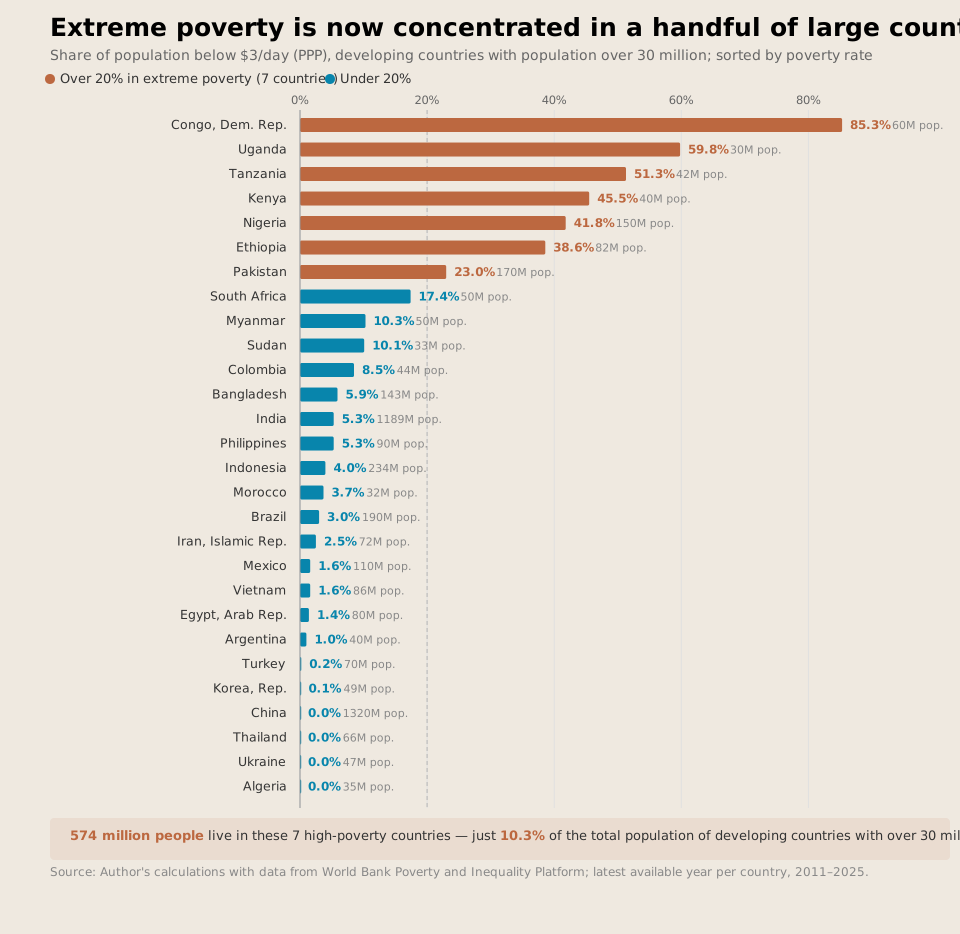
Foreign policy interests, by contrast, tend to focus on relationships with large and powerful countries. These are less interested in the relationship with Malawi and more interested in the relationship with China. PATCH does not promote the donor country’s national interests, and thus foreign policy interests rightly have little interest in it. Targeting the mitigation of harms cannot deliver globally important “soft power.”
Consider a thought experiment: Imagine there is a one-hour, one-on-one meeting between the head of state of any of the large developing countries in the figure above and the head of state of a large donor country (U.S., UK, Japan, Germany, the Netherlands). For which of these countries can you even imagine the leadership of the developing country wanting the donor country’s bilateral assistance on the meeting’s agenda?
One might argue that the goals of PATCH and the foreign policy elite overlap in war, conflict and failed state situations. In situations like these, the humanitarian needs are immense and the projectized approach is the only workable channel. However, aid agencies that focus on PATCH often struggle when they try to provide anything besides immediate humanitarian relief.
PATCH can succeed in providing critical services but doesn’t necessarily help governments build sustained capability — or even survive as a state. The USAID and World Bank-funded Basic Package of Health Services (BPHS), which started in 2003, is a good example. Health conditions in Afghanistan improved enormously and the BPHS is seen as highly effective. However, it was implemented largely via NGO contracts and hence neither contributed to the legitimacy of the Afghan government nor built durable local capability. Individual Afghans benefitted substantially, but the Afghan state had essentially no stakes in the program.
After nearly $60 billion spent on reconstruction (not including either U.S. military expenditures or support to military and security forces), the Afghan state collapsed in a matter of days.
National Economic Interests
Soft power is all well and good, but it cannot be measured in dollars. It is not surprising legislators say things like: I agree that our assistance produces important benefits for people in the recipient countries, and I can understand that it might augment our country’s global power, but what are the concrete benefits to my constituents? Politicians love win-win situations as much as the rest of us; in an ideal world, foreign aid would bring in both soft power and at least some dollars into the national economy.
Historically, there was an easy answer to this. Foreign assistance that focused on economic growth raised the exports of the donor countries and hence created jobs in two ways.
First, investment in infrastructure (roads, power plants, dams, ports) was key to raising and sustaining growth in developing countries. These investments required sophisticated capital goods that the donor countries tended to produce — and bilateral assistance programs could even steer the choice towards the donor country (with mechanisms ranging from direct tying of assistance to donor country purchases to just nudges).
Second, the result of economic growth was higher incomes in the recipient country. With higher incomes, people consume more imports; and exporting firms in the donor countries were at least potential indirect beneficiaries.
If a country’s key companies get additional sales from aid, this provides a powerful constituency for aid. Growing home firms may even increase the number of jobs in legislators’ constituencies, making aid useful to the legislators.
However, the PATCH approach does not claim to promote economic growth and hence cannot claim to be instrumental in promoting donor country exports. Though there are private sector firms (both nonprofit and for-profit) that implement projects and this creates some jobs, these firms are small and are essentially clients of the assistance agency and hence bring little or no additional power to the politics of aid. There is a substantial political difference between foreign aid augmenting the sales of large domestic firms — bringing power from outside the aid industry —– and firms whose main source of revenue is aid contracts.
This weaker connection to private interests makes aid much more politically vulnerable. It is notable that reform and restructuring of assistance agencies nearly always explicitly highlights the goal of greater alignment with the donor country’s national interests and often mentions promotion of country exports as a goal of assistance.
Assisted Suicide: Did Bilateral Assistance Decline Because It Got Better at Doing Less?
One might believe that the death of independent aid agencies came as the inexorable consequence of geopolitical changes. Perhaps a downgraded importance of bilateral assistance was an inevitable product of the end of the Cold War.
Another view is that “international development” has been a victim of its own success. It is true that since 1990 extreme poverty has been dramatically reduced, child mortality has declined and the number of children never attending school has fallen to very low levels. It might be argued that this would inevitably, and rightly, reduce donor countries’ commitments to international development.
I don’t think either of these is the entire reason for the decline in bilateral aid. I believe the shift from broad development assistance to the narrower PATCH strategy intensified political support among some constituencies but reduced it among others. In the pursuit of greater legibility, aid agencies lost the support of key parts of the aid coalition.
First, the PATCH approach was of little interest to nearly all developing country governments who saw this mitigation approach as, at best, only a small component of their own more ambitious agendas. This had the domestic consequence that the foreign policy establishment no longer saw their country’s assistance agencies as an important component of their country’s global strategy. This cut off one leg of political support.
Second, the move away from a focus on broad-based economic growth to PATCH meant the domestic “private sector” interest in assistance was reduced to NGOs and contractors. The only supporters left were the pure altruists — never a majority nor a typically powerful group in any country.
Successful public policy requires the maintenance of a sufficient coalition of actors within the actual political decision-making process. Reducing the size of that coalition is equivalent to voluntarily climbing into a slide and pushing off. You cannot be surprised to find yourself at the bottom.
This is not the usual criticism of aid. It did not “fail” nor was it particularly “wasteful” or “ineffective.” My argument is in many ways the opposite. In trying to be more demonstrably successful and cost-effective at producing visible and high-impact benefits, the agenda of assistance narrowed. And even when that approach made bilateral assistance more cost-effective at countering the harms from the lack of development, it had two other effects.
One, it made bilateral development assistance less and less relevant to the actual national development goals of nearly all developing countries. Two, it reduced the support from key domestic constituencies that supported aid because it did good around the world but not in ways that also supported key national interests.
The future of development assistance is not arguing about whether the projects of USAID (or other agencies) did or did not directly contribute to “saving lives.” If bilateral agencies are to survive, they must be able to gain back the support of powerful political actors by supporting donor country national interests. And a key element of that is making development assistance a partnership with recipient countries in promoting a broad vision of national development.
Lant Pritchett has worked in the field of development for 40 years, 20 in the World Bank, 20 in academia (Harvard HKS, Oxford BSG, LSE SPP). He has engaged in research and practice in a variety of domains, including economic growth, education, social protection, governance and state capability, and labor mobility. He was co-author with David Dollar of the 1998 World Bank report Assessing Aid: What Works, What Doesn’t and Why.
If you have comments on this article, or wish to contribute to the discussion, please email them to letters@indevelopmentmag.com. Responses will be featured in a letters section.