

Cheap lifesaving drugs already exist. A better injection device could get them to patients in time.
Stuck in the Vial: How Autoinjectors Could Unlock Old, Cheap, Lifesaving Drugs
English
In the U.S., over 1.5 million people are prescribed an epinephrine autoinjector, such as an EpiPen — a small pen designed to deliver a single dose of adrenaline. People carry it in case of anaphylaxis, a severe allergic reaction to foods, medications, insect stings or other materials that can become fatal within minutes. Treating anaphylaxis, though, has become remarkably simple: pick up an EpiPen, remove the cap, push it against the thigh and hold for a few seconds.
Using one requires no preparation. Inside the pen, a hidden needle deploys into the muscle, delivering 0.3 mg of epinephrine. Epinephrine cues the body’s “fight or flight” response, tightening blood vessels and causing the heart to beat harder and faster. Within minutes, the collapse in blood pressure reverses and the airways relax. The person can breathe again. Anyone can do it; no trained medical professional is needed.
This is new. For most of medical history — and still today across much of the world — treating anaphylaxis has required a trained healthcare worker to carefully draw medication from a glass vial into a syringe, with steady hands, at the correct dose, during a life-threatening emergency. The autoinjector transformed this complex procedure into something almost anyone can perform for anyone, in seconds. This is a remarkable feat of medical engineering.
But the use case for autoinjectors is not limited to anaphylaxis. In wealthy countries, autoinjectors — and similar technologies like reusable pens — are increasingly used for non-urgent, chronic therapies like GLP-1 medications and autoimmune disease treatments. This has drawn considerable commercial investment, resulting in expanded manufacturing capacity and reduced costs per unit.
This additional scale could allow us to return the technology to emergency use, where it could transform patient care in low- and middle-income countries (LMICs).
Where Autoinjectors Began
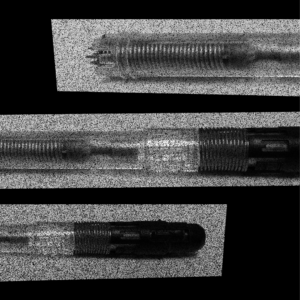
The autoinjector was not the first attempt to simplify emergency injection. Its predecessor was the syrette, a squeezable tube of medicine — similar to a tube of toothpaste — fitted with a needle. Developed by Squibb around the start of World War II, the syrette was primarily used to deliver morphine to soldiers.
To use one, a soldier broke an inner seal with a wire pin, worked the needle under the skin and squeezed the tube empty. This was an advance over drawing up medicine from a vial into a syringe, but it was still far from ideal. Successful administration relied on a series of fiddly steps being executed rapidly and correctly, no less by a frightened person in the chaos of battle. Imagine squeezing a whole toothpaste tube into your thigh during an emergency!
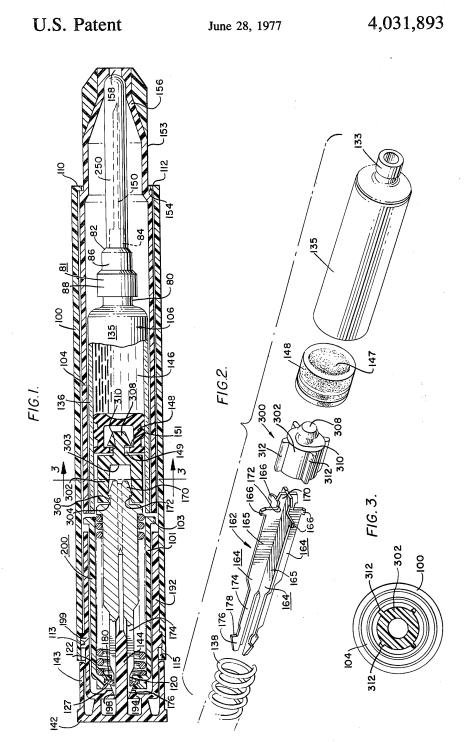
Seeing this, National Institutes of Health (NIH) cardiologist Stanley Sarnoff sought to create a device that could allow one to inject an antidote in a single motion. In the 1950s, he and his wife founded Rodana Research (later renamed Survival Technology) to build it. A patent he filed in 1953 described the first modern autoinjector concept: a spring-driven hypodermic injector designed so that “a person unskilled” could give an injection “either to himself or to another person.” Loaded with a 2 mg dose of atropine, the device was later commercially marketed as the AtroPen.
The invention soon spread beyond the battlefield. By the early 1960s, NASA was equipping astronauts’ emergency medical kits with autoinjectors to deliver anti-motion-sickness drugs, stimulants and vasoconstrictors for shock. Survival Technology also adapted the device to deliver epinephrine instead of atropine. The underlying challenge was the same: a soldier under chemical attack and a person in anaphylactic shock both needed a drug that worked fast, transported easily and required no training to give. A new glass-cartridge design, developed by one of the company’s engineers, Sheldon Kaplan, became the EpiPen — patented in 1977 and approved by the FDA in 1987.
In parallel, a second family of injection devices — pens — was being developed for routine injections. The key design difference was that users pushed the needle in by hand rather than relying on a spring-loaded mechanism to deploy it. Novo Nordisk built the first pen in 1985 — the NovoPen — allowing people with diabetes to administer insulin daily without having to use a vial and syringe.
Autoinjectors followed pens into non-emergency markets in the 2000s, starting with Abbott’s Humira Pen and Amgen’s SureClick, both for treatment of arthritis. Humira went on to become the highest-grossing pharmaceutical drug of all time, with over $200 billion in cumulative sales. Such a lucrative market made it worthwhile to develop and sell these drugs in higher-cost autoinjector formats. It is unsurprising, then, that between 2000 and 2023, around 40% of FDA-approved injectable biologics1 were delivered by autoinjector, and almost all for chronic maintenance treatment — not emergencies.
The Neglected Applications
In emergency medicine, autoinjectors are most useful when:
- There is no oral option for treatment. The drug either isn’t absorbed fast enough by mouth to work, or an oral drug doesn’t exist.
- Minutes matter. Timely administration of the treatment has a critical impact on patient outcomes and mortality. This is often linked to the first; if an oral drug isn’t fast enough, it is likely that minutes will matter.
- No clinician is in reach. The person best placed to give the treatment is usually a parent, a bystander or the patient themself — not a clinician requiring access to an intravenous (IV) line.
Where all three hold,2 an autoinjector may be the only realistic way to get lifesaving drugs into the patient. Yet despite having been developed more than half a century ago, they are now rarely used in emergency medicine outside of anaphylaxis.
This is because the set of circumstances described above is relatively uncommon in developed countries. Most people have fairly easy access to clinicians; they are a 911 call away. However, it happens far more often in LMICs. Life-threatening injuries are more common, and people are often far from a trained clinician when they strike.
Consider tranexamic acid (TXA) as an example. It is a cheap, off-patent, proven drug that controls bleeding. It is highly effective at reducing deaths from bleeding in two settings: traumatic hemorrhage, or severe blood loss after an injury such as a road traffic accident, and postpartum hemorrhage (PPH), or severe bleeding after childbirth. And it is hardly a new treatment: TXA was discovered in the 1950s by Japanese medical researcher Utako Okamoto and her husband Shosuke Okamoto to treat PPH.
Traumatic hemorrhage is responsible for about 2 million deaths each year and is a leading cause of preventable death, while PPH is the single largest cause of maternal mortality worldwide. The CRASH-2 trial, which followed just over 20,000 trauma patients, found that TXA given within the first hour cut bleeding deaths by roughly a third (RR 0.68). The WOMAN trial, which followed just over 20,000 postpartum hemorrhage patients, found similar results: TXA given within three hours of birth cut deaths due to bleeding by 31%.
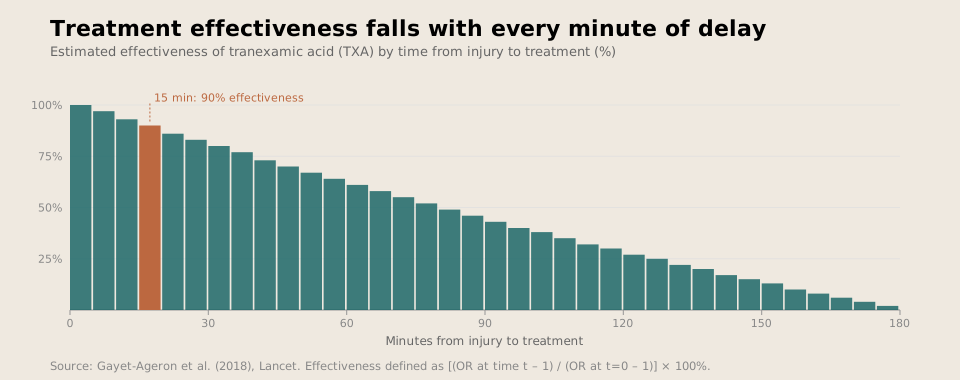
But the benefit is acutely time-sensitive. A pooled analysis of the CRASH-2 and WOMAN trials found the odds of survival were over 70% higher with immediate treatment. The benefit dropped by roughly 10% for every 15 minutes of delay.
If a new mother experiences hemorrhage shortly after childbirth in a well-equipped hospital, this is manageable — TXA is often on hand and it only takes a nurse a few moments to insert an IV line. Yet readiness across healthcare facilities varies enormously across LMICs, where the share of facilities able to provide basic emergency obstetric care can range from 2% to 79%. Many women do not give birth in facilities at all: in sub-Saharan Africa, a third of births occur outside a facility, and nearly three in ten women of childbearing age live more than two hours from their nearest hospital. So although TXA was discovered over 50 years ago and is available cheaply as a generic, few of these women receive it — no one present at the birth is trained or equipped to give an intravenous drug.
The benefits of a better way of administering TXA are even more obvious for trauma care. After a car accident, it is not possible to carefully prepare an IV line on the side of the road. Well-stocked ambulances are rare in many LMICs, where patients are often transported by family members, neighbors or private vehicles. Where prehospital services do exist, intravenous TXA is rarely given: in South Africa, only 2.8% of trauma patients at risk of hemorrhage received TXA before reaching a hospital.
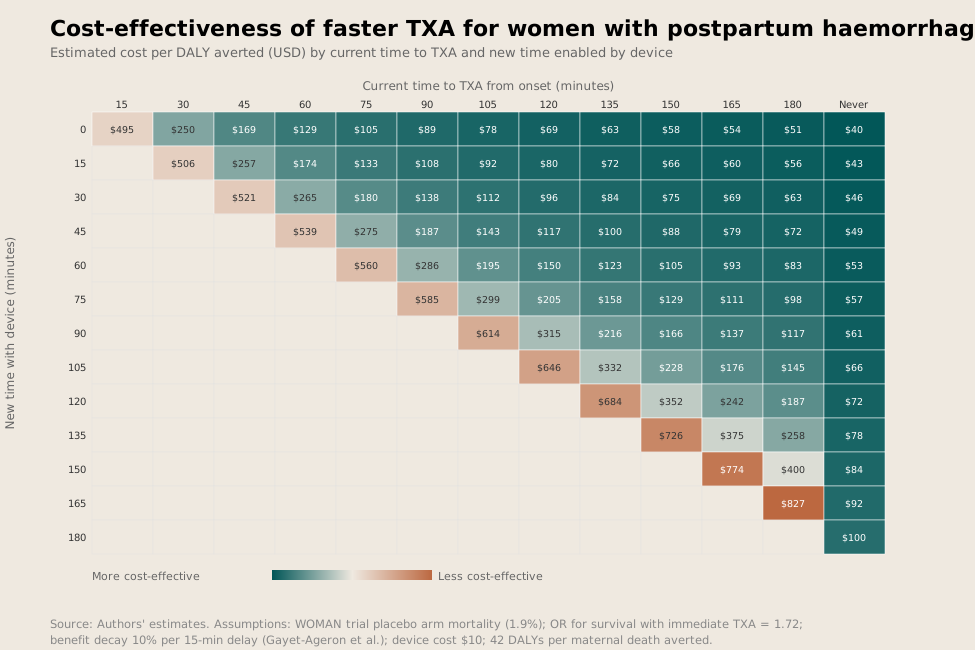
Autoinjectors could close this gap. TXA does not have to be delivered by IV; a trial has found intramuscular TXA reached therapeutic levels in the blood within minutes and achieved bioavailability close to that of intravenous administration. This means it could be given via prefilled syringes in two 5 mL injections, or — with further engineering to concentrate the formulation — as a single autoinjector. Both are technically feasible, and an autoinjector would allow a wider range of people — lower-cadre health workers, birth attendants, family members — to administer it. Such a device could be carried to home births, or given on the spot in facilities where no one is trained to place an IV line or a line is not yet set up — in both scenarios, a potentially lifesaving intervention. From our own back-of-the-envelope estimates, if a TXA autoinjector were stocked in these settings, 3.2 times more women experiencing PPH would receive TXA, and they would receive it 1.5 hours sooner on average. This could avert 20% of deaths from postpartum bleeding at a cost-effectiveness of $155/DALY (disability-adjusted life year).3
Yet because most of the benefit would be in LMICs where procurers have limited purchasing power, firms have few incentives to invest in developing cheap autoinjectors for TXA. After all, they could spend R&D dollars on chronic diseases more common in rich countries,4 where the ROI on spending is likely to be higher.
Development of a TXA autoinjector has begun, but it is unlikely to address these particular issues. Current development is oriented towards trauma care gaps in high-income countries — accidents, mass-casualty events and battlefield injuries. A device built for these buyers may not transfer well to LMICs: It may assume climate-controlled storage in ambulances and stockpiles, use costlier components like automatic needle shields, electronic voice or light guidance or be engineered to withstand battlefield conditions — a level of robustness not needed for an at-home birth. And there is little incentive to strip these features out when high-income procurers are willing to pay for them.
A similar story applies to snakebite antivenom. Snakebites kill somewhere between 80,000 and 140,000 people a year, with more than 85% of deaths occurring in South Asia. The World Health Organization (WHO) named snakebite envenoming a highest priority neglected tropical disease in 2017. Yet the problem is not a lack of treatment. While antivenoms must be tailored to the snake, existing polyvalent and narrow antivenoms cover the most common snakes in a region.5 The problem is access.
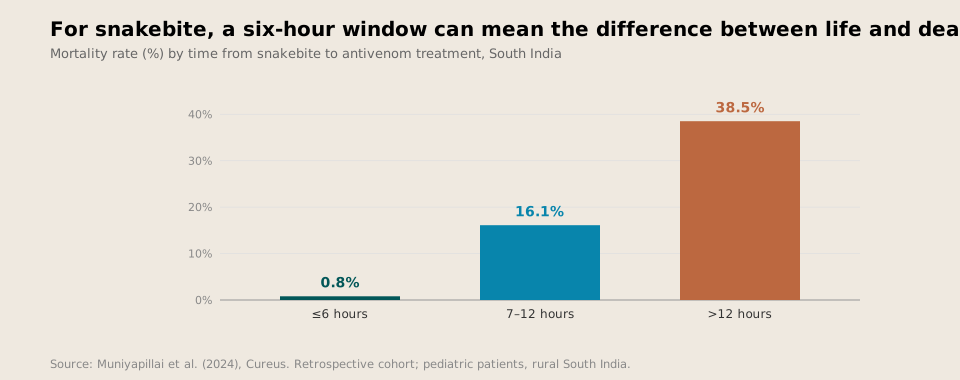
As with anaphylaxis and bleeding, snakebites can be fatal and require immediate treatment with lifesaving antivenom. In one Indian study, mortality was 0.8% when antivenom was given within six hours of a snakebite but increased to 38.5% when treatment was delayed beyond 12. Yet because antivenom is administered intravenously, snakebite victims must get to a clinic before they can receive it.
This creates two delays in treatment: once in getting to a facility, and again after arriving. Because snakebites occur overwhelmingly in rural areas with long travel times to care, many victims never reach a healthcare facility in time. An estimated 77% of snakebite deaths in India occur outside a hospital. Even when patients reach healthcare facilities, a study in South India found that only 39% got antivenom at the first one they visited. Most were bounced around two or three more facilities before getting a full dose, often because facilities had no one on site trained to give it. These barriers to timely treatment help explain why snakebite has proved unusually challenging to address: although mortality has declined over the past two decades, progress has been too slow to meet 2030 WHO goals.
It has long been assumed that only slow, intravenous administration would work, because antivenom molecules were too large for reliable absorption through muscle. But a 2021 human study, which compared intravenous and intramuscular administration of antivenom, found intramuscular patients fully recovered without needing repeat doses. A 2025 large-animal study offers a mechanism behind this: Intramuscular antivenom neutralized venom more completely and just as fast as, if not faster than, intravenous antivenom did. It may do so partly because it’s absorbed into the lymphatic system — the same route much of the venom itself travels through. The evidence is still preliminary, but if validated further, it could remove the requirement for an IV line.
This suggests that it may be possible to bring snakebite treatment out of the clinic and into the hands of farmers and local emergency responders. While antivenom remains costly, and finding ways to lower prices is important, cheaper vials help little if patients cannot access them in time. The evidence here is less advanced than it is for TXA, but it certainly bears more investigation.
Nor are these the only examples where autoinjectors could save lives. Several other drugs may fit the same profile — they are fast acting, poorly suited to oral dosing and most likely to be needed when there is not a clinician on hand. These include intramuscular artesunate for severe malaria and magnesium sulfate for eclampsia, a leading cause of maternal death. Even atropine — the nerve-gas antidote that inspired the first autoinjector — could find a new purpose. Atropine is also an antidote to organophosphate pesticide poisoning, a major cause of fatal pesticide self-poisoning that accounts for more than 100,000 deaths globally each year. These drugs are already cheap and easily available; what’s missing is an affordable, readily available device that allows them to be administered in the way that is needed.
How?
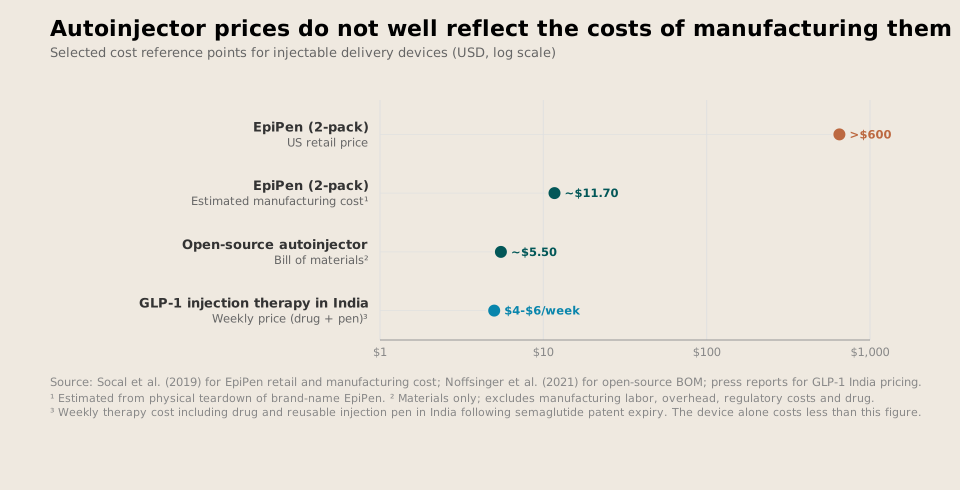
An obvious objection to the use of autoinjectors in LMICs is cost. A two-pack of brand-name EpiPens may cost more than $700. But the billed amount in rich countries is not the same as its manufacturing cost. Engineers who took apart a brand-name EpiPen estimated the manufacturing cost of a two-pack at about $11.70 (2026 dollars). Another analysis put the bill of materials for an open-source, 3D-printed autoinjector at around $5.50,6 with 57% of the cost attributable to a single steel spring. This doesn’t include all costs — shipping, medication, R&D — but it is suggestive that significant cost reductions are possible.
Indeed, we are already seeing monumental cost reductions in the self-administered injections industry.7 When Novo Nordisk’s semaglutide patent expired in India in early 2026, multiple manufacturers launched generics within months. While list prices for Mounjaro and Wegovy exceed $1,000 per month in the U.S., weekly GLP-1 injections in India can be obtained for a fraction of that cost — some therapies delivered through reusable pens are priced at about $4-68 per week. If the all-in cost of therapy is $24 per month, clearly the pen costs less than this.
As demand for GLP-1 medicines increases, production capacity and sophistication will increase too. Novo Nordisk has committed more than $23 billion to expand production capacity.9 Ypsomed, another major manufacturer of autoinjectors, is investing nearly half a billion Swiss francs to increase its annual production capacity by up to 500 million pens and autoinjectors.
While some of this investment is for reusable pens rather than autoinjectors, both are built by the same industry — firms like Ypsomed manufacture both, using shared components and fill-finish lines. Indeed, most growth is happening in the format needed for emergency use cases — immunology biologics and the newer obesity drugs are mostly delivered through single-dose, disposable devices. While these devices may not have the spring mechanism of an EpiPen, they are still vastly faster and easier to use than inserting an IV. Cost savings that widen profit margins could instead be passed on to reduce prices.
All of this means that autoinjectors are likely to become increasingly cheap and easily available.
What’s Still Needed
Despite the advances in manufacturing making cheap, easily available autoinjectors a possibility, it is not inevitable that they will be used to save tens of thousands of lives. In fact, far from it.
Why is this the case? We are not missing the drugs themselves — they already exist, and many are decades old and off-patent. What’s missing is a market large enough to pull research and development toward a delivery device suitable for LMICs.
Right now, autoinjector R&D is geared towards rich-world markets, which combine a greater willingness and ability to pay with lower barriers to entry. Indeed, autoinjectors accounted for around $160 billion in drug sales in 2024,10 and autoinjectors are the dominant delivery platform in immunology, the second largest therapeutic market. Profit margins are relatively high for these drugs.
Markets in LMICs are very different. Though the overall market size is potentially large, selling products there requires navigating many different approval systems with limited commercial return on investment. The profit per device would be much lower than that earned on, for instance, the Humira Pen. As a result, development for these settings is far from the minds of R&D departments at pharmaceutical companies, who see a simple equation of costs greater than expected returns. This is despite the tremendous potential for impact in these settings — the DALY burden from maternal hemorrhage and road injuries is over 50 million annually in LMICs.11
For autoinjectors containing TXA, antivenom and other medicines to be developed for LMICs, this equation must be rebalanced; otherwise, “technically plausible” is where the technology is likely to remain.
Philanthropic capital could be used to ease this transition. There are several ways such capital could engage.
One would need to begin by establishing the groundwork. This includes identifying the high-burden indications where an autoinjector would be cost-effective and building the evidence base for them. This could include funding clinical trials to advance promising candidates, commissioning health technology assessments to make the procurement argument or developing demand forecasts to give investment certainty to firms and manufacturers.
From there, the right market-shaping approach is trickier. Getting a device into a user’s hands is an end-to-end process: proving the safety and efficacy of intramuscular delivery, engineering a device that is robust, heat stable and cheap enough for LMIC conditions, taking it through licensing and regulation, coordinating with manufacturers, getting onto treatment guidelines, establishing procurement channels, training health workers and building trust in the communities that would use it. When these steps are profitable, they are normally incentivized and coordinated by the forces of the free market. Where they are not, there are two broad approaches.
The first is to coordinate the chain itself: Choose a firm or product and fund each step directly, through grants, contracts, milestone payments and procurement commitments. There is precedent for this: PATH’s Uniject — a prefilled, single-dose, auto-disable device — was developed in the 1980s and 1990s through a public-private partnership. The device has enabled traditional birth attendants to immunize pregnant women against tetanus, carry hepatitis B vaccines to rural births and administer oxytocin to women at home right after delivery. Uniject itself cannot hold enough volume for even a concentrated TXA formulation, but the model behind it could be repurposed — today with partners such as the Drugs for Neglected Diseases initiative (DNDi), Unitaid, MedAccess or PATH again. The model is demanding, though, which partly explains why no organization has repeated it for autoinjectors: The funder carries the coordination, and the risk of backing the wrong firm or design.
The second is for a funder to try and recreate the forces of a profitable, free market themself through mechanisms like advance market commitments (AMCs). An AMC is a binding promise to buy a product that meets a set specification, at a set price, from whichever firm delivers it. The funder picks no firm, funds no individual step and does not pay out any money if the product is not delivered to users. Instead, firms organize themselves (as they do in high-income, profitable markets) to carry out the R&D, regulatory work and manufacturing, all in competition for the committed purchase. While more costly than other mechanisms, an AMC for a low-cost antivenom or TXA autoinjector could give firms a reason to build one while shielding funders from downside risk if the product turns out to be ineffective.
Regardless of the market-shaping mechanism used, it is important to not let opportunities to cost-effectively save lives pass us by. Autoinjectors were invented to expand lifesaving medical access; we should continue to look for ways to use them to do so. From battlefields in France in the 1940s to rural Nigeria today, they should be used to make it easier to treat urgent medical issues.
Akhil Bansal is a practicing physician in the UK’s National Health Service, and a global health researcher. He is a fellow at both the Center for Global Development and at Renaissance Philanthropy. Georgia Bradley is a researcher at Dartmouth College. Both Akhil and Georgia are part of the Market Shaping Accelerator, a joint initiative of the Center for Global Development, the University of Chicago, and Dartmouth College.
If you have comments on this article, or wish to contribute to the discussion, please email them to letters@indevelopmentmag.com. Responses will be featured in a letters section.
- Excluding insulin and vaccines. ↩︎
- There is a fourth condition, which is that the dose of medication needed is larger than a milliliter. This prohibits the use of existing, prefilled syringe mechanisms like Uniject. ↩︎
- Compared to the standard of care, in which some women in these settings get referred to facilities and receive TXA. For our rough back-of-the-envelope calculation and assumptions, see here. We value the price of an autoinjector at $10/dose. ↩︎
- For instance, immunology, oncologics and antidiabetics therapies ↩︎
- These are preferred to targeted antivenoms, which are often impractical. This is because snakes are rarely brought in to hospitals with the victim and the differences in clinical syndromes separating one snake from another are nuanced and not well known. ↩︎
- The original estimate of CA$6.83 (reported in 2023) was converted to U.S. dollars using the 2023 CAD/USD exchange rate and inflation-adjusted to 2026 dollars. ↩︎
- Including pens, prefilled syringes and autoinjectors. ↩︎
- Semaglyn by Zydus has a 15 mg reusable pen for 2,200Rs/month; at the maximum dose of 2 mg/week, this is 550Rs/week, or $5.70. Semasize by Alkem is 450Rs/week, or $4.67/week. ↩︎
- Including acquisitions; see Novo Holdings’ 2024 acquisition of three Catalent manufacturing sites ($11.7 billion) and 2024 plans for DKK 80 billion into expanding own API production capacity ($12.2 billion) ↩︎
- Total, global therapeutic drug sales for autoinjectors in immunology, antidiabetics, anti-obesity meds and respiratory agents were approximately $95B-105B, $30B, $22B and $8B. ↩︎
- Coming to 47,192,584 DALYs due to road injuries and 2,979,097 DALYs due to maternal hemorrhage as of 2023, global burden of disease across low socio-demographic index (SDI), low-middle SDI and middle SDI. ↩︎