

The movement of people could once again be the driving force behind global convergence.

Where’s My Ministry For Emigration?
English
Leaving Genoa in northwest Italy, Luigi Pastene arrived in Boston in 1848, and began selling produce from a pushcart in the city’s North End neighborhood. By the 1870s, permanently settled in the United States, he had been joined in business by his son Pietro, and the pair specialized in selling Italian imports including olive oil and tomato sauce from Naples in southern Italy.
In the same decade, Luigi Vitelli arrived in New York from Naples. First selling lace and handicrafts, he later began importing and marketing canned San Marzo tomatoes. In 1919, he returned to Italy and built his own processing plant for canned tomato exports to the US business, the origin of a firm that expanded into the multinational Vitelli Foods.
Pastene and Vitelli were just two of the millions of Italians and tens of millions of Europeans that emigrated to the New World—many permanently, some temporarily—in the second half of the 19th century and early part of the 20th century, the age of mass migration.

This migration was not just a boon for the United States. Many migrants sent money home, adding $4 million to $30 million a year to the Italian economy, a US government commission estimated in 1896. Herman Stump, US Commissioner-General of Immigration in the mid 1890s, reported that “the marked increase in the wealth of certain sections of Italy can be traced directly to the money earned in the United States.” But it was not simply about the money; emigration soaked up excess labor, returned migrants brought back new skills and contacts, and migration links drove stronger trade and investment relationships.
Indeed, the age of mass migration coincided with—and was possibly one of the drivers behind—a period of rapid income convergence between the old and new worlds. By 1910, incomes in Italy were perhaps 30% higher than they would have been without emigration.
Today, we are once again in an age of mass migration. And the movement of people could again be the driving force behind global convergence—especially if origin countries seize the opportunity.
A New Age of Mass Migration
The number of migrants worldwide has been rising again. One estimate for the first decade of the 20th century—the previous peak—is that 1.67% of the world’s population migrated across the Atlantic or Siberia. In the first decade of the 21st century, migrant flows amounted to about 1.2% of the world’s population.
But this was just the start. Global demographic trends point to a dramatically rising demand for migrants from the world’s richer countries. Europe will see its population decline by about 150 million people over the next century, not far off the one quarter drop between 1300 and 1400 as a result of Black Death.
But it isn’t only Europe in this situation or even just the richest countries. Upper-middle income China is facing a demographic cliff. The working age population in the country will fall by 160 million between 2020 and 2050. By the 2040s or 2050s, Brazil, Thailand, and Turkey will also start shrinking.
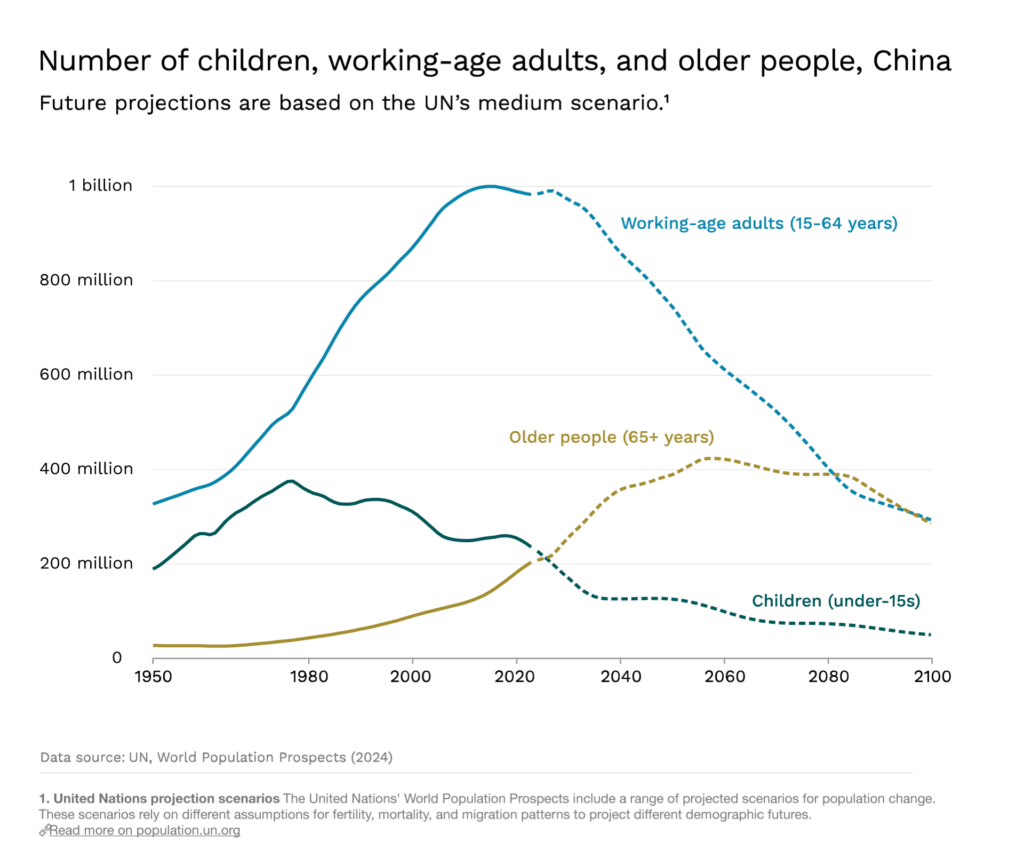
The impact on workforces has already begun. As recently as 2008, high income countries were adding 6 million people to the working-age population each year. From the mid 2020s, they will lose 2 million a year. Add in upper-middle income countries, and that climbs to losing 10 million workers a year by the 2030s. These missing workers do not immediately disappear; rather, they retire. And retired people will continue to demand goods and in particular nontradeable services like care, even if they no longer produce them. That means they will create demand for work even if they’re not working.
Stagnating or shrinking working-age populations are one significant reason why the last few years have seen stories about worker shortages in farming, healthcare, mining, restaurants, sales, construction, transport, professional Santa Claus actors, daycare, the beer and wine industry, cheesemaking, security, interior decoration, ski lift operation, and zookeeping.
Population decline will be why even politicians elected on anti-immigrant platforms are opening the doors to more migrants. Politics cannot sweep away demographic trends. In Hungary over the last decade, a government publicly committed to not accepting a single migrant has opened up to ‘guest workers’ instead, and immigration rates have climbed dramatically since 2016. Something similar has occurred in Italy. These countries follow in the footsteps of traditionally immigrant-phobic Japan and South Korea to woo migrant labor.
Opportunities for Origin Countries
But population decline is not universal. The working-age population in low and lower-middle income countries will expand by about 1.12 billion between 2020 and 2050, or by about 37 million per year. They will also be the most educated generation in their countries’ history. The proportion of children in low-income countries that have completed lower secondary education has climbed to 38% in 2024 from 17% in 2000, for example. As they enter the workforce, they will want good jobs.
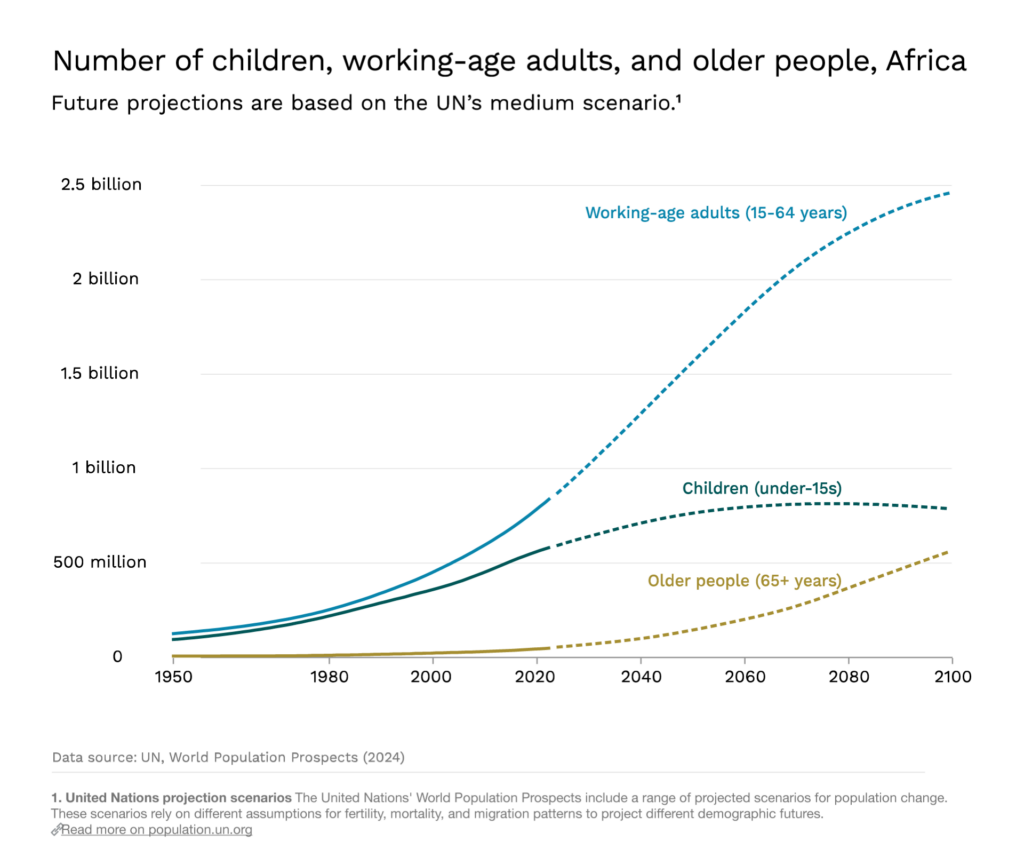
Ensuring there are such jobs is the secret of turning the ‘demographic dividend’ of a bulging working age population into the kind of miracle growth rates that East Asian countries achieved in the second half of the 20th century. But there is a risk alongside that potential: without more jobs, the dividend could help spark turmoil: the Arab Spring was powered by a young, educated population with nowhere to go but the streets.
And there are fewer domestic opportunities to provide that employment. The traditional development model of rapid growth in jobs and income through manufacturing exports is breaking down. Relative demand for manufactured goods is falling worldwide and global value added in manufacturing exports as a percentage of global output is declining. That’s because older, richer people—like those vanishing from the labor force in rich countries—want services rather than stuff. They need healthcare, not cars. Add in continuing automation, and forecasts suggest there may be about 66 million fewer people working in manufacturing worldwide in 2050 than in 2018. Meanwhile, global services employment (much of it untradeable and difficult to automate – think home care, education, policing, construction, cleaning, and maintenance) might climb from about 1.3 billion in 2018 to 1.9 billion between 2018 and 2050.
This means that the timing of the second demographic transition toward a shrinking workforce in older countries couldn’t be better. Upper income countries need more workers, while lower income countries have workers to spare. Migration is the mutually beneficial solution to this global workforce imbalance.
Benefits of Emigration
Like immigrants in the 19th century, modern immigrants remain deeply connected to their home countries. Remittances are an increasingly large portion of incomes in developing countries, already accounting for a third of capital inflows to those countries in 2022, far more than all foreign assistance combined. Remittances help reduce levels of extreme poverty, pay for healthcare and education, increase savings, and cushion income shocks. And, for about a third of the world’s countries, remittances revenues were more than manufactured export revenues in 2023.
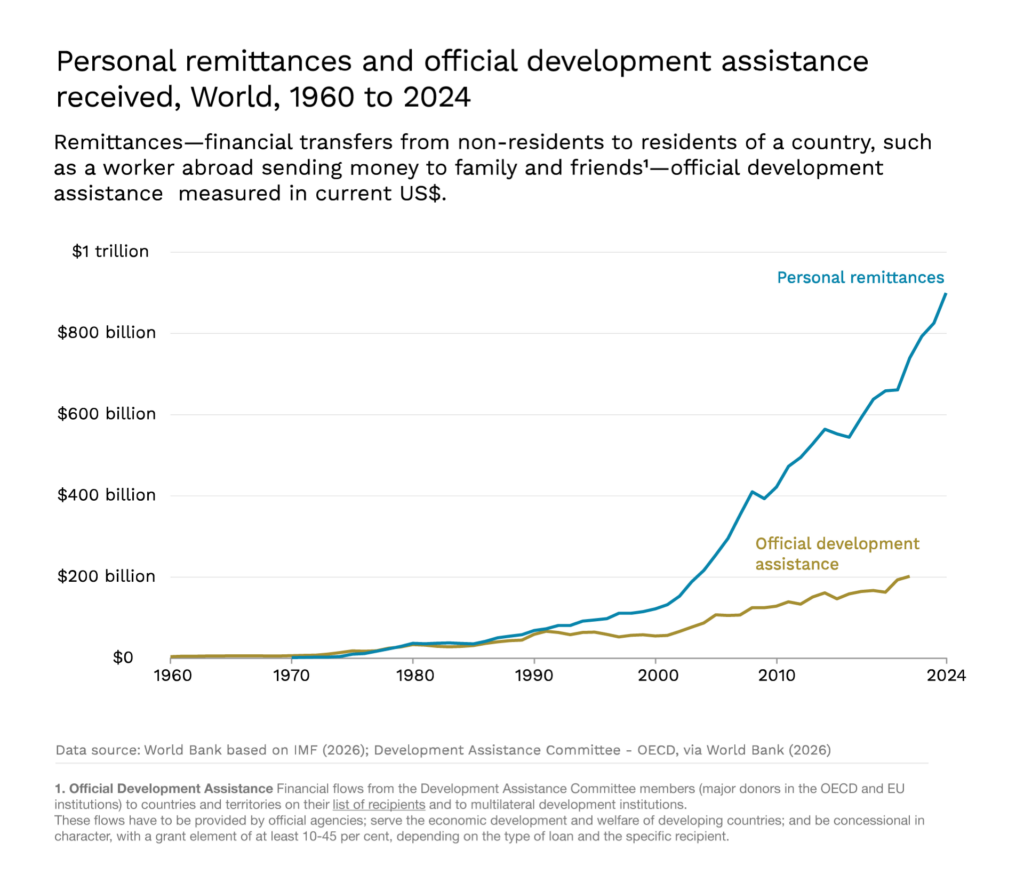
But, as it was a century ago, emigration is about far more than remittances. Migration promotes learning, trade and investment.
In the Philippines, the opportunity to migrate and earn as a nurse abroad has been a considerable incentive to stay in school and study nursing: so much so that for each nurse migrant, nine additional nurses were licensed in the country. This ‘brain gain’ effect will be why nearly three-quarters of the long-run income gains from emigration out of the Philippines came from domestic rather than migrant income. The prospect of emigration drove increased education, which in turn increased domestic income.
Similarly, the Indian information technology boom was underpinned by a domestic talent base that expanded in response to the opportunity to emigrate to the US, and then benefited from the contacts and experience of those who had migrated. Sridhar Vembu is one example: he studied at the Indian Institute of Technology – Madras, did graduate work at Princeton, and went on to a career at Qualcomm in the US. He used that experience to found Zoho, a software development company that set up offices in small towns and villages in India, providing customer relationship and project management tools for small and mid-sized companies around the world.
There are many such examples. Migrants with experience in South Korean textile factories returned alongside South Korean investment to launch Bangladesh’s own textile export revolution, while return migrants to Mexico powered a significant shift in workforce distribution toward the manufacturing sector. Refugees who fled the former Yugoslavia and spent time in Germany in the 1990s brought skills back to their countries after the war was over and fueled a knowledge-intensive export boom.
Across the world, countries that have more emigrants in communities in the US see faster trade growth with those communities. Meanwhile, those with more college-educated emigrants in the US receive more FDI from the US, and those with more patent-producing emigrants in the US have seen faster manufacturing growth.
It’s true that the cross-country correlation between emigration and economic growth suggests the relationship isn’t strong on average and may be negative for some countries. This is likely at least partially because mass emigration can be an act of desperation—fleeing violence or lack of opportunity. But a country investing in its future by harnessing the power of emigration is a distinctly different proposition than a failed state in which citizens have no choice but to leave if they can.
And the opportunity is large and growing: indeed, the average country already has an emigrant stock more than twice the size of its stock of manufacturing employees, and existing emigration may already be shrinking cross-country income inequality and global poverty, reducing the number of people living on less than $5.50 a day worldwide by between 67 to 105 million people.
Where’s My Ministry for Emigration?
When it comes to encouraging emigration, the Philippines has set the standard by creating the Philippine Overseas Employment Administration, providing pre-emigration training and certification, and an Overseas Workers Welfare Administration to assist workers and help prevent their exploitation abroad. Some eleven million Filipinos live overseas, and remittances amounted to 9% of GDP.
Other origin countries should follow its example by exploiting the increasing need for workers in rich countries to ensure greater benefits for those who stay at home. This is likely to involve a focus on more migration: not least, signing a bilateral labor agreement is associated with larger flows.
But, to reap the greatest benefits, sending countries need to do more than that. They need to ensure that emigrants have the skills they need to seize the best opportunities they can: not just in farm labor and housekeeping, but also in nursing and IT.
Increasing supply is key to making this work as part of a growth strategy. If the number of skilled workers is fixed, emigration might reduce access to those skills at home. And there is a linked point here about expansion of training to meet the demands of potential emigrants. Since most of the gains from emigration are private rather than public, the associated training costs should also be private rather than public.
Take nursing: in the Philippines, most trainees pay for their education. For-profit nursing schools have expanded to provide that training and the country now has a lot more nurses at home and abroad as a result. To ensure equitable access, countries might provide loans to cover education and training costs, which (in the case of medical staff) could be forgiven if students go on to practice in public hospitals and clinics at home.
As moving abroad is expensive, and many potential migrants have limited access to credit, origin countries could also provide potential emigrants with loans for travel and resettlement costs. And they could also help ease the process by backing domestic university and vocational training curricula that meet destination country standards: for instance, German and Indian education institutions are developing joint nursing curricula.
But as the competition for immigrants—and especially skilled immigrants—heats up, destination countries should themselves be increasingly willing to bear the costs of training. Japan, which has long included training as part of a package offered to emigrants, is improving that package to better guarantee rights, allow flexibility to switch employers, and ban demands for payment to access the training.
Origin countries could also make better use of their returning migrants. Currently, it is all too common for returnees to use their savings to invest in low-productivity, low-growth small enterprises, perhaps because of low skills or few opportunities. Origin countries can help to prevent this by facilitating migration to employment opportunities that will create skills and linkages that can be exploited to create domestic industry. Following the Bangladesh model, for example, if a government wants to encourage textile manufacturing at home, it should help potential emigrants find work in that industry in a destination country with a mature textile industry (preferably at all employment levels).
And origin countries should make it easy for that diaspora talent to return. Taiwan created the Industrial Technology Research Institute (ITRI) to turn the country into an electronics powerhouse. Its early strategies included sending students for advanced courses and employees for training to US schools and companies. Once people were trained to global standards, there were incentives to return to Taiwan. The institute provided housing, health services, and the country’s only public bilingual secondary school to lure talent back. The institute—and its returnees—later spun out both United Microelectronics Corporation (current market capitalization: US$24 billion) and Taiwan Semiconductor Manufacturing (market capitalization: US$1.6 trillion).
But instead, many countries discourage return migration. Some don’t allow dual citizenship, forcing potential emigrants to choose between their new country and their old. Few countries coordinate on social security payments for (potentially) temporary migrants. Both are fixable problems—Morocco, for example, actively encourages return migration by including social security arrangements in its bilateral labor agreements.
Countries can also focus on building out the industries that their existing stock of emigrants already work in. For instance, the Philippines has focused on building its medical tourism industry. If nurses that go abroad wish to return to the Philippines, there are internationally accredited hospitals in which they can work. In 2023, there were already some 30,000 medical tourists in the country.
That said, serendipity plays a role. Consider the example of Fahad Awadh. He left Tanzania as a young child and studied in Canada. He was not a highly skilled immigrant; there was no particular plan that he would be an asset to Tanzania. But, in Canada, he built a clothing brand and learned about sourcing and trade. When he returned to Tanzania in 2013, he used his skills and connections to found and build YYTZ Agro-Processing, which processes nuts and markets them globally under the More than Cashews brand. It sources from 4,700 smallholders, increasing their incomes and customer base. Certainly, agroprocessing is some distance from Awadh’s original experience in clothing. But a larger flow of emigrants increases the chance that these random acts of cross-country entrepreneurship occur.
The first age of mass migration closed with the imposition of migration restrictions in the US and beyond. The second age is beginning as similar restrictions are loosened under the increasingly urgent pressure to find workers. And, like the first age of mass migration, the second has the potential to make the world considerably richer. Luigi Pastene and Luigi Vitelli made migration a tool for Italian development a century ago, and it worked as well today to help Fahad Awadh create jobs and growth in Tanzania, ITRI launch semiconductor factories in Taiwan, and Bangladesh build its textile industry. More developing country governments should seize the opportunity.

Charles Kenny is a Senior Fellow at the Center for Global Development, and the author of Getting Better: Why Global Development is Succeeding and Life, Liberty, and the Pursuit of Utility: Happiness in Philosophical and Economic Thought.
If you have comments on this article, or wish to contribute to the discussion, please email them to letters@indevelopmentmag.com. Responses will be featured in a letters section.