

In 1995, seven in 10 Nepalis lived in extreme poverty. By 2022, fewer than one in 40 did.

Moving Out of Poverty: Nepal’s Unusual Journey
English
I. A Remarkable Story of Extreme Poverty Reduction in Nepal
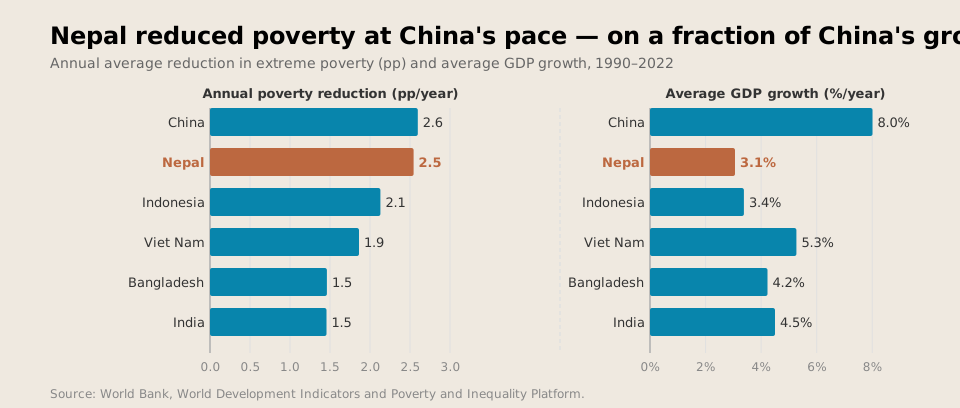
Over 1995-2022, Nepal lifted 2.5% of its population from extreme poverty each year. Compared to the giants of extreme poverty reduction — China, Indonesia, Vietnam, Bangladesh, and India — Nepal’s pace is matched only by China. The extreme poverty rate in Nepal now is lower than in the considerably richer Indonesia, India, and Bangladesh.
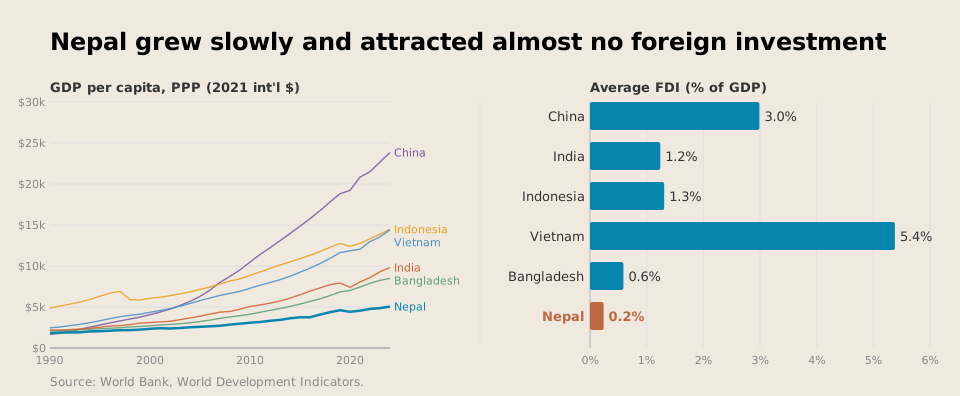
Nepal’s journey out of extreme poverty also looked very different from that of these other countries. These countries — responsible for the global decline of extreme poverty from 43% in 1990 to 10% in 2025 — did it through sustained growth, foreign direct investment, export expansion, and industrialization. Nepal had almost none of that:
- Real GDP per capita grew by 8% annually in China and by over 4% in Vietnam, India, and Bangladesh. Nepal grew by just 3.1% on average.
- Foreign direct investment was important in Vietnam and China, averaging 5.4% and 3% of GDP, respectively; in Nepal, FDI averaged just 0.2%.
- Exports as a share of GDP soared in Vietnam and increased steadily in China, India and Bangladesh until the 2000s. In Nepal, exports fell from a high of 25% in the mid-1990s to below 10% today.
- Manufacturing-led industrialization flourished in Bangladesh and Vietnam and remained strong in China and Indonesia over this period. In Nepal, industry’s share of GDP fell from about 20% in the mid-1990s to about 10% today.
- Large-scale safety net programs targeting the poor were key in Indonesia and Bangladesh. In Nepal, such programs were not scaled and sustained.
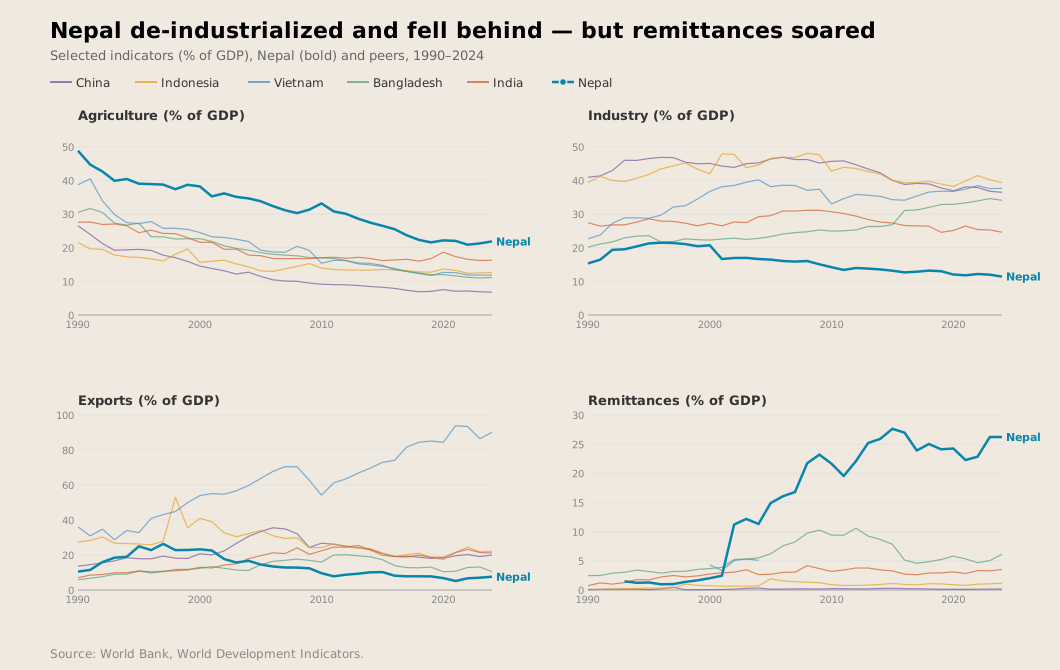
By nearly every conventional measure, Nepal moved backwards, except for one: its poverty rate fell.
So, what happened? Large-scale migration!
Beginning around 2001, Nepali workers began leaving for the Gulf States and Malaysia in substantial numbers. The share of Nepalis living abroad doubled from 3.3% to 6.9% between 2001 and 2011, where it has remained since. Remittances, which averaged only around 1.5% of GDP before 2001, rose sharply to roughly a quarter of GDP since 2009.1
Nepal’s escape from extreme poverty was built not on factories or foreign investment but on the export of labor. Is this replicable elsewhere? Maybe.
II. The Spectacular Rise in Gulf and Malaysia Migration
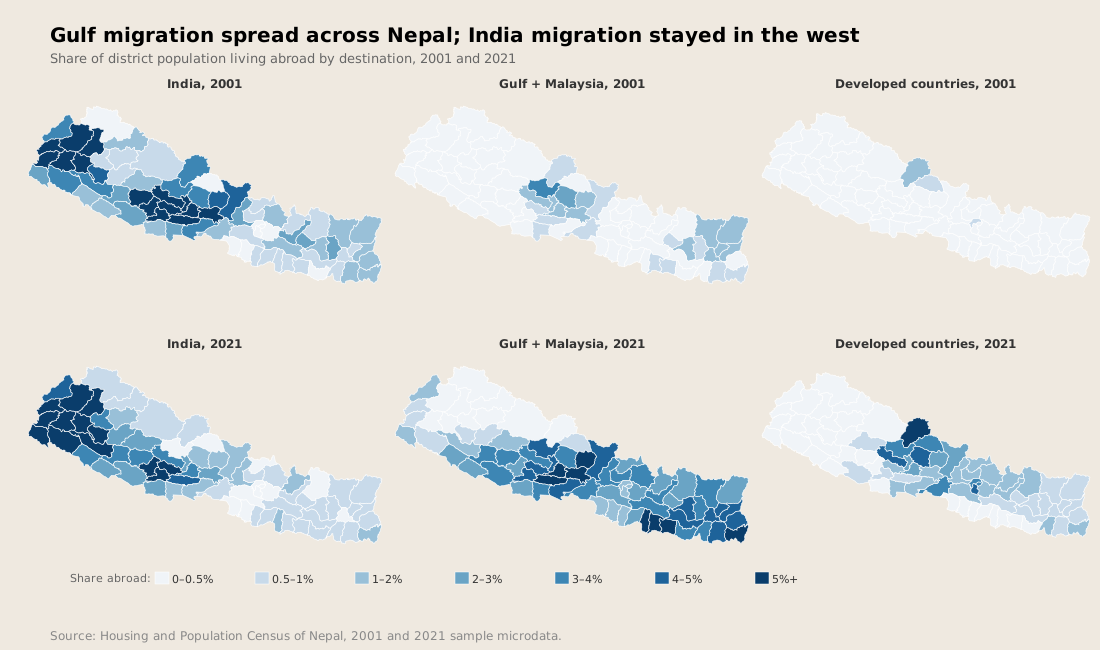
Historically, India was the predominant destination for Nepali migrants. Somewhat unusually, Nepal maintains an open border with India, which has facilitated the movement of workers between the two countries. As a result, international migrants accounted for about 3% of Nepal’s population between 1960 and 2001, with India remaining the destination of over 77% of Nepali migrants. This migration was largely relatively local, mostly from western Nepal to nearby Indian cities.
By 2011, Nepal’s migration map had changed dramatically. Although 2.5% of Nepal’s population still lived in India, migration elsewhere had expanded dramatically. Six in 10 migrants from Nepal lived outside India by 2011, with the share increasing to two out of three migrants by 2021. The shift was driven by rising migration to the Persian Gulf — especially Qatar, the United Arab Emirates, and Saudi Arabia — and to Malaysia, which together accounted for half of all Nepali migrants by 2011.
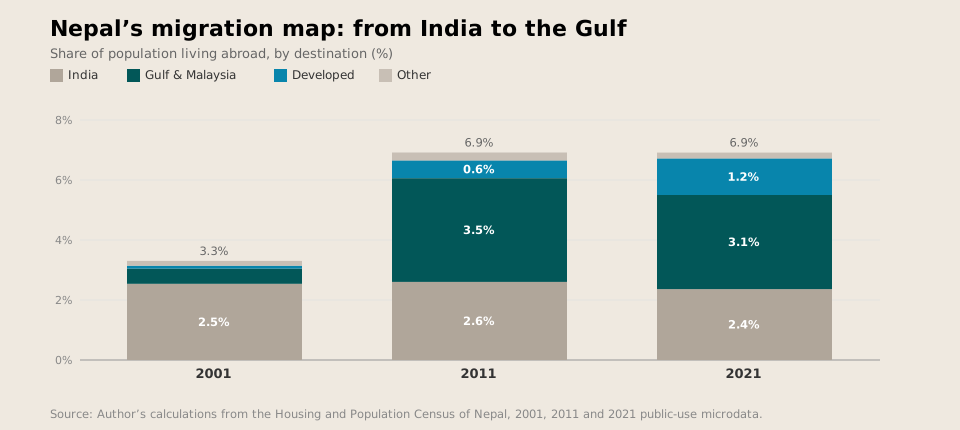
Although the overall migration rate remained broadly unchanged between 2011 and 2021, destinations continued to diversify. The share of Nepali migrants in developed economies — across North America, Europe, Australia, and parts of Asia — rose to 18% from 3% in 2001 and 8% in 2011, led by Australia, the United States, Japan, the United Kingdom and South Korea.
The Initial Push and Pull
The sharp rise in migration after 2001 was due to a confluence of push and pull factors. Nepal’s first decade of democracy after 1990 had not delivered the prosperity and economic opportunities many expected. Industrial growth, led by export-oriented carpet manufacturing, rose in the early 1990s but lost momentum very quickly.2
Deprivation and frustration, especially in the poorest parts of the country, helped fuel the Maoist insurgency. By the late 1990s, the insurgency had made large parts of the country unstable. Things continued to escalate after the army was deployed in 2001. The years that followed were the bloodiest of the conflict, until its resolution in 2006.
As conflict and joblessness pushed workers out, rising demand for low- and mid-skilled labor in Malaysia and the Gulf pulled them in. Facing acute labor shortages in manufacturing, plantations, and construction after the 1997-98 financial crisis, Malaysia opened its doors to Nepali workers in 2001. At the same time, an infrastructure and real estate boom across the Gulf countries drove demand for construction, hospitality, and domestic workers from South Asia, including Nepal.3
The System That Made It Persist
Private recruitment agencies mushroomed to match the demand with supply, numbering over 800 by the 2010s. To find prospective workers, these agencies — concentrated largely in Kathmandu and a couple of other cities — relied on tens of thousands of individual agents whose networks permeated villages and communities with little or no prior experience of international migration.
The government took steps to facilitate migration. Decentralizing passport issuance to district offices in the early 2000s meant that prospective migrants no longer had to travel to Kathmandu to obtain one. The Foreign Employment Act of 2007 sought to facilitate labor migration while making it safer, better managed, and more decent. Agencies like the Department of Foreign Employment and the Foreign Employment Board were established to regulate and monitor the sector and improve migrant welfare. Bilateral labor agreements and memoranda of understanding were signed with destination countries to better regulate migration.4
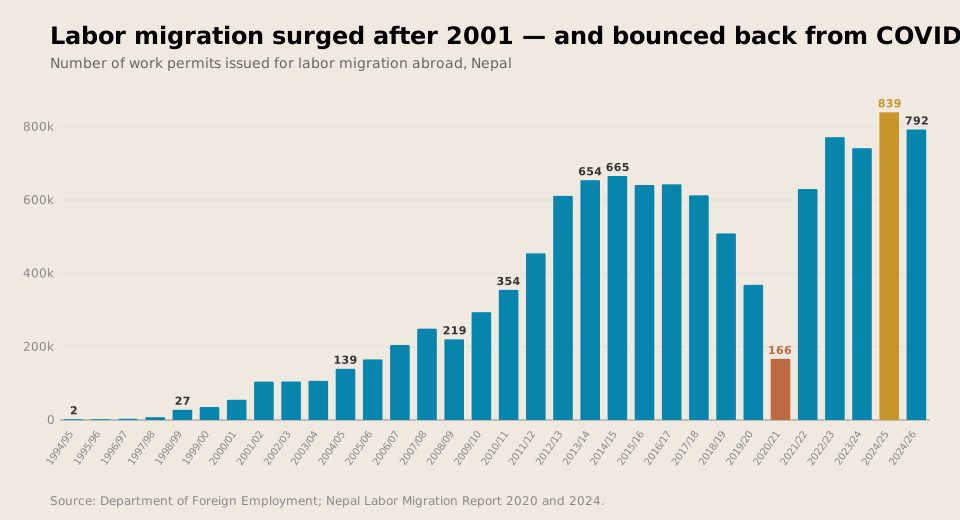
With this, international migration from Nepal took off and kept rising. Nepal issued about 2,000 labor permits for migrant workers in 1995; by 2005, it was issuing more than 140,000. The Maoist conflict ended in 2006 and elections were held in 2008, but outmigration continued to surge. Passport issuance was recentralized during the transition to machine-readable passports from around 2010 to 2015, yet migration kept growing. After a brief slowdown during the COVID-19 pandemic, the numbers rebounded and exceeded pre-pandemic levels, with about 800,000 permits issued annually in recent years.
Once networks, recruiters, systems, and expectations were in place, the original triggers mattered less. As long as overseas demand remained strong and promised higher wages, people continued to migrate for work.
The Appeal and Reach of Gulf-Malaysia Migration
Nepali migrants have three tiers of possible destinations — India, Gulf-Malaysia, and developed countries — with different sets of costs, risks, and return.
India offers the lowest-cost, lowest-barrier option, given the open border, proximity, and established migration networks. This makes it accessible to poorer households, but the earnings gains are only modestly higher than in Nepal and job prospects are uncertain.
Higher-income destinations in North America, Europe, and Australia offer greater returns, but high costs and barriers related to visas, documentation, education, and financing keep them out of reach for most households. For many, student migration is the only viable pathway, further raising costs and delaying returns. These destinations are only accessible to the wealthiest Nepalis.
The Gulf countries and Malaysia offer a more attractive option for many households. Earnings are three to four times higher than in Nepal with very little uncertainty. Unlike migrating to India, where workers have to search for a job upon arrival, migrants already have a job lined up in advance before traveling to the Gulf countries or Malaysia. Recruitment agents help take care of passports, documentation, employment contracts, and visas. Although upfront costs of $1,000-2,000 are substantial, the credible prospect of steady overseas income made migration bankable. Many households borrowed to finance migration, and local moneylenders were willing to lend against expected earnings abroad and regular remittances sent to the family left behind. For moneylenders, lending to a migrant with an employment contract in Malaysia, for instance, presumably posed less repayment risk than financing migration to India or a business venture in Nepal due to the uncertainties involved.
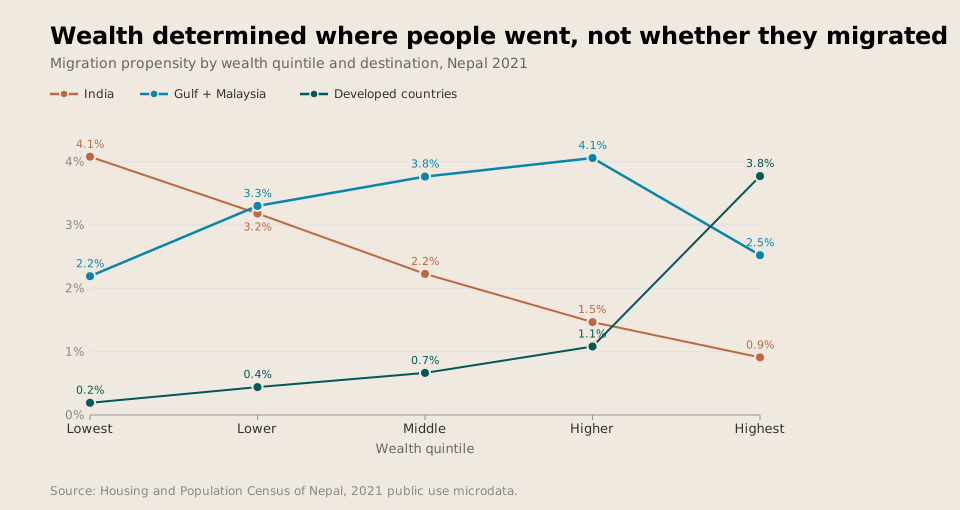
High labor demand, combined with affordability, made Gulf-Malaysia migration available to a broad segment of Nepali households. More than 2,000 migrants now leave for these destinations each day, from all socioeconomic groups and virtually every part of the country.
The temporary nature of Gulf-Malaysia migration also mattered for remittance flows. With no pathway to residency or citizenship, workers had little incentive to relocate their families or invest abroad for the long term. After covering basic living costs, most earnings flowed back to Nepal as remittances. This combination of scale, accessibility, and remittance intensity transformed the economic landscape of Nepal.
III. The Transformation at Home
The opportunity to work abroad in the Gulf and Malaysia transformed Nepal. But there was no export boom, no large industrial parks, and no major poverty-targeted transfer programs. Instead, transformation began closer to home, with millions of households with family members abroad.
Transformation of the Family
The most immediate channel for impact was the higher earnings abroad. In low- and mid-skilled jobs in the Gulf and Malaysia, Nepali workers could earn three to four times more than at home.5 These transfers raised consumption, helped repay migration loans, kept children in school, improved diets, financed home repairs, and helped families cope with shocks.
Higher incomes also translated into greater investment in children’s education, especially for girls who were lagging behind. With more resources and higher expected returns, families were better able to keep children enrolled and cover education costs. A 10 percentage-point increase in the probability of migration to the Gulf and Malaysia raised child enrollment by 4 percentage points and increased girls’ schooling by 0.26 years, making education one of migration’s most important long-run development channels.
Transformation of the Local Communities
Beyond the immediate household, migration also reshaped local economies. With new income from abroad, families could purchase more things, raising demand for local goods and services. At the same time, the departure of young men tightened the labor markets, creating opportunities for women and poorer workers that remained.
By 2011, nearly half of Nepal’s around 4,000 villages had at least a quarter of their young men aged 15 to 40 living abroad. A 10 percentage-point increase in village migration rates raised wages for those who stayed behind by 25% and increased labor force participation by about 4 percentage points. This created opportunities even for households without migrants. Participation gains came mainly from women entering non-farm work and men working more in agriculture, while wage gains were strongest in agriculture for both men and women and in non-farm work for women.
Higher remittances increased local demand for shops, transport, restaurants, construction and other services. They also provided households, both migrant and non-migrant, with capital to start or expand businesses to meet the growing demand. In addition, returnees often brought back savings, exposure, and ideas for ventures they could pursue in Nepal.
Overall Impact on Poverty
Together, these effects improved living standards across the board and drastically reduced extreme poverty. Villages with higher migration rates to the Gulf and Malaysia saw larger reductions in poverty. Rising migration rates to these destinations alone explained 40% of Nepal’s poverty reduction between 2001 and 2011.
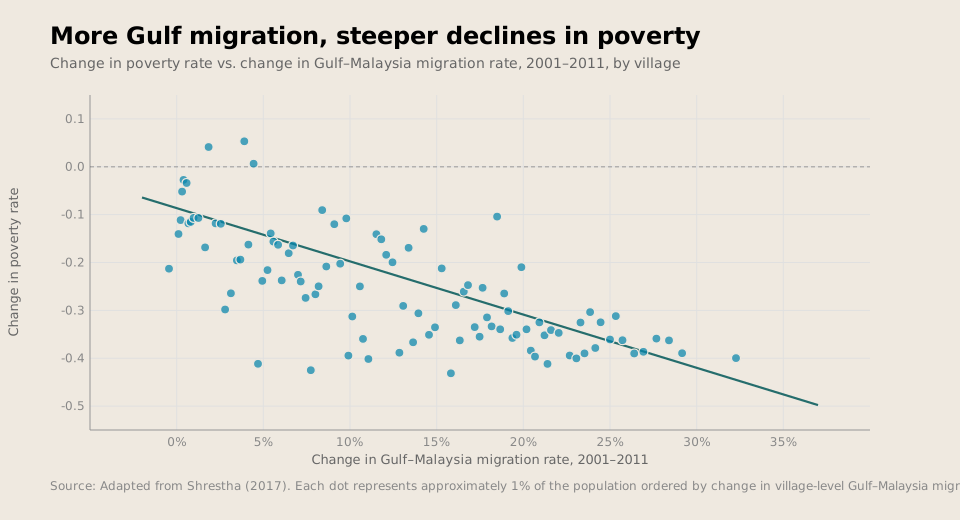
Three factors were critical to this transformation: scale, affordability, and large earnings gains. Migration to India had only the first two, and so did not produce the same poverty impact. By contrast, Gulf-Malaysia migration reshaped local economies within a decade. Household by household and village by village, it became Nepal’s most important engine of poverty reduction.
IV. The Costs of Migration
The impressive poverty reduction story of migration has not been without tradeoffs. Millions of Nepali workers took a gamble: borrowing heavily, trusting recruiting agents to place them in jobs in unfamiliar countries, and spending their prime years away from family. This was not easy, it wasn’t smooth, and it had some important consequences beyond the reduction in poverty.
The Lives of the Migrants
The most salient risk is migrant deaths. Two thousand people leave every day, and about four of those will come back in a coffin, devastating their families. This translates to an annual mortality rate of 0.65 per thousand.6 Is that a high rate? Turns out it’s not. The annual mortality rate for Nepali men of the same age composition as migrants in Nepal is 2.3 per thousand, 3.5 times higher than that of migrants. In fact, the mortality rate of Nepali migrant workers is lower than that of men in Canada (0.8 per thousand) or the United States (1.4 per thousand) with the same age composition.7
While the mortality rate itself is not unusually high, the causes of migrant deaths deserve closer attention. Almost two out of five deaths are officially attributed to “natural causes,” cardiac arrest, or heart attacks; more than one out of five to traffic accidents and suicide. Understanding the specific mechanisms behind these sudden and catastrophic events is essential for prevention. Perhaps, better information, education, and training — particularly on hydration, heat management, stress, and mental health — could help save lives.
Abuse and Exploitation
Abuse and mistreatment are also widely reported, including contract substitution, excessive fees, unpaid or delayed wages, passport confiscation, unsafe worksites, and crowded housing. The same intermediation system that made migration accessible at scale also created space for exploitation. After all, recruitment agents and agencies know a lot more about the actual conditions than the migrants, and they exploit misinformation in their favor.
If other countries wish to emulate Nepal, they must be aware of these risks. Stronger monitoring of recruitment agencies, better enforcement against abusive recruiters and employers, and clearer information for prospective migrants can improve worker welfare. Prospective migrants, especially going abroad for the first time, value practical information: Even basic information on average wages and mortality risks can influence their decisions and behavior.
Changing Social Fabric
Perhaps migration’s greatest non-economic transformation has been its effect on family structure. Migrants are overwhelmingly men, and many spend long stretches of their young and most productive years away from spouses, children, and parents. These absences have consequences.
Migration might lead to greater empowerment and agency for women, especially wives who manage remittances, household budgets, and make farming and business decisions while husbands are away. Women may also make decisions differently, often in ways that favor children’s health and nutrition. This change, if it translates to participatory decision-making when husbands return, could strengthen family welfare and improve women’s well-being. But years of separation can also strain marriages.
Migration has also reshaped family formation. Evidence from a similar context in Bangladesh finds that unmarried men delay marriage and remain for longer in extended households with parents and siblings. The family may also move to cities and the plains. Over time, these private decisions add up to broader changes in household structure, intergenerational support, and rural settlement patterns. The 2021 census already documents population decline in 34 of Nepal’s 77 districts, mostly rural hill and mountain districts.
These changes may also interact with Nepal’s rapid fertility decline and affect sex ratios at birth. The prospect of male migration could further increase the economic value of a son, and accentuate the already strong preference for sons. Extended male absence may further accelerate fertility decline. Together, lower fertility and stronger son preference can intensify pressure to have a son and increase the risk of sex selection at birth. By 2021, Nepal had 112 males born for every 100 females — a ratio comparable to some of the worst-performing Indian states. Migration may not be the only driver, but it could be exacerbating an increasingly worrying trend.
Some are also concerned about the macroeconomic impacts of remittances. Evidence, beyond speculations drawing from increased consumption and wages, is, however, absent.8
V. Path Forward
In many ways, one might have expected Nepal to have seen stagnation, or even a growth in extreme poverty over the last two decades. There was widespread conflict in the 2000s, a major earthquake in 2015, and perennial instability of governments throughout. There were none of the usual indicators of structural transformation — no export growth, no industrialization, no East Asian miracle.
And yet: Extreme poverty is now rare. Nepal’s experience shows that migration can be a powerful driver of poverty reduction. It did not replace the need for growth and job creation at home, but provided sustained high incomes to the masses when domestic opportunities were limited. Millions of Nepalis have benefitted.
Can this model work for other low-income countries? It seems possible other countries may look to Nepal, for two reasons.
First, the development paths followed by China, Vietnam, Bangladesh, India, and Indonesia are becoming harder for today’s low-income countries to replicate. The prospects for growth by focusing on expanding rapid, labor-intensive, export-led industrialization look far worse than they did in the 1990s. Automation, artificial intelligence, protectionism, supply-chain disruptions, and geopolitical uncertainty are all reshaping global production in unpredictable ways. Countries that missed that wave will need other ways to deliver sustained income gains for poor households. Expanding access to better labor markets abroad offers one credible pathway.
Second, demographic divergence across countries has created a stark gap between where jobs are and where workers are. Wealthy, aging economies face growing labor shortages in care, construction, hospitality, and other labor-intensive services.9 Many developing countries, by contrast, have large and growing youth populations but too few jobs.10 Well-managed migration can connect workers where opportunities are scarce with jobs where labor is needed.
No country should build its entire development strategy around a single sector, product, or pathway. Nepal’s experience shows that well-managed labor migration can be a powerful complement to domestic job creation and poverty reduction. For many low-income countries facing limited domestic opportunities, migration may be an area they cannot afford to ignore.
Maheshwor Shrestha is a Senior Economist in the Social Policy unit at the World Bank. He has led policy dialogue and programs on social protection and youth employment across countries in Sub-Saharan Africa, East Asia, and South Asia. His research focuses on migration, labor markets, education, health, and social safety nets in developing countries.

If you have comments on this article, or wish to contribute to the discussion, please email them to letters@indevelopmentmag.com. Responses will be featured in a letters section.
- At 24.2%, Nepal ranks fourth among all countries in terms of remittances as a percent of GDP since 2010. Tajikistan, Tonga, and Kyrgyz Republic are the top three countries. ↩︎
- At its peak in the early 1990s, the hand-knotted carpet sector employed over 250,000 workers and accounted for two-thirds of all exports. The sector was established by Tibetan refugees and had strong links to markets in Europe. However, starting in the mid-1990s, the sector faced reduced demand from abroad, in part due to concerns around the use of child labor and competition from other countries in the region. ↩︎
- Migration to the Gulf countries and Malaysia also increased from countries like Bangladesh, India, and Pakistan over the same period, perhaps in similar or even larger numbers. But relative to the population, Nepal’s outmigration was much higher. By 2024, the expected number of international migrants was 5% of the population in Bangladesh, 1.3% in India, and 2.7% in Pakistan, compared to 8.9% in Nepal. Likewise, the impact of migration and remittance in Nepal is a lot more salient. ↩︎
- The first Bilateral Agreement signed was with Qatar in 2005, followed by South Korea and the United Arab Emirates in 2007, and Bahrain in 2008. To date, Nepal has signed agreements with about a dozen destination countries in and beyond the Gulf countries and Malaysia, including South Korea, Japan, and the United Kingdom. ↩︎
- Based on average wages in Nepal and reported wages abroad. Rigorous evidence from Bangladesh for migrants in Malaysia finds a similar wage premium. ↩︎
- Mortality rate here is calculated based on data from 2009 to 2013. The comparison mortality rate is also around the same time. ↩︎
- The comparison here is not meant to be a causal comparison. For instance, migrants are likely to be healthier than non-migrants of the same age and have a lower ex-ante mortality rate. But benchmarking helps move the dialogue beyond the headline numbers to more useful diagnosis and solutions. ↩︎
- The typical argument for a potential Dutch disease effect is more complicated in the context of Nepal. Nepal’s exchange rate is pegged to India’s rupee, which significantly dampens the exchange rate appreciation effect. Also, unlike in the context of a typical resource curse setting where a small segment controls the resources and forex inflows, remittance flows to millions of individuals. So, the distortionary political economy impacts of the powerful elite controlling a large export sector is also absent for Nepal. ↩︎
- Some estimates suggest that the European Union will need 131 million workers from outside the Union by 2050 to maintain today’s working-age-to-elderly ratio. ↩︎
- For instance, 15 million jobs must be created annually just to absorb sub-Saharan Africa’s growing youth population but is falling far short of this target. ↩︎