

A successful commercial firm does something no NGO can.

Exporters Without Borders: Why You Should Start a Company Instead of Working in Aid
English
June Jambiha was a quintessential hustler. Like many in Kenya’s capital of Nairobi, she sold clothing as an informal entrepreneur, her income in 2018 swinging wildly, from $400 one month to $60 the next. This uncertainty made it nearly impossible to plan: hard to save, borrow, or commit to anything beyond the next week. But in Kenya, where over 80% of jobs are informal, hustling was less a choice than the only option available.
June joined my company, Wasoko, a B2B e-commerce platform linking small shops to large manufacturers, as a telesales agent. Her starting pay was lower than her best month selling clothing, but, for the first time, it was predictable. She knew what would land in her account the following month and the month after that. More than the money, though, there was an upward trajectory: her career could grow. Joining Wasoko didn’t just give June a paycheck; it gave her a career.
Entrepreneurship by Default
In developing countries, many people become entrepreneurs by default. Most have informal, cash-in-hand jobs. There is no certainty in entrepreneurship. At any given time, there could be a glut of opportunities, or income could completely dry up, and individuals have little control over this. When your income can differ markedly from month to month, it is hard to plot a path forward. Should you take out a loan to grow your hustle when your income could disappear the following month?
People in wealthier countries rarely stop to think about what a regular paycheck actually provides. A few prefer the adrenaline rush of building something of their own, but most, given the choice, prefer a steady job, since housing payments, credit cards, and expected bills are all far easier to manage. A paycheck is a reliable inflow that lets you build a future, not just get through the month.
People in poor countries share those preferences. As highlighted by Abhijit Banerjee and Esther Duflo in Poor Economics, these individuals do not necessarily want to be hustling; they simply have no choice. There are not enough steady jobs to be had.
To lift the floor for the 800 million people living on less than $3 a day, we don’t need more projects; we need more payrolls.
Effective Entrepreneurship
Non-governmental organizations often try to limit the damage from this massive deficit of employment opportunities. Cash transfers can allow people to invest productively, and asset transfers mean that people do not have to save for those purchases. But NGOs are inherently limited by the generosity of donors. What if there is a better option?
A successful commercial firm does something no NGO can: it issues “cash transfers” to a large group of people every month, indefinitely, funded by the market rather than donor whims. Indeed, private sector growth is the key to the structural transformation required to create hundreds of millions of jobs. No rich country today has become wealthy through the intervention of NGOs.
Rather, it is businesses that make a country rich. Take Singapore as an example. It became an export hub, first in goods and later in services. As the private sector grew, the state had more money to invest in public goods and advanced infrastructure, enabling further private-sector growth. Growth laid the foundation for everything else.
All of this can feel like a task for governments and economists—structural transformation is an initiative too large for any one person to shape, right? That assumption is wrong. Firms don’t emerge from policy; they are built by founders. You could be one of them.
I started Wasoko in Kenya in 2015. The seed of the idea had come from a month spent living in a rural village in Egypt a few years earlier, where I was doing remote coding work while learning Arabic. What I kept noticing was a simple, persistent problem: the neighborhood shops kept running out of basic items, such as soap, cooking oil, flour, and sugar. The shopkeeper then faced a half-day trip to the nearest city’s wholesale market to restock, at a significant cost in time and transport.


Wasoko replaced that trip with a mobile phone order and same-day delivery. By consolidating dozens of individual restocking runs into a single route—one driver, one truck, serving many shops—the marginal cost fell significantly for each shopkeeper. What had once taken half a day and eaten into thin margins could now be done on the phone in two minutes.
Wasoko eventually grew to serve more than 100,000 small businesses across six countries in Sub-Saharan Africa, with a team of 2,000 people. Most held entry-level logistics and customer support roles—the vital first rungs of the formal economy. Each drew a monthly paycheck; that payroll helped support the lives of more than 10,000 family members. Those paychecks paid school fees, covered medication, and funded improved housing.
My experience at Wasoko is just one data point in a larger argument. Scale-up entrepreneurship—moving from the startup phase to manage increasing complexity and growth—is not merely a business strategy; it is the most powerful engine of mass job creation and poverty reduction ever built. All countries start with informal economies; the transition to an advanced economy happens one firm at a time.
Creating Firms in Poor Countries
Starting a business in a developing country means confronting a hard ceiling almost immediately. Most potential customers are poor. While you can build something genuinely useful and serve real demand, you can still find your growth fundamentally capped by local purchasing power—the very condition you set out to change.
But there is a way around this, by focusing on exports. By selling to global markets, firms bypass the constraints of domestic purchasing power entirely to access demand that is effectively bottomless.
This is what economist Dani Rodrik calls an “unconditional escalator.” Unlike domestic-facing firms, whose growth depends on rising local incomes, an export firm can scale as far as global demand will take it—in principle, until every willing worker in the country has a paycheck. This is roughly what China did when it became the manufacturer to the world. In the 1990s, Chinese consumers were too poor to support demand for their own sprawling manufacturing industries, but American consumers were eager to buy cheaper Chinese goods. In time, the employment gains made the average Chinese citizen much richer.
But the gains go beyond employment. To compete in global markets, a firm must meet international quality standards and benchmark itself against the world’s best—driving productivity levels that domestic industry rarely needs to reach. This is how a country climbs the complexity ladder: not by protecting local champions, but by forcing them to compete.
This was the scale logic of the “East Asian Miracle,” the rapid economic growth and industrialization, along with significant poverty reduction, in eight economies in the 40 years to 1990. Countries like Singapore, South Korea, and Thailand did not achieve historic poverty reduction through domestic services or aid. They did it by investing in manufacturing. By starting with low-complexity exports like textiles, they built the organizational muscle and fiscal surplus to move into higher-value industries. Each export factory served as a school of management and engineering, creating a self-reinforcing cycle of wealth and skill.
The organizational capital created within these pioneering firms eventually “spills over” into the broader economy. As people move on from the first scale-up firms, they take their knowledge with them. Economists Ricardo Hausmann and César Hidalgo argue this vital “productive knowledge”—the collective ability to perform complex tasks—is rarely found in textbooks; it must be acquired through learning-by-doing within functional organizations.
There are legions of historical examples. Consider Floramérica, the first cut-flower exporter in Colombia. Floramérica was founded by a few Americans in their early thirties who brought US-style business management to their pioneering venture. Within six months, they were exporting to the US and, within three years, employed 400 people.
But Floramérica didn’t just grow flowers; it engineered a multinational cold chain from scratch. It negotiated with airlines to create cargo space, designed specialized refrigerated trucks to navigate Andean mountain roads, and mastered the stringent plant import standards of US Customs. This required a level of organizational knowledge that Colombian domestic business did not have at the time. By solving these complexity problems, it created a high-productivity blueprint for an entire nation.
The knowledge didn’t stay inside Floramérica. Local employees mastered the trade and left to launch their own ventures, seeding an entire industry. Today, Colombia is the world’s second-largest flower exporter, with an ecosystem generating US$2.4 billion in annual value with 200,000 formal jobs as of 2025.
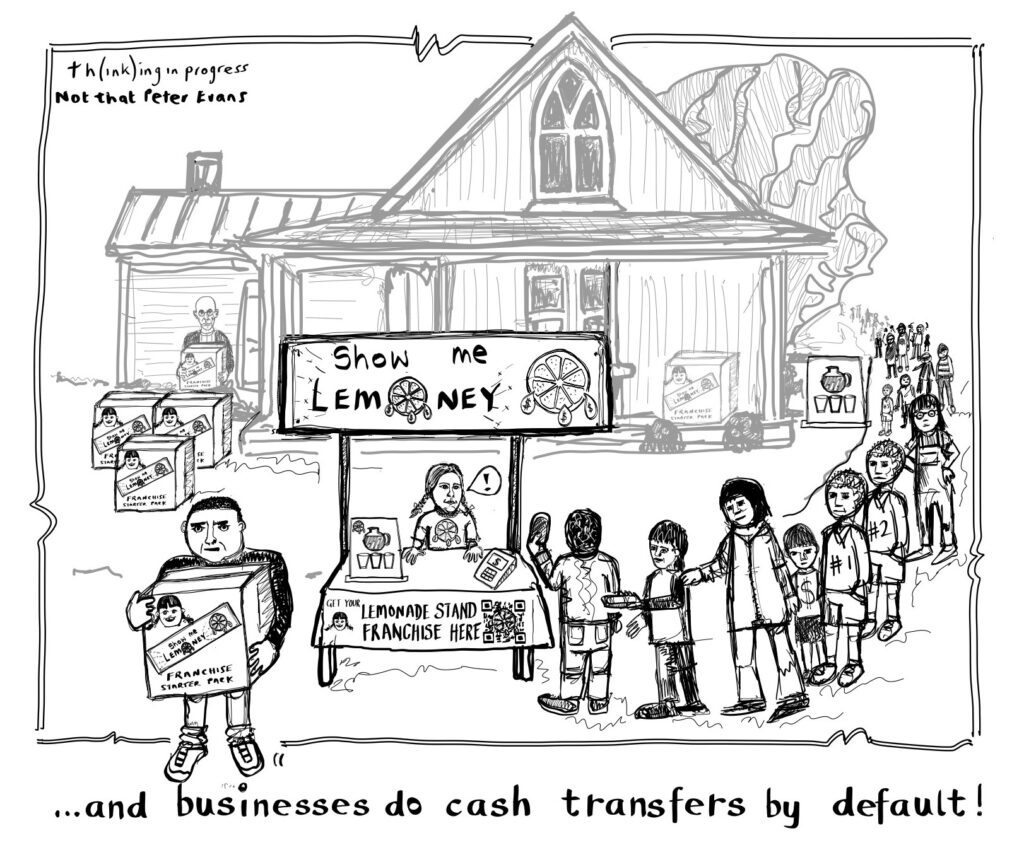
It is difficult for an NGO to compete with that level of impact. This outcome was achieved through entirely different mechanisms outside of standard aid practices: The founders of Floramérica didn’t write policy papers, disburse cash transfers, or run a randomized control trial. They built a scale-up business in a poor country selling to global markets. In so doing, they catalyzed the structural transformation that gave hundreds of thousands of people exactly what June Jambiha spent years looking for: a reliable paycheck and a path forward.
And it’s repeatable. One of the Floramérica founders, Thomas Kehler, went on to launch SalmoAmerica in Chile—one of the first salmon exporters in what is a $6.5 billion industry employing 86,000 people in the country as of 2023.
Does This Still Work?
A common objection to export-led growth is that commodity prices are volatile: a nation that builds its economy around coffee or copper can be devastated by a price crash. This concern is real, but it misidentifies the target. Raw commodity exports are often capital-intensive rather than labor-intensive. They concentrate wealth in a few hands and can generate perverse incentives such as “Dutch disease,” where resource windfalls crowd out other productive sectors, or corrupt the elites who hoard outsized resource profits. The answer is not to avoid exports altogether, but to focus on value-added, labor-intensive manufacturing. A garment factory or food-processing plant prices its output primarily against the cost of entry-level labor, which is far more stable than iron ore or arabica futures. It is also precisely this kind of production that generates the broad-based employment that lifts living standards across a society.
A related worry is that the era of export-led industrialization is closing. With tariffs rising, there are significant efforts to relocate manufacturing closer to home, and manufacturing’s share of global value-added output is lower today than it was two decades ago. Is the window for the remaining poor countries to industrialize closing too? The window may be narrowing—but the alternatives are worse. For any developing country, the question is not whether manufacturing is growing as a share of global GDP, but whether there is room on the escalator for new entrants. There is: China’s share of global apparel exports peaked at nearly 37% in 2010 and has since fallen as wages have risen. Bangladesh’s share of global apparel exports has increased from 4.2% in 2010 to nearly 7%, while Vietnam’s more than doubled from 2.9% in 2010 to just over 6% as of 2024 World Trade Organization reporting. Both countries followed the same path: their lower wages attracted the labor-intensive industry while building general organizational capacity, while China’s rising wages pushed the lowest-complexity production onward to the next location.
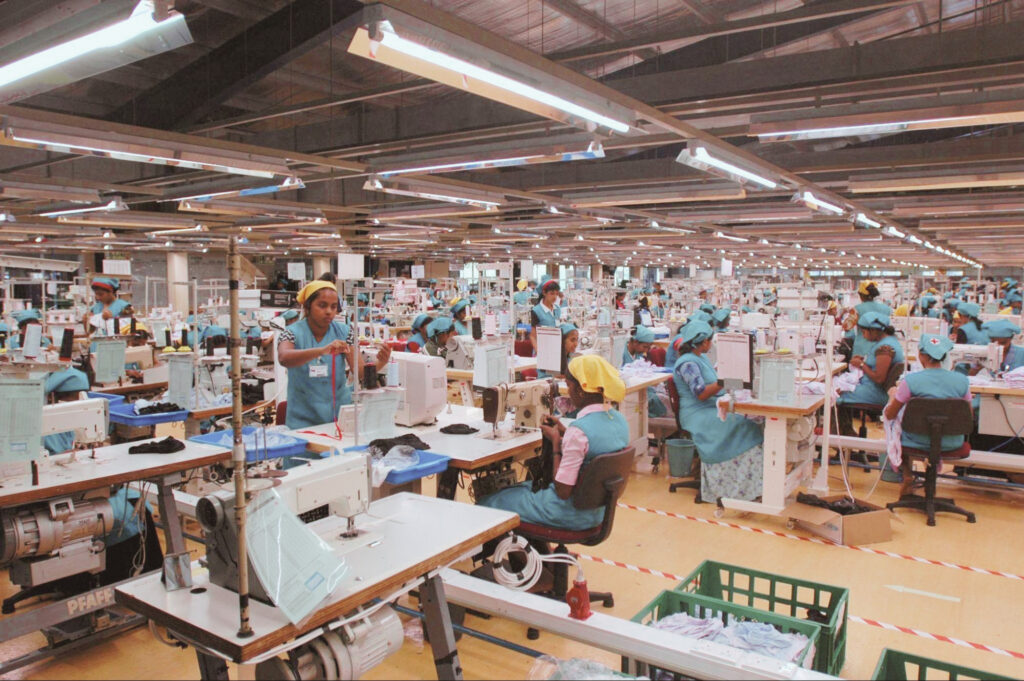
Vietnam and Bangladesh are themselves now traveling up the escalator: Vietnam’s electronics exports now surpass its garments while Bangladesh is pushing into higher-value textiles and luxury apparel. The entry-level production that built their export sectors is moving again. Sub-Saharan Africa, with the world’s youngest workforce and wages below those that drew investment to Southeast Asia a generation ago, is the most logical next address. The alternative—betting on domestic demand—remains a structural trap: you need rising incomes to grow demand, but you need demand to raise incomes. Exports break the cycle.
Still others worry that manufacturing automation will make mass employment in the sector a thing of the past. As robotics gets cheaper and more capable, developed countries could reshore manufacturing entirely, closing the window for developing nations before they have climbed through it. This is a serious eventuality and should not be waved away.
But the economic forces driving advancements in robotics should be examined against the conditions for entry-level manufacturing. The robotics deployments that have transformed manufacturing over the past two decades have been concentrated almost entirely in high-precision, high-cost production—automotive assembly, semiconductor fabrication, aerospace components—where replacing expensive skilled labor makes compelling economic sense. The entry-level manufacturing that developing economies rely on sits at the opposite end of the spectrum: handling soft, irregular materials with low-cost labor in fast-changing production runs has attracted comparatively little capital investment. The dexterous manipulation of malleable, unpredictable fabric remains one of the genuinely unsolved challenges in robotics. Even where automation is technically feasible, the economics of deploying it against a workforce earning $65 a month remains deeply unfavorable—robots have high fixed costs, must be retooled for different product lines, and, as orders fluctuate, cannot flex up or down the way a human workforce can. Human labor in physical manufacturing may eventually be made redundant, but even apparel manufacturers in China today still rely on human tailors to drive their production.
Furthermore, other growth paths besides manufacturing face even stronger headwinds. Tradeable services exports look like an increasingly bad bet. Public companies in service-driven export industries such as business process outsourcing have seen their share prices fall by as much as 70% following advancements in leading artificial intelligence companies. So far, manufacturing has been immune to this; collective market intelligence suggests that widespread reshoring across industries through extremely low-cost automated production remains beyond the forecastable window of cash flow impacts.
But there is another category of objection altogether. Is this neo-colonialism, and who is an outsider to reshape an African economy? But this critique misunderstands the mechanism. Export entrepreneurship in developing markets is not about arriving with answers to problems you don’t understand. You—the prospective founder—may not have particular expertise in a specific low-income market. But you don’t have to. Your comparative advantage can come from deep knowledge of high-income buyer markets to build a bridge between local production potential and global demand.
A founder who understands what a European retailer or American distributor needs from a supplier, and who can help a Ghanaian or Kenyan manufacturer meet those standards, is not imposing. The goal is not to serve as an extractor of basic materials from poor countries, but to start businesses in poor countries selling to new global customers who had never bought anything from there before. Eventually, firms started by local people you trained or inspired will probably outcompete you—and that’s the real win. The rising tide of growth brings gains to many people: the workers who will earn formal wages for the first time, the local entrepreneurs who will start the next generation of firms for global customers, and all the new local businesses that will form as they spend their wages.
Founder’s Journey
This is not an easy path. It is for the ambitious; those who want the highest impact and are unafraid of getting their hands dirty. Export-driven growth firms are gritty, capital-intensive businesses defined by physical logistics and hands-on operations. There is no startup accelerator like Y Combinator for garment factories, but success has the potential for far more societal uplift. A B2B software-as-a-service company may be the best job creation mechanism in Silicon Valley, but in Tanzania it is definitely not. These unglamorous industries are precisely those that pull people out of poverty at scale. They provide formal employment to workers who have never had steady paychecks and help countries gain access to the unconditional escalator of global demand. Your potential impact is limited only by the global market.
Success begins with initiative and immersion. As a software developer who grew up in California, I had no prior awareness of the supply chain challenges of small shopkeepers before my time in the rural Egyptian village after a university exchange program to study Arabic. I returned to my second year of undergraduate studies at the University of Chicago with an idea: what if small shops could instead reorder inventory by text message? I entered the concept into a university business plan competition and won a $10,000 prize. That recognition and modest starting capital gave me what I needed most: the means to justify a leave of absence to my parents and the runway to build out an initial prototype of the envisioned system.
I cold-emailed consumer goods brands across emerging markets, pitching the concept to anyone who responded. After months of dead ends, there was interest from an unexpected quarter: the Kenya office of Wrigley, the global purveyors of Juicy Fruit and Doublemint chewing gum. Following the suggestion of a potential pilot, I bought a ticket to Nairobi two weeks later and spent several months riding along on delivery routes with their local distributors, coding in the evenings to update our fledgling platform for presentation at the next Wrigley management meeting.
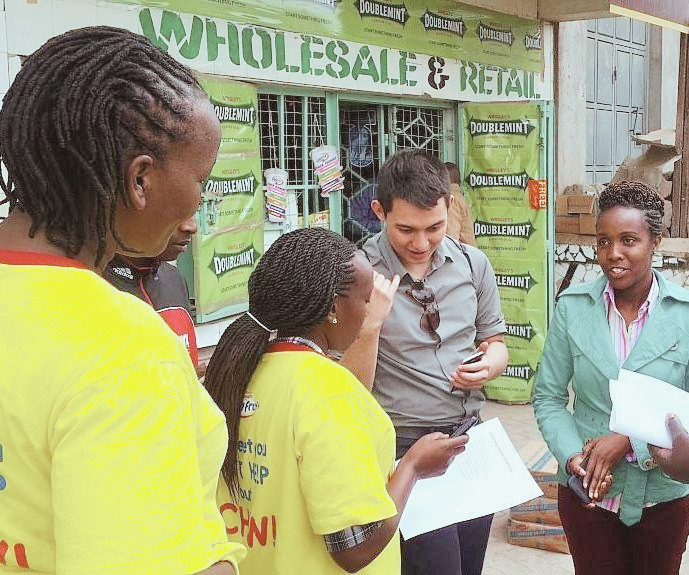
That on-the-ground education shaped everything that followed. We launched what became Wasoko as a simple SMS-ordering service: lean, low-tech, and grounded in what we had actually seen. But the market quickly imposed a harder lesson: a platform that merely connects buyers and sellers is worthless if delivery is unreliable. To provide real value, we had to own the full supply chain. We built our own logistics, managed our own inventory, and became a fully integrated B2B platform. This is the opposite of what the typical asset-light Silicon Valley playbook would have prescribed, but it was the only approach that actually worked. In markets where the infrastructure doesn’t exist, you can’t outsource it. You have to build it.
That meant starting from nothing and scaling through the unglamorous middle. Our first warehouse was a two-bedroom apartment, emptied out and stacked floor-to-ceiling with chewing gum and soap. As volumes grew, we moved to a house with a yard large enough for shipping containers, which we packed with inventory as we expanded capacity. Eventually we operated a network of industrial facilities across six countries, shifting hundreds of millions of dollars worth of goods. The progression sounds logical in retrospect; at the time, it was improvised, one problem at a time.
There were other challenges. We were hiring for roles with no established talent pipeline, in markets where professional norms were still forming. How does one hire a head of product when that job doesn’t yet exist in the market? The first person we did hire did not show up on his first day. He was unreachable for three days, then resurfaced with a relaxed explanation: he had gone away for a family event, and in any case had decided not to leave his existing job. We eventually put together an exceptional team, made of people like former-hustler June Jambiha, but it was by a process of trial and error.
Country expansion was no smoother. When we entered Rwanda, new suppliers demanded upfront cash before releasing goods. I went to our local bank branch to withdraw the equivalent of $10,000 in Rwandan francs—and discovered they held only $1,500 in local notes. I ended up on a motorcycle to the national branch in the capital city of Kigali, returning with two large bags of cash to close the deal.
But it was worth it. By the time I left the firm, it was serving 100,000 small businesses. After my nine years of living in and scaling the business across six African countries, Wasoko completed Africa’s largest-ever tech merger with MaxAB, an Egyptian e-commerce firm, poetically bringing me full circle back to Egypt.
And as for June Jambiha, within a year of joining Wasoko she was promoted to local team leader, and by five years later she left to co-found a consultancy with former colleagues to help the next generation of East African businesses improve their sales and operations.
Beyond Wasoko
Through that decade of venture building in Africa, I came to understand a harder truth: the path to widespread prosperity would not come from simply helping local businesses operate more efficiently. Wasoko was a start, but local purchasing power was deeply constrained. Creating genuine engines of income growth requires businesses built to serve markets beyond developing countries—using global purchasing power to drive convergence.
That conviction is what brings me back to you. If you want to improve livelihoods across the world, I would push you not towards Silicon Valley or the UN, but to the factory floor.
Start with radical immersion. If you lack a network in your target market, offer to work for free; local entrepreneurs are rightly skeptical of unproven outsiders. Spend at least six months working for a local export business, learning to navigate regulatory thickets, building supplier trust, and absorbing the nuances of the business culture. This is the most valuable capital you can acquire, and it cannot be found in a policy brief or a business school classroom.
Then build small, test rigorously, and commit to the long haul. Export-led ventures require a multi-year horizon; dabbling in actual development does not work. Study what succeeded in Asia and apply those lessons to the untapped comparative advantages of your chosen market. Most enterprises in low-income countries today serve protected local markets; the frontier is in helping them compete globally.
This path will likely never put you on a stage at the World Economic Forum in Davos. You won’t have a diplomatic passport and your work will probably be invisible to the global aid industry. But consider what the world actually needs: not more development consultants, but more exporters without borders—people willing to trade the conference circuit for the factory floor, who go to places where formal employment barely exists and build the supply chains that bring it into being. In the long arc of human history, development has never been a product of charity. It is built by those who go forth and export.
Daniel Yu is the founder of Wasoko, one of Africa’s largest e-commerce companies, and now the founding partner of the Africa Jobs Fund, a new program under Renaissance Philanthropy to finance and build African export manufacturing and labor mobility pathways.
If you have comments on this article, or wish to contribute to the discussion, please email them to letters@indevelopmentmag.com. Responses will be featured in a letters section.