

Is anticipatory action the future of aid or an expensive gamble?

The Price of Preparedness
English
Setting the Scene
In Turkana, Kenya, the International Rescue Committee (IRC) spent six months preparing for a disaster that never came.
The eight-person team assessed feasibility and need, registered 1,300 households and monitored government forecasts for a drought or flood indicator that would trigger the release of funds to each household.

But the threshold was never met, so no cash went out. On paper, the program did nothing, and cost roughly $112,000.
So Was That a Waste or a Worthwhile Premium for the Option to Act?
That question sits on top of a much bigger one. According to ALNAP, humanitarian actors moved an estimated $7 billion in cash and vouchers in 2025, roughly a fifth of all humanitarian aid. Very little is distributed before a shock — less than half a percent of humanitarian sector funding in any form1 is anticipatory.
Is waiting for a crisis to act the right choice? Maybe not. Crises are growing larger and more frequent, especially those driven by climate, while funding for humanitarian response continues to shrink.
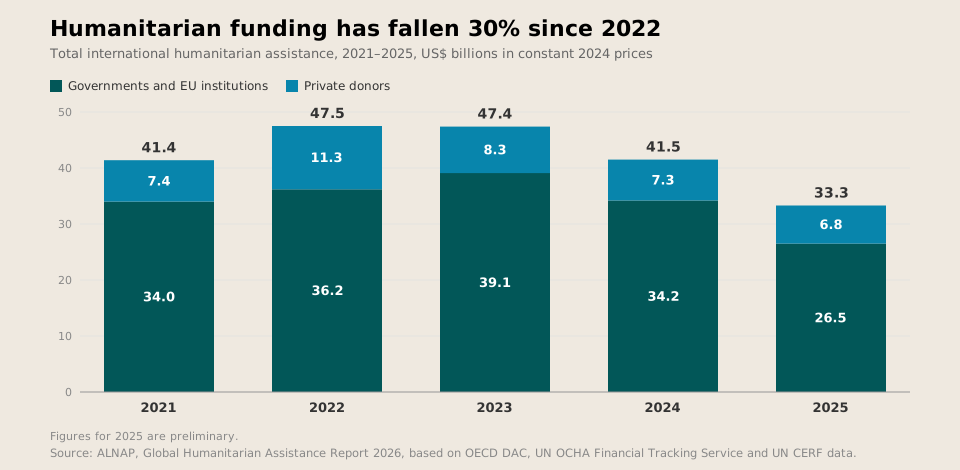
In this environment, any way to stretch limited funding is valuable. The sector’s own answer is to act earlier to stretch money further. Supplies cost less to buy and move before a shock, and families can prepare for it rather than go into debt or sell off assets to cope. Had Turkana’s trigger fired, 1,300 households would have received cash while there was still time to buy additional food or take preventative measures to protect themselves and their livelihoods. In 2024, a negotiating group of donors and aid agencies called on donors to target at least 5% of their humanitarian budgets for acting ahead of shocks, a goal that largely2 has yet to be achieved.
Shrinking funding may be what finally forces the rethink.
Humanitarian System Reform: A History
Against today’s backdrop, we think adopting new approaches to make the most of limited money should be a priority.
One of these approaches is anticipatory action — what the Turkana program was building. Anticipatory action expands on disaster risk reduction and early warning system developments dating back to the 1970s and was further inspired by World Bank insurance model innovations of the early 2000s.
Of course, the underlying idea of reading signs of a coming shock and acting in advance predates structured humanitarian aid. Kagunyu et al. note that pastoralist communities in Kenya’s drylands have long anticipated floods and droughts through their own early warning systems: animal behavior, flowering plants, cloud patterns.3 These communities prepare for the coming shock, but their ability to prepare is limited by their own resources.
Humanitarian actors have far more resources. However, they have rarely turned early warnings into action. For example, forecasters issued “increasingly dire” warnings for 11 months before famine was officially declared in Somalia by the United Nations in July 2011. The international response largely failed to mobilize until after that declaration. According to the UN, this delay contributed to the famine’s death toll of nearly 260,000 people, half of them children under five years old.
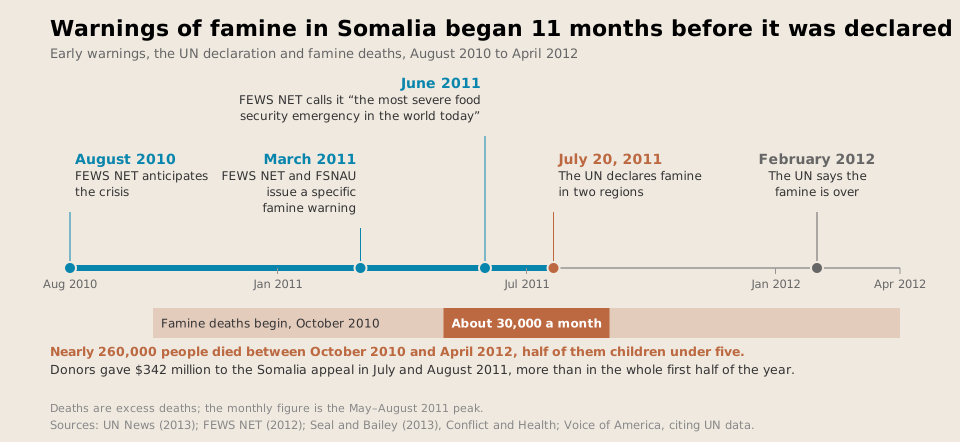
Anticipatory action tries to avoid this delay. Rather than wait for a disaster to strike before mobilizing relief, anticipatory action ensures resources reach households in advance of a shock. This is often triggered by a forecast crossing an agreed-upon threshold — for instance, a weather forecast showing a certain likelihood of flooding.

In practice, anticipatory action programs can vary a lot. A program can be lean and only begin investing in resources once a long-range forecast flags a likely hazard — or it can be something that requires much more investment and creates standing protocols and systems.
Across designs, though, anticipatory action changes both what a response costs and what benefits it delivers.
Anticipatory action has costs that traditional aid programs do not. Building and maintaining forecasts, triggers and delivery systems are real costs. But anticipatory programs allow households to buy and move supplies before prices spike and access is cut off. A Start Network rapid evidence assessment finds that early action can be cheaper than reactive aid for this reason.
Benefits can be significant. When families receive cash before a crisis, they can react better. They can move themselves and their families away from a natural disaster before it hits, prepare for a storm or flooding or buy what they need before prices climb. This can help families protect their livelihoods and keep the assets they would otherwise sell to survive. But a “wrong” forecast, where the trigger activates but the hazard never arrives, can mean anticipatory action pays out to non-impacted households. This can be seen as a waste of money and is not a problem in traditional humanitarian response, where transfers wait for confirmed need.
Anticipatory Action: The Evidence, As We Know It
There are some circumstances where anticipatory action is helpful and some where it is not. Unfortunately, the debate on anticipatory action is decidedly less nuanced than it should be. Depending on whom you ask, anticipatory action represents either the future of aid or an expensive gamble. Proponents see a smarter, faster and more dignified model. Skeptics see money wasted paying out on forecasts that don’t come to pass — or, as in Turkana, programs that have been set up but never trigger.4
According to the Anticipation Hub, anticipatory action activations roughly tripled from 2022 to 2025, reaching over 9 million people across 54 countries last year. But despite being around for over a decade, research exploring the cost-effectiveness of anticipatory action continues to lag. The IRC has been working to close that learning gap.
Since 2021, we have implemented anticipatory action programs in eight countries.5 We’ve conducted cost and impact analyses to answer questions such as whether delivering cash as one lump sum protects households better than two half-sized payments and whether giving cash before a flood hits protects households better than giving it after.
Though there is still much to learn, these programs and evaluations helped us develop much-needed heuristics to understand whether and how anticipatory action can maximize humanitarian cost-effectiveness.
1. Context determines what anticipatory action can do, not just how well.
A Mercy Corps synthesis argues that anticipatory action can serve two different purposes: (1) act as earlier aid, providing the same welfare gains as post-shock assistance and (2) let households protect productive assets and livelihoods before a shock closes off options.6
There can be limits to that second option, though. We conducted the first-ever randomized controlled trial of anticipatory action cash transfers in Afghanistan in drought-plagued Badghis Province in 2025. The IRC randomized whether households received a single cash transfer before the harvest season or two smaller transfers (with the same overall amount), one before and one after. All families in the program were suffering; a trifecta of near-total harvest failure, cross-border restrictions that cut off seasonal earnings and sudden withdrawal of humanitarian funding left households with almost nothing to fall back on. By endline, around 94% of households that received a cash transfer reported no income at all.

The cash was a lifeline. It helped families meet some of their immediate needs and avoid new debt; for many, it was the first assistance they’d received in roughly a year. Delivering the transfer as a single payment (before the shock) generally left families relatively better off than splitting it in two, but the average household in both treatment arms began and ended the study as “food insecure.”7 Anticipatory action could help blunt the impact of a shock, but it could not restart the wider economy and restore incomes. In a context this fragile, anticipatory action can be but one component of recovery.
The IRC was not alone in finding this — a qualitative Save the Children study across drought-impacted areas of Kenya and Somaliland also indicates that livelihood-protecting anticipatory action is unlikely to be enough on its own in a protracted crisis. For this reason, the study recommends layering anticipatory action with conventional humanitarian aid for the hardest-hit households.
2. The cheapest anticipatory action system is the one you don’t build from scratch.
Anticipatory action relies on forecasts and the ability to move money fast. These systems can be very costly to build but cheap to reuse.
In Somalia, we layered our program onto resilience and early-warning systems already in place.8 As a result, setting up the program cost roughly $52 per household and took three months. It would have cost an estimated $2889 per household to build the same capability from scratch. We estimate that use of preexisting systems lowered the set-up costs from 28% of total program cost to 7%.
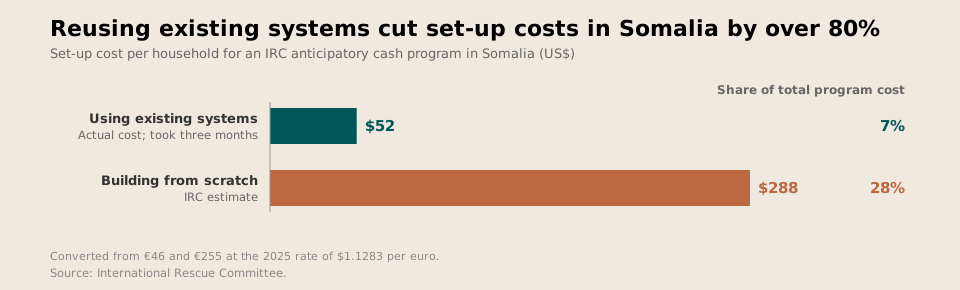
We were certainly not the first to work with existing systems. When the World Food Programme delivered forecast-triggered cash ahead of Bangladesh’s 2020 monsoon, it relied on widely used mobile money channels; during Nepal’s 2021 floods, the Nepal Red Cross Society routed cash through the government’s Social Security Allowance system.
But our Somalia research program is among the few to quantify this reuse dividend, as well as to note that “working with existing systems” isn’t the same as “free.” Where a system already exists like in Somalia, this can be a powerful model.
When systems don’t already exist, the sector defaults to a “build” and “fuel” model. Under this model, the humanitarian actor invests up front in standing up frameworks and triggers from scratch (“build”) then releases money to households (“fuel”) when a trigger fires. But for many organizations and contexts, an up-front investment can be hard to justify, difficult to finance10 and time-consuming to establish.11
A leaner approach, e.g., standing up a hazard-specific contingency plan once a long-range forecast flags a high-probability threat, may help12 stretch resources further and respond faster.
This is what we did in Guatemala: free long-range forecasts from Columbia University’s climate institute flagged a high-probability flood season four months out; the open-source GloFAS flood platform pinpointed when to trigger; and cash and early-warning texts moved through a bank and a messaging platform we already worked with. The only thing newly built was our contingency plan, which spared us the cost of building our own trigger mechanism.
3. Fast action runs on patient money.
The two lessons above assume funding that (1) persists between shocks and (2) can move on a forecast. But the humanitarian system currently runs the other way around: it releases money once a loss has already occurred and been formally recognized (e.g., via a famine declaration or an emergency appeal). Under current rules, most humanitarian funding runs on an annual basis (or shorter) and is often tied to a donor fiscal year and specific geography. Many donors now say they want to act before a shock, yet the funding landscape does not reflect this. Some donors’ financial rules even prevent them from directly disbursing ahead of a shock at all.13
Increased use of two funding structures could help change this. Multiyear funding lets up-front investment pay off when spread across seasons: build once and activate across multiple forecasts. Pooled,14 flexible funding can do most of the rest: release money on a forecast, move as the forecast shifts and spread the risk of a trigger not firing across multiple seasons. Our German Federal Foreign Office funding spanned several countries, which let us work more probabilistically across them. When Turkana did not have a drought and the Kenya trigger didn’t fire, that money wasn’t “stuck” but could instead go where the need was.
Neither of these funding structures is new. The IRC’s own research on multiyear, flexible funding demonstrates how they lower administrative and cost burdens for both donors and implementers. Self-reporting indicates that in 2024, 14 of 22 donors gave more than 30% of their humanitarian funding as multiyear grants, up from 10 donors in 2023.
Where We Go From Here
The team in Turkana prepared for a trigger that never came. As a standalone project, it can seem like money spent on nothing. But judged as a part of a system — one aimed where hazards recur, based on data and delivery systems that span seasons, and funded to act in advance — it looks like a premium on an insurance policy: one worth paying where hazards recur and hard to justify where they do not.
And even an unactivated trigger can leave something behind. In Turkana, we trained partners in household-economy analysis (a method for estimating what a given shock will cost a household and how much of it they can absorb) and tested new forecast methods. The experience helped reshape how we work, too — concentrating set-ups where forecasts are more likely to trigger.
The real question isn’t does anticipatory action work, but where it fits, what it’s built on and how it’s funded to last. If we get that right, anticipatory action could be one of the more promising innovations in the redesign of a multibillion-dollar humanitarian response system. Get it wrong, and it’s a multibillion-dollar bet that will never pay out.
The authors thank Clare Clingain and Mikaela Cochran-George for the research and analysis underpinning this article and Emily Barnes, Ben Excell, Miles Murray and Anneleen Vos for their technical review. Any errors are our own.
Justin Labeille is a Senior Director at the International Rescue Committee’s Airbel Impact Lab, where he leads the Best Use of Resources team. He previously directed cost-effectiveness evaluations at GiveWell and Giving Green, and held global research and policy roles at Living Goods, Innovations for Poverty Action, and J-PAL.
Paige Kirby is a Senior Advisor at the International Rescue Committee’s Airbel Impact Lab, where she works to change how funders use cost evidence. Previously, she led work on economic resilience and sovereign debt at USAID, managed foreign assistance budget execution, and worked in policy and applied research at Development Gateway and the OECD.
If you have comments on this article, or wish to contribute to the discussion, please email them to letters@indevelopmentmag.com. Responses will be featured in a letters section.
- Anticipatory action spans modalities, including cash and in-kind aid, and covers response to a range of hazards, including climate, health and conflict-related shocks. In this article, we’ll primarily focus on cash transfers for climate-related shocks. ↩︎
- The main exception to this is Germany, a donor which has set (and met) its own quantitative 5% target. ↩︎
- From this, as Derbyshire et al. note, an open question remains whether anticipatory action’s data-driven triggers build on — or around — that knowledge. ↩︎
- Note that learnings from Turkana have informed an agile IRC approach that has been activated six of seven times. ↩︎
- Afghanistan, Chad, El Salvador, Guatemala, Iraq, Nigeria, Somalia and Kenya. ↩︎
- There is also early exploration into using anticipatory action to protect gains in other sectors, including education (see the Geneva Global Hub for Education in Emergencies for more). ↩︎
- Each household received roughly $244 in total, constrained by the size of our funding envelope. With a fixed budget, implementers often must decide whether to transfer more money to fewer households or transfer less money to more households — and in this case, we chose the latter. ↩︎
- Through the Building Resilient Communities in Somalia (BRCiS) consortium, funded by the UK Foreign, Commonwealth & Development Office (FCDO). ↩︎
- In original currency, EUR46 and EUR255 — flipping 0.8862 2025 exchange rate used here to be 1.1283 EUR to USD. ↩︎
- This type of model can also leave gaps in areas where no framework exists but climate shocks still occur. In Afghanistan, for example, the UN’s 2025 Humanitarian Needs and Response Plan anticipatory action framework was limited to northern areas. ↩︎
- The six- month-long Turkana program set-up sounds lengthy but was actually quite quick by anticipatory action standards! ↩︎
- Cost savings from such an approach would come by assembling readiness from preexisting parts, though we can’t yet say whether this approach beats build and fuel on cost-effectiveness. ↩︎
- DG ECHO’s anticipatory funding reaches NGOs largely through pooled structures rather than direct grants. In 2024/25, the body commissioned a study whose objectives included analyzing ECHO’s legal and administrative frameworks and assessing the feasibility of a dedicated instrument to finance the fuel component of anticipatory action. ↩︎
- Pooled financing is where several donors contribute to a shared fund that disburses against agreed criteria, rather than each donor individually disbursing their own grants to implementers. ↩︎