

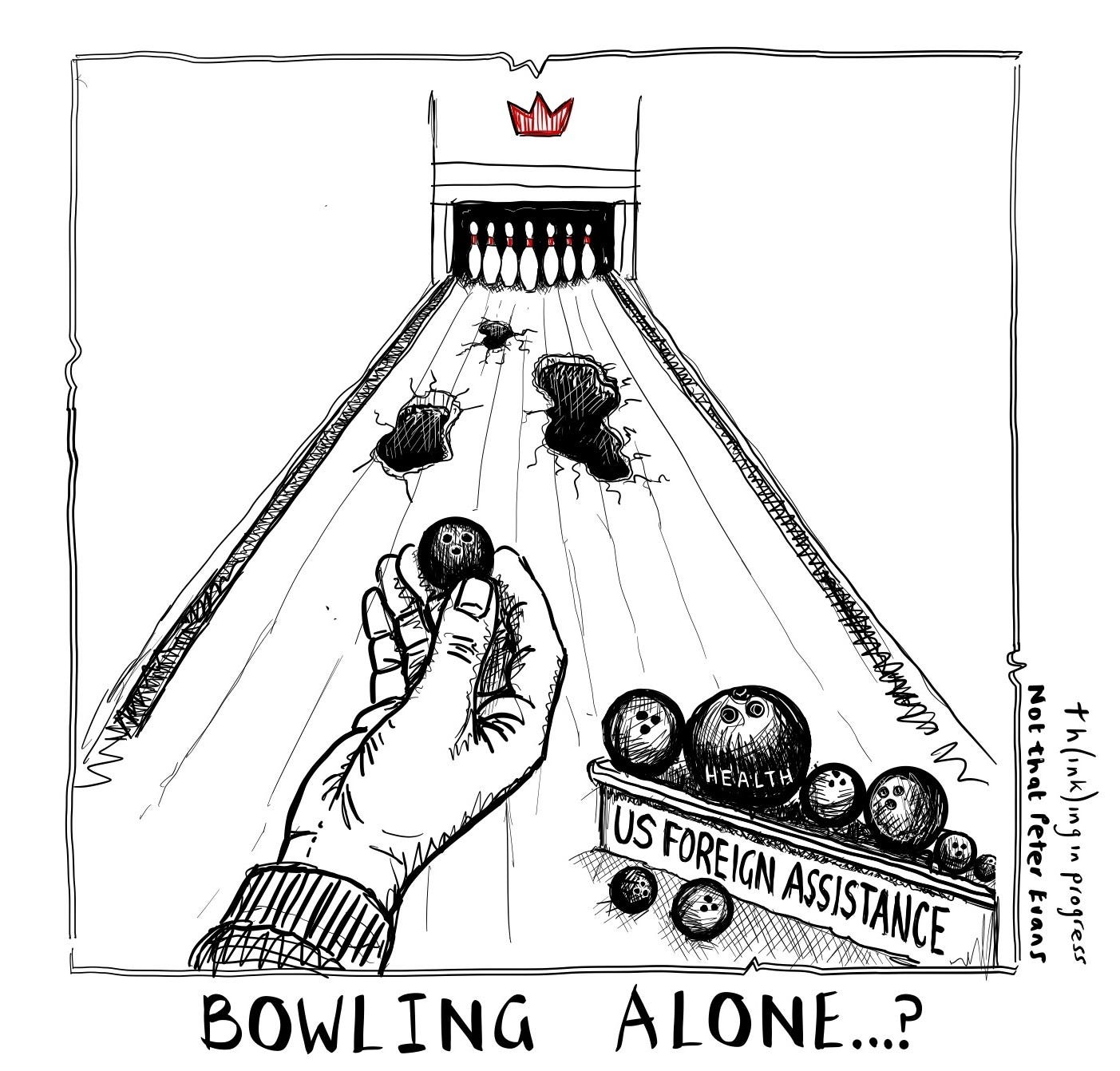
The U.S. is now operating an aid program without an aid agency.
In the first few months of 2025, the U.S. foreign aid program as we knew it ended. Initially, the Trump administration announced a “pause” while the new administration reviewed spending. The pause concluded with the announced termination of about 83% of all awards from America’s flagship assistance institution, the U.S. Agency for International Development (USAID). This resulted in a cut of around $13 billion in foreign assistance almost overnight, with whole sectors of support effectively shut down.
As part of that process, USAID itself was dismantled. Nearly all of its 10,000 staff were terminated, along with as many as 280,000 people providing contracted services. Although the legal structure of USAID remains, and a number of court cases over its shuttering are unresolved, it is unlikely to return in any similar form.
But foreign assistance continues. The administration has resumed spending and has even begun issuing some new awards. Congress has budgeted funding for a program with much of the scale and breadth of 2024 and earlier. In essence, the U.S. is now operating an aid program without an aid agency. In no small part, the future impact of U.S. foreign assistance will depend on whether, when and how that changes.
Following the Money
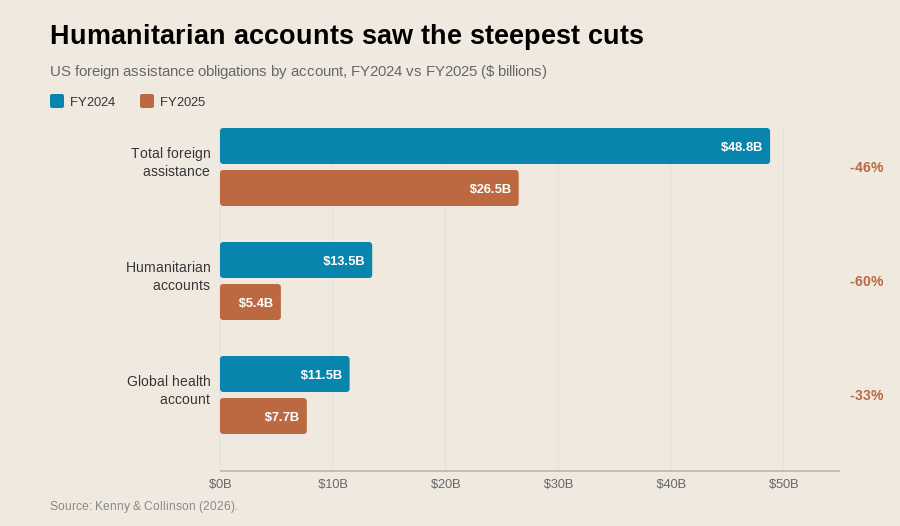
Spending fell far and fast. Total designated international development and humanitarian assistance outlays (current spending) under fiscal year 2024 — the period October 2023 to September 2024 — totaled more than $41.4 billion; in fiscal year 2025, that fell to $33.3 billion.1 Commitments to future spending (obligations) dropped more substantially from nearly $48.8 billion to $26.5 billion.2
Most health and humanitarian spending categories were comparatively protected from immediate cuts, but humanitarian spending in particular saw a steep drop-off in new obligations. From fiscal year 2024 to fiscal year 2025, the two main humanitarian accounts saw obligations decline from $13.5 billion to $5.4 billion, while obligations from the primary global health account declined from $11.5 billion to $7.7 billion.
Through the end of the second quarter of fiscal year 2026 on March 31, total outlays across the major foreign assistance budget subfunction still had not recovered, running at 72% of their level at that point in fiscal year 2024 and obligations at 74%. More detailed data on sectoral and country-level funding across U.S. assistance programs was delayed, but USAID spending for fiscal year 2025 suggests the only sectors to see rising obligations from the agency compared to the prior year were those tackling tuberculosis and malaria.
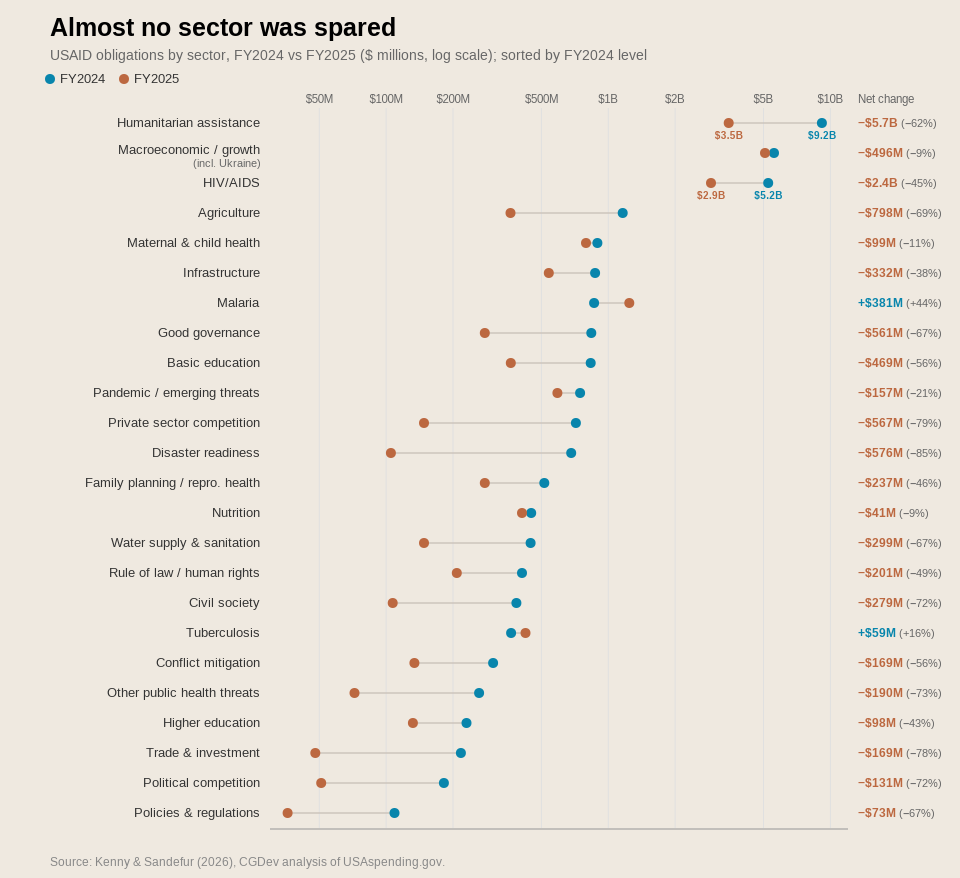
Spending in USAID-related accounts largely followed the patterns of early cuts. Sectors only subject to a small (less than 10%) cut included nutrition and support for Ukraine. At the other extreme, a number of sectors saw obligations fall by more than two-thirds: good governance, policies and regulations, trade and investment, private sector competition, civil society, political competition, water supply and sanitation, agriculture, disaster readiness and “other public health threats” (those beyond pandemic preparedness and major infectious killers).
The geography of aid has also changed. Zimbabwe, Burma, DR Congo, Yemen and Syria saw more than a two-thirds cut in USAID obligations between fiscal years 2024 and 2025 — a combined decline from $3,205 million to $816 million. Afghanistan faced a reported 100% cut to future aid obligations. At the relatively less-affected end, Egypt, Pakistan and Jordan all saw their obligations fall by 15% or less, while Lebanon saw a small increase.
Declines in spending were more than matched by declining capacity to deliver assistance. Out of the 10,000 USAID staff, only about 700 (around one in 14) were absorbed into the State Department to help it run former USAID programs. State itself also saw staffing cuts. Each of the remaining staff responsible for transferred awards now covers a much wider remit; State Department contracting officers overseeing foreign assistance were estimated to be responsible for managing about $260 million in awards each, compared to $65 million per contracting officer at USAID in 2022.
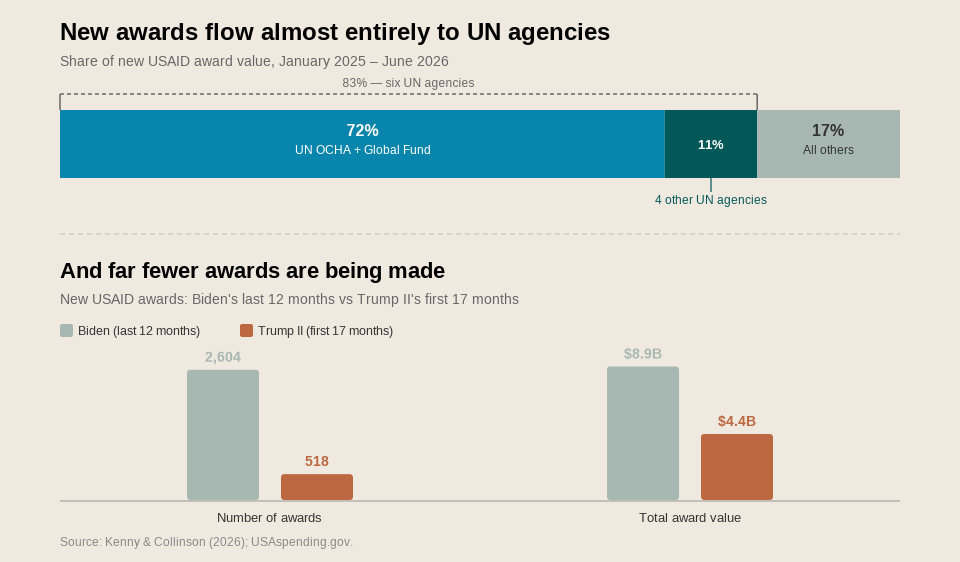
Perhaps unsurprisingly, this resulted in falling behind on payments to remaining contractors and contracts, and a significant lull in developing any new projects. About three months after the end of the initial foreign assistance pause, new spending obligations were still running at a third or less of the level of the past. It was nearly a year before there were any significant new awards. USAspending.gov data suggests that by the start of June 2026 the administration had awarded 518 contracts and awards under the main foreign assistance accounts in the 17 months since coming to office, compared to 2,604 in the last 12 months of the Biden administration. While the pace has picked up over time, the combined value of awards is still much lower. By June, the Trump administration had awarded $4.4 billion over 17 months, as compared to $8.9 billion in the last 12 months of the previous administration.
Impact
Prior to the pause, U.S. foreign assistance delivered measurable impacts across a range of sectors, including education, infrastructure, agriculture and violence prevention. USAID was particularly strong in delivering global health and humanitarian assistance, where it supported interventions estimated to save more than 3 million lives a year.
Given the size and breadth of the portfolio, even carefully executed budget cuts would likely have led to lives and livelihoods lost. The approach taken by the administration was some distance from well thought through. For example, there was an official waiver system to allow lifesaving assistance to continue during the aid pause at the start of 2025, but a chaotic situation in which most staff were placed on administrative leave prior to termination, rules and definitions regarding waived assistance were unclear and exceptions required senior management approval meant it was largely ineffective. Even aid that was officially allowed to continue through the pause largely ceased.
Other donors did not step in to fill the resulting gaps — indeed, the global total of aid from countries other than the U.S. fell in 2025 and 2026. Germany, the United Kingdom, Japan and France, notably, all cut foreign assistance last year. Recipient governments in some countries did try to respond, not least South Africa, which largely mitigated the impact of declining support for antiretroviral delivery. But the broader picture was considerably less positive. Most aid that was cut was not replaced.
Many people died as a result. However, the short-term mortality impact was likely less than initial cuts and forecasts suggested, thanks in part to the resumption of U.S. assistance in mid-2025.
At that point, the U.S. government focused on restarting some of the most effective lifesaving approaches alongside triage and unfunded continuation of services by providers. The flagship U.S. global HIV program, PEPFAR, which backs services preventing perhaps 1.6 million deaths a year, is a case in point. Much of the early coverage of the pause focused on this program. But by the end of fiscal 2025, antiretroviral treatment supported by PEPFAR had nearly recovered to the previous year’s levels. At the same time, coverage is still meaningfully worse than it was a year prior, new enrollments in treatment declined, services aimed at harder-to-reach communities appear to have been significantly reduced, testing levels fell to rates not seen since COVID-19 disruptions and a range of prevention activities (including pre-exposure prophylaxis) were significantly curtailed. This all suggests the risk of significantly slower progress against the global HIV epidemic in the years to come — and higher mortality as a result.
Regarding other areas of global health, there were significant cuts to maternal and child health, but in the end, they were not as severe as originally predicted. Despite a delay in U.S. funding, Gavi, the Vaccine Alliance, delivered a record number of vaccine doses in 2025 — and it looks like funding from the U.S. will only be delayed, not rescinded. Preliminary data from USAID suggest rising spending on malaria-related activities, though we will not have a clear picture of the status of global malaria campaigns in 2025 until the WHO World Malaria report is issued in December.
The U.S. was also one of the major funders of global pandemic preparedness, a role tested by the 2026 Ebola outbreak in DR Congo. While pandemic and emerging threats saw a relatively modest 21% global decline in USAID obligations in fiscal 2025, and a $3 million U.S. disease surveillance project in DR Congo was given a waiver early last year during the spending pause, capacity has still been seriously hurt. In 2025, USAID obligations to the country fell by 68% compared to 2024, and U.S. capacity to react to outbreaks was hobbled by a lack of staff. Every member of the USAID team that had responded to a 2025 Ebola outbreak in Uganda was fired. There is no surge capacity elsewhere in the U.S. government, either; while the U.S. Centers for Disease Control has provided support, it has also been substantially weakened by cuts, losing some one-quarter of its workforce.
The evidence is less clear when it comes to the impact of humanitarian assistance cuts. What we do know is that the U.S. was a major financier of global humanitarian response, particularly in crises that got little attention from other funders, and that the U.S. cuts have occurred as the rest of the world has also become less generous, so that in 2025, global humanitarian funding per person in need was at less than one-third of the level of 2019.
And, at least initially, it appeared as though the U.S. would be considerably less ready to respond to new and growing crises. When an earthquake hit Myanmar in March 2025, it took days for a small U.S. response team to arrive, only to be told they were being laid off while working on the recovery effort. Ninety-five percent of the staff in the bureau that deployed disaster-response teams were fired. Between them, Afghanistan, DR Congo and Mozambique saw 6 million more people in need of food assistance in December 2025 than they did in November 2024. USAID spending in Afghanistan fell 28% between FY 2024 and 2025, in DR Congo 42%, and in Mozambique 30%.
It is very hard to quantify the health and mortality outcomes of the U.S. humanitarian retreat. Most humanitarian needs occur in settings with little administrative data; it is difficult to track what is happening and even more difficult to determine what the counterfactual would be. The cuts themselves hobbled global tracking capacity. It will be years, if ever, before we know the true toll from the disruptions.
It does seem likely that triage efforts helped; the sector attempted to make sure the most important needs were met, even with limited resources. Nonetheless, cholera deaths — a disease closely associated with humanitarian crises — may have doubled in Africa, and rising deaths were associated with declining U.S. assistance. There is worrying evidence of rising maternal and child mortality in refugee populations across Africa. Meanwhile, famine looms in Afghanistan and Yemen, where all U.S. food assistance has been withdrawn. And with crops being planted without fertilizer in response to rising prices driven by the U.S.-Iran war, the next 12 months will sorely test a dramatically weakened global humanitarian system. The World Food Program reported in June that there were already signs of millions of additional people worldwide being unable to afford a basic food basket adequate for nutrition.
The New Model?
The Trump administration does not intend to exit foreign assistance completely. But they have chosen to restructure how aid is delivered and who delivers it.
USAID is functionally dead; what capacity remains has been moved to the State Department. The intention seems to be for State to remain the primary foreign assistance organ through the remaining years of the Trump administration. Staffing has increased somewhat in response to State’s expanded portfolio but remains well below USAID levels.
This low staffing level has cemented the early decision to largely abandon smaller awards. The State Department is favoring large international organizations in their grants; the UN Office for the Coordination of Humanitarian Affairs and the Global Fund, between them, accounted for 72% of the value of all reported new awards issued from the start of the Trump administration up to June 2026. Add in four other United Nations agencies, and that climbs to 83%.
This is in tension with the Trump administration’s stated priorities; administration rhetoric has focused on questioning the efficacy and accountability of multilateral organizations like the UN. However, this does not seem likely to change in the near term; 2026 awards have been just as focused on large organizations as 2025 awards.
For future awards, the administration is working to shift a bilateral global health program previously reliant on contractor and nonprofit delivery to one largely based on master agreements with recipient countries. Under these new agreements, governments will be responsible for coordinating supply chains, management and service delivery. Further payments from the U.S. will be contingent on achieving coverage and quality results.
It is also worth noting the types of awards the State Department is not making. There are relatively few small awards to nonprofits; there are also fewer opportunities to competitively bid for awards. Certain functions of USAID are not being replicated within State — there is no equivalent of DIV, which tried to incubate scalable interventions, or the Office of the Chief Economist, focusing on evaluation capacity.
Some of these changes have the potential to improve aid effectiveness. The Global Fund is recognized as being one of the more cost-effective large organizations in development. Flexible UN humanitarian funding can be directed where it is needed most while reducing some of the overlap and transaction costs of a system of competing agencies. And there have long been calls to abandon the parallel system of health care linked to U.S. health interventions, which use American contractors and nonprofits, and work directly with governments instead.
At the same time, future plans are unclear. The bilateral global health agreements promise to phase out U.S. spending over a five-year timeframe but offer scant details on how to ensure people receiving lifesaving support continue to have access to it and whether there will be a backstop to safeguard progress in tackling diseases in the event of government underperformance. And while a shift to local government provision may reduce overlaps in provision, it is a stretch to believe that low-income Liberia can provide the same quality and reach of U.S.-supported health services with 37% of the money. Department staff are still in the throes of negotiating implementation plans to operationalize the high-level agreements.
Again, whatever the efficiency gains of the administration’s “humanitarian reset,” the cuts are still large. It’s difficult to see how $3.8 billion in funding committed to the UN Humanitarian Coordinator could achieve what the $8 billion 2024 humanitarian budget could.3
The administration’s response to the June 24 earthquakes that struck Venezuela, where the State Department has highlighted a financial commitment of more than $300 million alongside military and search-and-rescue deployments, suggests there is still political will to mobilize for high-profile emergencies. But it is unclear whether the same would extend to crises in countries seen as less strategically important.
Furthermore, a focus on U.S. domestic benefits comes at a price to aid efficacy. Negotiations around health agreements in some countries have drawn criticism for making health aid contingent on data access, and reports suggest these agreements are, at times, advancing alongside discussions about securing access to critical minerals, raising questions about whether such ambitions will come at the cost of saving lives. USAID received criticism for being too political, but it seems that the State Department may be even more so — the Trump administration’s plan for aid puts U.S. interests at its core.
In part due to this focus, the State Department is also backing U.S.-based innovations as development solutions. This has included purchasing sufficient quantities of lenacapavir doses to protect 3 million people from the risk of HIV, working with drone delivery company Zipline to support medical supply delivery to 15,000 health facilities across Africa and purchasing 30 million spatial mosquito repellents to reduce malaria risk. Some of these interventions seem promising; lenacapavir, in particular, might be able to reduce the risk of HIV spread due to other aid cuts. But these programs are relatively small in comparison to the cuts; in the hundreds of millions of dollars rather than billions.
Furthermore, the State Department lacks the kind of evaluation capacity that could monitor impact at scale and determine if drone delivery is cost-effective or how spatial mosquito repellents function in situ. It is likely we won’t know if these programs are more or less effective than the USAID programs they replaced.
Finally, the administration has taken perhaps the most politically robust and least efficient part of U.S. foreign assistance — defaulting to U.S. food delivered on U.S. ships even in emergency contexts — and made it even less effective. The program is now located within the Department of Agriculture and is seemingly focused on maximizing purchases from American farmers and seeking to build markets rather than minimizing global hunger and sending food to countries that aren’t in dire need of support.4
Secretary of State Marco Rubio has sought to wield aid more deliberately as an instrument of U.S. foreign policy, prioritizing strategic investments that advance U.S. geopolitical and commercial objectives, while also keen to proclaim America’s continuing generosity and innovation through global health support and humanitarian relief. The administration still echoes its early criticisms of prior foreign aid, signaling plans to move away from many of the NGO implementing partners of the past. But realizing a new vision around an expressed desire to ensure accountability, work more directly with partner governments and foster novel solutions could run headlong into capacity constraints — and may fall short of lawmakers’ expectations for what U.S. foreign assistance should look like.
Congress Begs To Differ
Over the last year and a half, lawmakers on Capitol Hill demonstrated limited appetite to save the institution of USAID — and where some did push back, they lacked the votes or political capital to stop its dismantling. Alongside bipartisan concern with the level of bureaucracy that had accreted at the agency, and justified concern that some USAID-funded programs were not evidence-based or cost-effective, many Republican lawmakers came to see USAID as a wasteful bastion of liberal ideology.5
But criticism of USAID does not mean that there is no appetite for foreign aid. In fact there is an abiding bipartisan desire to preserve some of the scale and breadth of activities that USAID previously managed. The spending deal reached by Congress in January preserved considerable funding for global health, humanitarian and economic assistance accounts.6 Congress also does not appear to agree with the Trump administration’s far narrower list of priorities; that package and the draft FY27 House spending bill include directives for spending in areas including agriculture, education, water and sanitation, democracy promotion, violence against women and women’s empowerment — all areas the administration’s actions suggested it was ready to abandon.
What happens to this funding remains an open question, given the administration’s limited capacity to spend it (and, at least in some quarters, a lack of will to do so). Last year, the administration managed to recover nearly $13 billion in previously appropriated funding for foreign assistance.7
But while the White House hasn’t ruled out the prospect of rescinding additional funds, administration opposition to foreign aid spending in general appears to be softening, at least somewhat. In fact, its most recent foreign assistance request to Congress was for additional (supplemental) funding: $1.4 billion in health and humanitarian support to respond to the Ebola outbreak in DR Congo and Uganda.
Where Do We Go From Here?
The State Department lacks the capacity to allocate the money currently proposed for foreign aid in the way it has been allocated in recent decades. The question, then, is what is an appropriate architecture to allocate funds (if indeed, they will be allocated at all).
Ideas include bolstering State Department capacity in global health and humanitarian delivery and making more use of other agencies that survived thanks to continued bipartisan support. These include the Millennium Challenge Corporation (which works with recipient governments to finance a package of investments designed to promote economic growth) and the U.S. International Development Finance Corporation (which invests in private sector projects mostly in developing countries). Another option is creating a new development-focused agency. None seems to be a clear winner at this point; at the moment, U.S. foreign aid still operates in a state of limbo.
Almost 18 months on from the foreign aid “pause,” the U.S. government has lost much of its standing capacity to respond to global health and humanitarian threats, to pilot and evaluate new approaches to development challenges and to deliver programs from peacebuilding through education to democracy promotion. Many lives have been lost, and the reputation of the U.S. as a reliable development partner has been undermined.
There is still the hope that a bipartisan coalition can come together not only to protect funding levels but to create new institutional structures for foreign assistance that, in the best of worlds, deploys that funding with greater impact than ever. But the shape, scale and extent of any replacement — if one emerges at all — is yet to be seen.
Charles Kenny is a Senior Fellow at the Center for Global Development, and the author of Getting Better: Why Global Development is Succeeding and Life, Liberty, and the Pursuit of Utility: Happiness in Philosophical and Economic Thought. Erin Collinson is director of the US Development Policy Program and a senior fellow at CGD. She previously served as director of policy outreach. Prior to joining the CGD staff, she spent over five years working in the US Senate.
If you have comments on this article, or wish to contribute to the discussion, please email them to letters@indevelopmentmag.com. Responses will be featured in a letters section.
- Total foreign assistance is measured as the 151 International Development and Humanitarian Assistance account. This excludes Economic Support Fund humanitarian and development assistance (notably to Ukraine). ↩︎
- Numbers pulled from USAspending.gov in early August 2026; it is possible later revisions will change these slightly. ↩︎
- A recent announcement suggests the State Department will pursue health and humanitarian aims through funding directed through a growing network of faith-based organizations, but it is as yet unclear how much of that funding would be new money vs. redirected current obligations. ↩︎
- Such as Rwanda and El Salvador. ↩︎
- The skew of political donations by staff did give some credence to that second allegation. ↩︎
- Across several major foreign assistance accounts, FY24 and FY25 non-emergency appropriations was $20.6 billion, with FY26 coming in at $23.1 billion. ↩︎
- State also notified the Hill in April that they are holding $19 billion across several accounts for USAID “close-out costs.” Since it is unlikely that closeout costs will reach $19 billion, it is unknown what these funds will be used for. ↩︎