

Pain control is often treated as a luxury, leaving millions in low- and middle-income countries to suffer needlessly.
A World Of Pain
English
Dr. M.R. Rajagopal is haunted by the memory of his cousin’s nightly cries echoing through his village. His cousin had no pain relief for flare-ups from a rare skin cancer on his scalp, which caused him immense pain. And his cousin was not the only person he was unable to help; his memoir details other occasions he was unable to do more for people in his care. In his early career, he was too cautious in administering morphine — an opioid — to a man who had burns on 70% of his body; he was afraid of creating an addict. For months, his patient was kept in agony with only a few hours of daily pain relief. Years later, the man bumped into Rajagopal and told him the ordeal almost destroyed him. Rajagopal was shattered — but the experience changed his approach to pain forever. Dr. Rajagopal went on to become a pioneer in modern Indian palliative medicine.1
These anecdotes are from more than 40 years ago, but the patterns are hardly a thing of the past. Across rich and poor countries alike, people are still routinely failed through a lack of access to proper pain relief.2
Having no access to pain relief can be agonizing. Cancer patients in Vietnam describe waiting for others to die so that they could get the leftover morphine. Kenyan patients speak of their wish to hasten their deaths due to their inability to find peace from pain. I experienced uncontrolled and agonizing pain myself when, as a child in Uruguay, I had second-degree burns on both legs. Without appropriate pain relief, my pain was more than just physical. As I counted down the hours to the next dressing change, the anxiety I experienced was just as distressing and memorable as the deep burn of the gauze coming unstuck from my raw flesh.
Some form of suffering is a core experience for most of us around the world. Depending on the country and survey, between 5% and 10% of people from the UK, US and Middle East report having pain that impedes their daily functioning. More than two-thirds of advanced cancer patients have serious pain, and recent estimates suggest over 70 million people endure at least one day of serious health-related suffering a year.3
As populations grow older and we make gains against communicable disease, the burden of disease is shifting to chronic diseases like cancers and other diseases of old age, which can be painful and long-lasting. In much of the world, where people still can’t access good-quality healthcare, many conditions that are easily treatable remain serious causes of pain. We need better systems to help people deal with pain and death in a dignified way.
From Plants to Pills
For as long as we’ve been able to feel pain, we’ve tried to soothe it. Plants have been our best friends in this effort. The oldest evidence of plants being used as analgesics dates back at least 5,000 years. The poppy (Papaver somniferum) features prominently in history, with Sumerians using milk of the poppy as early as 4000 B.C. Egyptian texts dating back to 1500 B.C. also describe using poppies for pain relief. Opium comes from poppies — it is the dried latex from its seed pods. Its potent pain relief qualities made it central to trade — and, later, wars. In 1806, a few decades before the First Opium War, the German pharmacist Friedrich Sertürner would isolate a key compound from opium. This compound would be marketed as morphine, after Morpheus, the ancient Greek god of dreams.
Willow was also used as pain relief, appearing in the historical record at around the same time as milk of the poppy. Later, researchers would modify some of the compounds found in willow and market the resulting drug as aspirin around 1899.4 By 1950, it would be the most frequently sold painkiller. Heroin was introduced about the same time as aspirin, and was initially touted by Bayer as the non-addictive alternative to morphine — a claim that quickly fell apart.
Later drugs have increased our capacity to manage pain — paracetamol and ibuprofen are among the most recent of the commonly used pain relief drugs, entering commercial circulation in the 1950s and 1960s. Each new drug has expanded our pain treatment repertoire — some drugs work well for cancer pain, some for acute trauma and others for childbirth.
These drugs and our evolving scientific understanding have dramatically improved our ability to treat pain. Opioids are particularly helpful for cancer pain; the UK’s National Institute for Health and Care Excellence (NICE) suggests that pain is difficult to control in just 10% of advanced cancer patients — for the vast majority, there are actionable steps that can be taken to alleviate their suffering.5
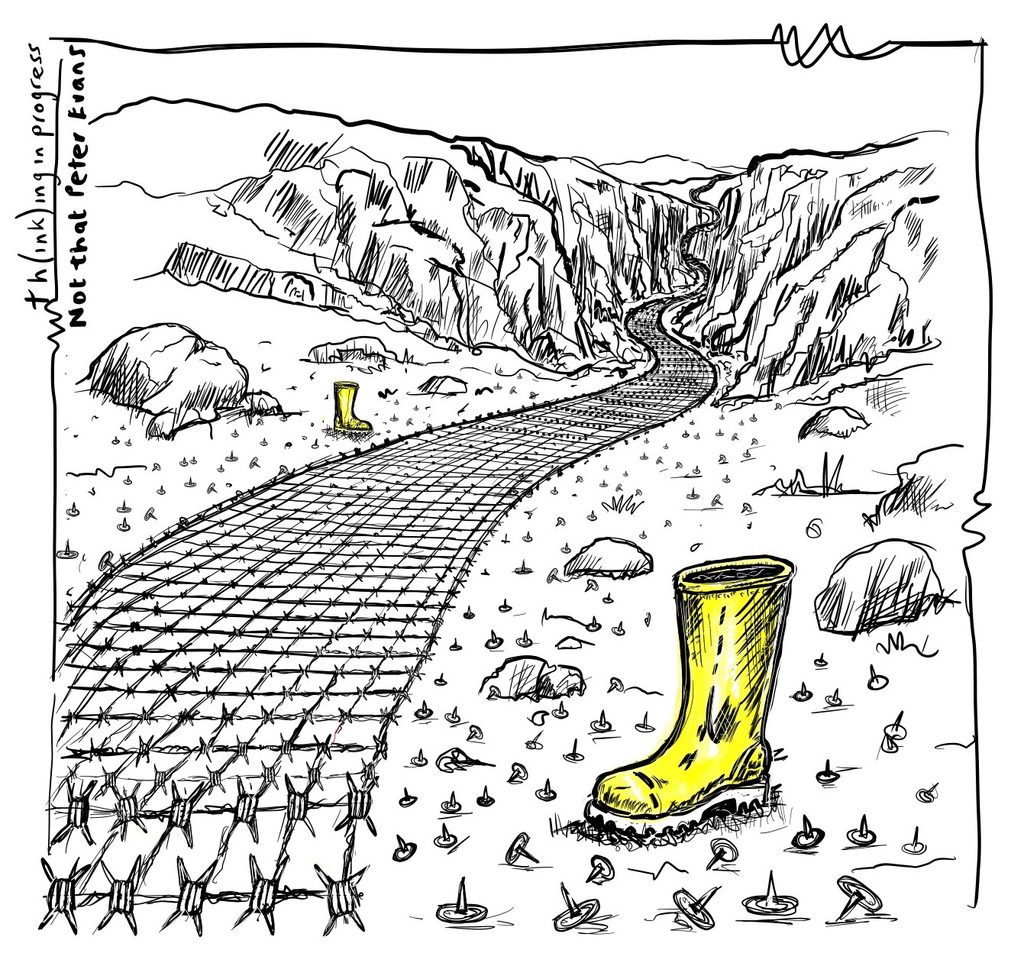
But in other corners of the world, patients with painful conditions remain woefully underserved. The standard of care in low-resource settings is worlds apart from what we would call ideal treatment. Estimates from 2020 showed that 84% of the world’s population lived in countries where opioid medications for pain control were not readily available. There is little hope of matching the type of pain to the best medication for that type of pain; across secondary and tertiary hospitals in Gombe, a rural Nigerian state, clinicians report having to use paracetamol and ibuprofen for all pain relief, including automobile accidents and even childbirth.6
For the Few, Not the Many
In some settings, suffering from a painful medical condition can be like a sentence to ongoing torture. This torture is far more common in low- and middle-income countries (LMICs) than in rich ones. 99% of children with serious health-related suffering are in LMICs. The lack of treatment for pain is especially common for the most severe types of pain, such as postsurgical and cancer pain. In Haiti, for instance, 99% of severe pain relief needs are unmet.7
Worldwide, the top 10% of countries by opioid consumption consume as much as 90% of all distributed opioids (converted into doses with the potency of morphine).
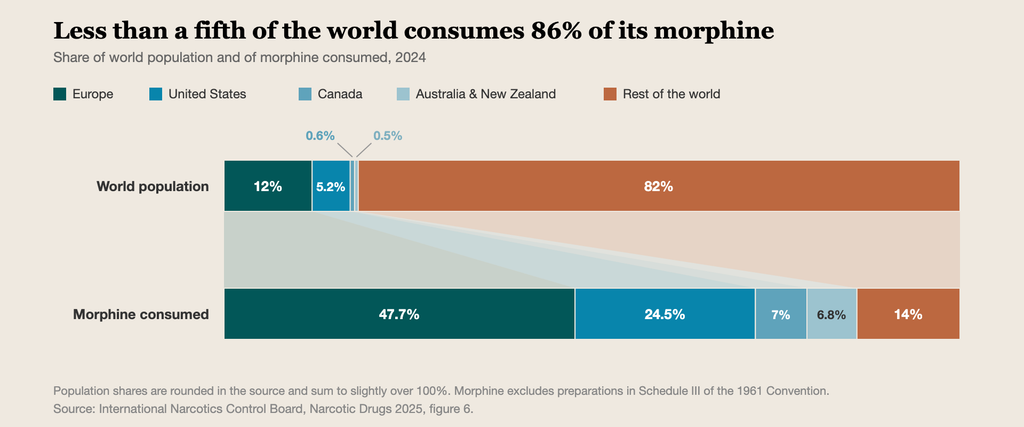
To put this into perspective, one paper estimates that the average yearly controlled opioid consumption is 32 mg per person worldwide, but Germans consume around 480 mg per person. Note that this is not due to Germans overconsuming opioids; it is simply that pain elsewhere is not treated.
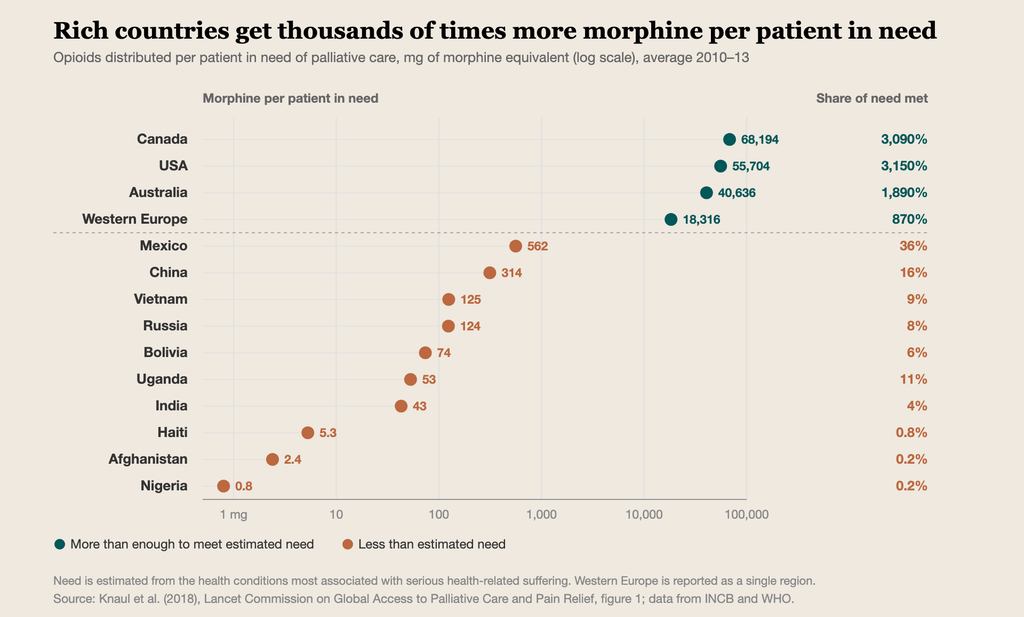
Many issues in global health and development can be boiled down to lack of money, but the lack of pain control is not one of them. Morphine is among the cheapest essential medicines out there; oral morphine for 10 days costs about the same as a loaf of bread. Instead, lack of pain management is driven by a fear of opioids’ side effects, accentuated by the opioid epidemic in the United States and the closely related War on Drugs.
Traditionally, clinicians have avoided using opioids as much as possible, as they can cause central nervous system depression. This reduces the rate of breathing and in doing so could potentially hasten death. As recently as 2012, a third of medical ethics educators in the United States believed this to be the case. However, while it is true that morphine and other opioids have a narrow therapeutic index, meaning that the safety margin for their use is fairly small, it is not true that they hasten death when correctly administered.
Doctors’ fears of overusing opioids have only increased with time. Opioids are addictive, and overuse is dangerous. The United States has experienced significant public health harm from the overprescription of opioids, with the opioid crisis peaking at perhaps 80,000 opioid-caused deaths per year. The start of the crisis was caused by the unscrupulous drug pushing of pharmaceutical companies for types of pain where opioids are not very helpful. In response, doctors became much more hesitant to prescribe. Indeed, doctors could even be prosecuted for overprescription.
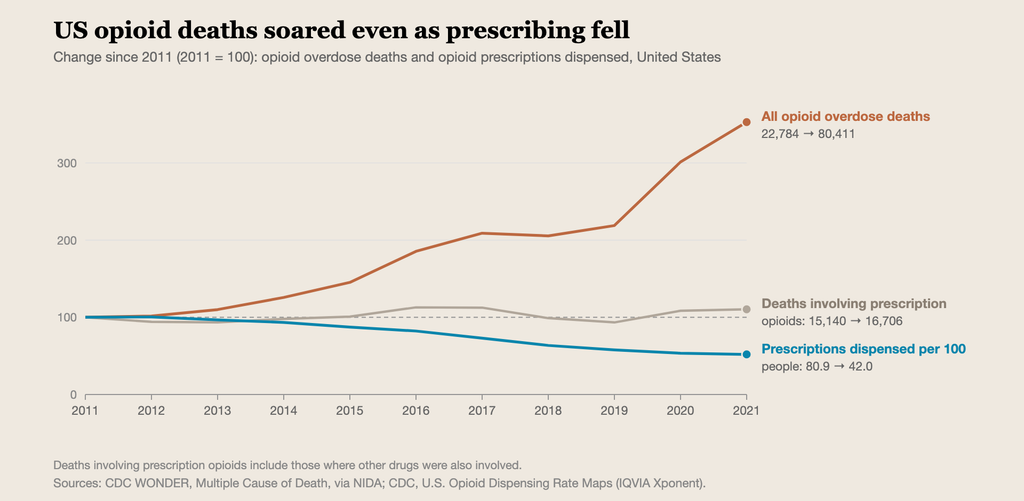
But while this first wave of the opioid crisis in the U.S. was driven by the prescribing dynamics of doctors, this was not the lasting mechanism for increased opioid deaths into the 2020s. Between 2011 and 2021, opioid deaths tripled, even as opioid prescriptions decreased by nearly 40% during the same period. Pain medication might have kicked off the epidemic, but it was not the lasting driver.
Still, fear of overusing pain medication became widespread. Some Iranian patients conceptualize their pain as divine intervention, while many other patients fear that relieving their pain would leave them addicted to the analgesics on offer. In Rajagopal’s own state of Kerala, doctors report that patients often reject palliative medicine. Fear, rather than cost-benefit analysis, drives medical decision-making.
It is true that prescribing opioid pain medications comes with risks. Estimates of the true rate of opioid use disorder as a consequence of prescribing are very heterogeneous. One study has estimated the prevalence of problematic pharmaceutical opioid use at 9.3% in patients with non-cancer pain, while other studies estimated the risk as 0.2% for individuals with no preexisting addiction issues. Even a 0.2% risk of addiction is not trivial, but it must be weighed against the harm of leaving patients in debilitating pain.
Crucially, opioid pain medication must be treated like all other possibly addictive pain medications — worth the risk in some circumstances, but not in others. Different cases require different approaches. And when opioids are used in end-of-life settings, there are fewer concerns about addiction — if a patient is dying, even addiction might be a reasonable choice to make the last few months of their life more bearable.
But despite these nuances, over time, regulation has tended to tighten restrictions on pain relief, further constraining who can access relief.
Restrictions begin at the international level. Countries must report their need for opiates to the International Narcotics Control Board before importing them. Unfortunately, countries often underestimate their own needs for opioids and fear being seen as lax on drug control. Thus, they rarely choose to deviate from their current level of imports — even if it is far too low. Furthermore, since pain medication is not seen as “lifesaving,” it is an easy place for governments to cut corners.
Prescribers are also severely limited. It is not uncommon for certain frontline practitioners who have prescribing powers, such as nurses, to not be allowed to prescribe strong pain relief. In such scenarios, it is a blanket ban — and not clinical judgment — that drives care.
The fear of diversion also often means clinicians can’t carry pain relief to the last mile. Instead, patients must go to a central medical store for pickup. In some areas, this can mean that patients in severe pain must travel for hours to get medication. In countries where there’s no access at the last mile — for instance Malawi, where rural clinics can’t stock strong pain relief — this can further increase the difficulty in obtaining proper medication, requiring people to travel for days to access care.
The pendulum on accessing opioids is starting to swing back now; the International Narcotics Control Board has acknowledged its overzealousness in cautioning against the use of opioids. Decades of regulations are difficult to untangle, though, and have lasting effects on clinical practice.8
In many countries, the bureaucratic procedures one must follow to prescribe opioids remain difficult to navigate, too few clinicians are allowed to prescribe and updates in regulation take too long to trickle down to clinical practice.
Instead, clinicians lean heavily on ibuprofen and paracetamol. However, these medications are only suitable for fairly mild pain; for postsurgical pain and cancer pain, they barely make a dent.
Most Suffering Is Unnecessary
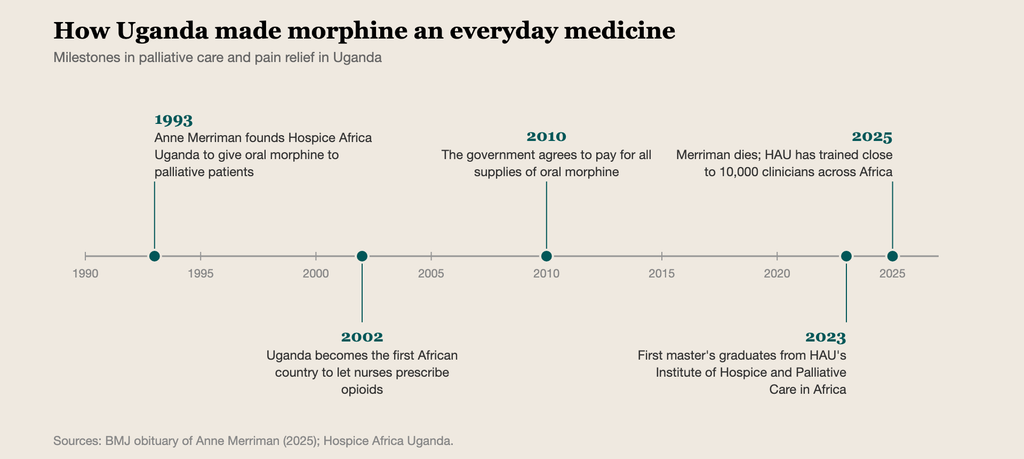
When medication makes it to the patient, alleviating suffering can be relatively straightforward. Dr. Anne Merriman, another well-known name in the field of palliative care, set up Hospice Africa Uganda (HAU) in 1993. She wanted to establish a community hospice service that would distribute oral morphine to palliative care patients.
Initially, this goal seemed impossible. When HAU was founded, it was not even legal to import powdered morphine. Merriman’s first win was lobbying the Ugandan government to allow the importation of powdered morphine.
Reconstitution of powdered morphine for administration is relatively simple; according to Merriman, it is “easier than baking a cake”. All it takes is powdered morphine, little bottles, a preservative and some food coloring to mark the strength of the resulting solution. And it is extremely cheap, meaning that enough morphine to support pain relief for a day can cost less than a dollar. By 2025, when Merriman passed away at the age of 90, HAU had treated tens of thousands of patients and trained close to 10,000 clinicians across Africa to reconstitute and administer morphine.
Alongside its direct work, HAU continued to lobby the Ugandan government to improve access to pain control through policy change. In 2002, Uganda became the first African country to allow nurses to prescribe opioids. In 2010, the Ugandan government agreed to foot the bill for all supplies of oral morphine.
Production also continued to improve. Those who were making the oral morphine in a kitchen sink in the early 1990s would have been shocked to know that today HAU has an automated morphine production unit that supplies all accredited Ugandan medical facilities.
Palliative care would also become a stronger part of the medical agenda in Uganda. Policies such as task-shifting, community outreach and setting up production units seemed to work well for Ugandan patients and would become a blueprint for other countries in the region. In 2023, HAU’s Institute of Hospice and Palliative Care in Africa had its first cohort of master’s students graduate.
Certainly, these low-tech solutions to plug opioid gaps are less interesting to pharmaceutical companies and philanthropists than developing new (and more profitable) drugs. But for decades, the medication development pipeline hasn’t produced much of note. Many efforts to work on specific “analgesic targets” other than mu-opioid receptors9 failed to deliver any results. The new drugs that have come on the market have often been developed for other ends and then repurposed, with little progress on purpose-developed non-opioid medications.10 Physicians have been stuck with opioids and a few non-opioid drugs — usually significantly less powerful than opioids — for pain management.
What Would It Take to Prioritize Pain?
Even in countries with excellent medication availability, progress in palliative care is often stuck for deeply human reasons: misconceptions, regulation, governance and lack of training. The barrier to good care is not medicine innovation but rather the lack of prioritization of pain control as a key part of treatment. Moreover, we need to change how people conceptualize palliative care. It is viewed as reserved for frail and dying people, which is perhaps why in the United States fewer than one in five young adults with advanced cancer get appropriate palliative care as part of their treatment.
Worldwide, most clinicians are still not properly trained in pain management and pain management specialists are very rare. Mozambique, a country of 35 million people, has just two physicians specializing in pain management. Zimbabwe, a country of 17 million people, has just two pain specialists. Pain management is often viewed as unimportant.
Unlike more easily measured conditions and health states, pain is difficult to quantify and measure due to its subjectivity. For philanthropies and policymakers, then, it can be difficult to make a case for grants to reduce pain. This is not helped by the fact that modern medicine tends to focus on cures rather than relief of symptoms, ignoring how much the latter can improve quality of life, even if the underlying disease is unchanged.
But properly managing pain can make a huge difference in quality of life. When my mother-in-law, a former nurse, was dying from amyotrophic lateral sclerosis (ALS) in Jamaica, she suffered debilitating pain from the disease’s effects on her nerves and muscles. Our entire focus became making her days (slightly) more comfortable. It took a long time to find doctors and nurses who’d prioritize her comfort and symptom management, but once we did, it was transformative. I will always remember how at peace she felt when she was finally in the hands of competent and caring professionals. We treasured that time; when she was able to relax in this way, she shared jokes and laughs with all of us. Other families deserve the same level of care, and the chance to find moments of joy with their loved ones.
To make this happen, identifying the right gaps at the national, subnational and bedside levels will be key. In some settings, the most pressing need will be addressing supply chain breakdowns for opiates; in others, it will be undoing aggressive scheduling and regulatory restrictions.
It likely won’t be that expensive, though. It would cost just $1 million to provide pain control to all the children in low-income countries who need palliative care; perhaps $150 million for enough morphine to reach all the patients who need it. Per capita, universal palliative care in lower-middle-income countries would cost under $1 per year. This is a very small amount and would be relatively easy for governments to cover, but the challenge of relieving pain remains deeply neglected by policymakers.
At the local level, some religious and charitable organizations provide places of respite for a handful of terminally ill people. Internationally, just a few organizations work on coordination and education. The problem’s multifaceted nature and resistance to being easily quantified should not detract from the need to increase funding and renew efforts to improve clinical attention to pain.
Progress will take time, as Rajagopal would come to understand as he sought to expand palliative care across India. But change is possible: in the more than three decades since Rajagopal started campaigning for better palliative care, his organization has made significant progress, including helping to amend the Narcotic Drugs and Psychotropic Substances Act for better access to pain treatment. Kerala, the state where Rajagopal practices, has essentially eliminated morphine stockouts. Other countries can make the same progress.
We should not condemn hundreds of millions to suffer; we must treat pain as seriously as we treat disease.
Morgan Fairless is Research Director at Ambitious Impact, a charity incubator. His team identifies and prioritises high-impact charity ideas across global health and development and animal welfare. His writing focuses on underappreciated issues affecting low- and middle-income countries.
If you have comments on this article, or wish to contribute to the discussion, please email them to letters@indevelopmentmag.com. Responses will be featured in a letters section.
- Rajagopal co-founded Pallium India and helped establish other palliative care centers. His efforts in palliative care have shaped policies affecting millions across Kerala and India as a whole. The modern field of palliative medicine itself only took its first steps in 1967 with the creation of St. Christopher’s Hospice in South London; when Rajagopal started his medical career in the 70s, the World Health Organization analgesic ladder — commonly used as a tool to teach clinicians how to address pain and breakthrough pain with escalating strength of medication — did not exist. It would not be introduced until 1986. ↩︎
- The International Association for the Study of Pain defines pain as “an unpleasant sensory and emotional experience associated with, or resembling that associated with, actual or potential tissue damage.” This consensus definition, which had previously remained unchanged for over three decades, now acknowledges that pain is not simply a measure of physical damage. Like all feelings and perceptions, pain is a complex experience produced by the mind. Nociceptors provide information to the brain, but that information is not pain in itself. The brain will take those stimuli and integrate them with context, memories and expectations to produce the experience of pain. ↩︎
- This is calculated using a set of conditions that cause pain and IHME’s Global Burden of Disease. As such, these could be a substantial underestimate if the set of conditions is not complete. ↩︎
- Aspirin would turn out to be the gift that keeps on giving. Due to its antiplatelet properties, it has turned out to be highly useful to prevent and treat some cardiovascular conditions. Nowadays, aspirin is a mainstay of preventative medicine. ↩︎
- In London last year, I was awestruck as I witnessed my wife cheerfully rank every opiate pain medication she’d been given in her palliative cancer care (her drug of choice was oxycodone, while fentanyl remains “overrated”). ↩︎
- I learned this through interviews with clinicians in a recent visit. ↩︎
- As per Knaul et al. 2018, “the amount of morphine-equivalent opioids distributed in Haiti is 5 mg per patient in need of palliative care per year, which means that more than 99% of need goes unmet.” ↩︎
- Prescription rules are particularly constraining in settings with few doctors or specialists. If nurses or other professionals are not allowed to prescribe, it can take too long to get a prescription set up. Changes in prescription rules interplay with professional identity and pride. In Malawi, updates to allow nurses to prescribe opiates were not initially adopted by the college of nurses. ↩︎
- The target of opioid medications. ↩︎
- There has been a recent bright spot – in January 2025, the FDA approved suzetrigine (Journavx). It is a first-in-class non-opioid drug. However, it is suitable only for acute pain and costs around $15/pill. ↩︎