Is anticipatory action the future of aid or an expensive gamble?
Setting the Scene
In Turkana, Kenya, the International Rescue Committee (IRC) spent six months preparing for a disaster that never came.
The eight-person team assessed feasibility and need, registered 1,300 households and monitored government forecasts for a drought or flood indicator that would trigger the release of funds to each household.
But the threshold was never met, so no cash went out. On paper, the program did nothing, and cost roughly $112,000.
So Was That a Waste or a Worthwhile Premium for the Option to Act?
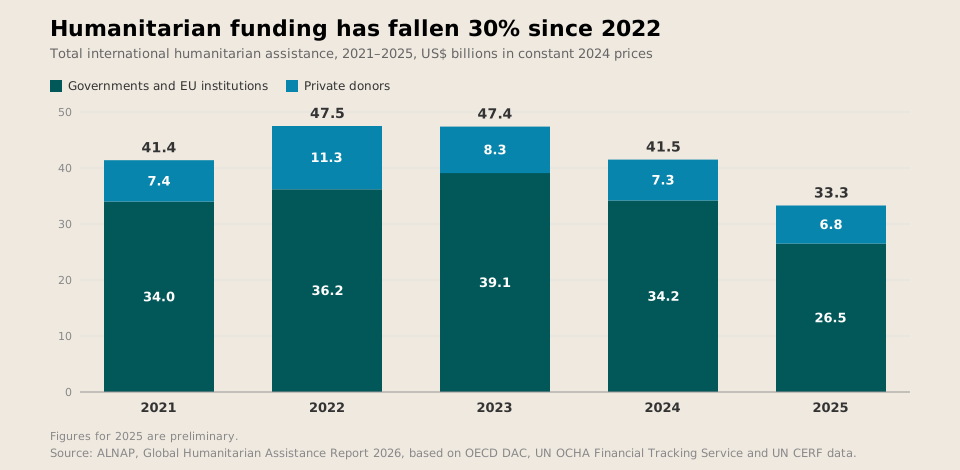
That question sits on top of a much bigger one. According to ALNAP, humanitarian actors moved an estimated $7 billion in cash and vouchers in 2025, roughly a fifth of all humanitarian aid. Very little is distributed before a shock — less than half a percent of humanitarian sector funding in any form1 is anticipatory.
Is waiting for a crisis to act the right choice? Maybe not. Crises are growing larger and more frequent, especially those driven by climate, while funding for humanitarian response continues to shrink.
Global humanitarian funding has declined in recent years.
In this environment, any way to stretch limited funding is valuable. The sector’s own answer is to act earlier to stretch money further. Supplies cost less to buy and move before a shock, and families can prepare for it rather than go into debt or sell off assets to cope. Had Turkana’s trigger fired, 1,300 households would have received cash while there was still time to buy additional food or take preventative measures to protect themselves and their livelihoods. In 2024, a negotiating group of donors and aid agencies called on donors to target at least 5% of their humanitarian budgets for acting ahead of shocks, a goal that largely2has yet to be achieved.
Shrinking funding may be what finally forces the rethink.
Humanitarian System Reform: A History
Against today’s backdrop, we think adopting new approaches to make the most of limited money should be a priority.
One of these approaches is anticipatory action — what the Turkana program was building. Anticipatory action expands on disaster risk reduction and early warning system developments dating back to the 1970s and was further inspired by World Bank insurance model innovations of the early 2000s.
Of course, the underlying idea of reading signs of a coming shock and acting in advance predates structured humanitarian aid. Kagunyu et al. note that pastoralist communities in Kenya’s drylands have long anticipated floods and droughts through their own early warning systems: animal behavior, flowering plants, cloud patterns.3 These communities prepare for the coming shock, but their ability to prepare is limited by their own resources.
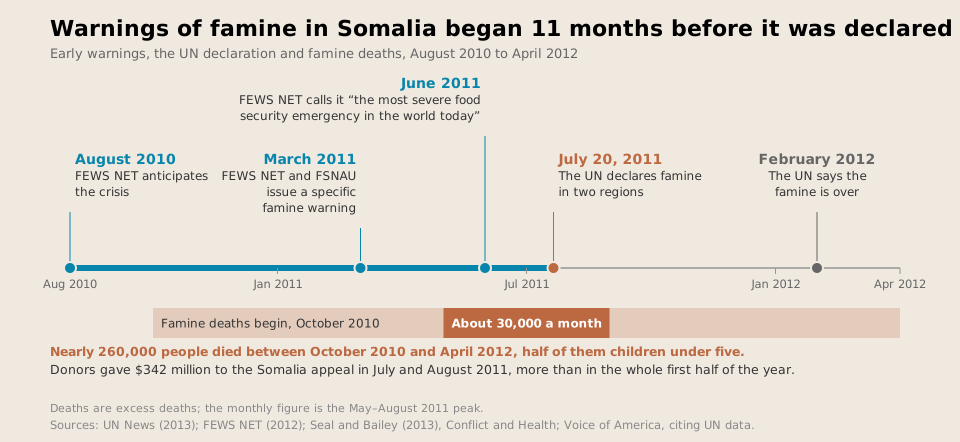
Humanitarian actors have far more resources. However, they have rarely turned early warnings into action. For example, forecasters issued “increasingly dire” warnings for 11 months before famine was officially declared in Somalia by the United Nations in July 2011. The international response largely failed to mobilize until after that declaration. According to the UN, this delay contributed to the famine’s death toll of nearly 260,000 people, half of them children under five years old.
In Somalia, warnings started long before famine declaration.
Anticipatory action tries to avoid this delay. Rather than wait for a disaster to strike before mobilizing relief, anticipatory action ensures resources reach households in advance of a shock. This is often triggered by a forecast crossing an agreed-upon threshold — for instance, a weather forecast showing a certain likelihood of flooding.
In practice, anticipatory action programs can vary a lot. A program can be lean and only begin investing in resources once a long-range forecast flags a likely hazard — or it can be something that requires much more investment and creates standing protocols and systems.
Across designs, though, anticipatory action changes both what a response costs and what benefits it delivers.
Anticipatory action has costs that traditional aid programs do not. Building and maintaining forecasts, triggers and delivery systems are real costs. But anticipatory programs allow households to buy and move supplies before prices spike and access is cut off. A Start Network rapid evidence assessment finds that early action can be cheaper than reactive aid for this reason.
Benefits can be significant. When families receive cash before a crisis, they can react better. They can move themselves and their families away from a natural disaster before it hits, prepare for a storm or flooding or buy what they need before prices climb. This can help families protect their livelihoods and keep the assets they would otherwise sell to survive. But a “wrong” forecast, where the trigger activates but the hazard never arrives, can mean anticipatory action pays out to non-impacted households. This can be seen as a waste of money and is not a problem in traditional humanitarian response, where transfers wait for confirmed need.
Anticipatory Action: The Evidence, As We Know It
There are some circumstances where anticipatory action is helpful and some where it is not. Unfortunately, the debate on anticipatory action is decidedly less nuanced than it should be. Depending on whom you ask, anticipatory action represents either the future of aid or an expensive gamble. Proponents see a smarter, faster and more dignified model. Skeptics see money wasted paying out on forecasts that don’t come to pass — or, as in Turkana, programs that have been set up but never trigger.4
According to the Anticipation Hub, anticipatory action activations roughly tripled from 2022 to 2025, reaching over 9 million people across 54 countries last year. But despite being around for over a decade, research exploring the cost-effectiveness of anticipatory action continues to lag. The IRC has been working to close that learning gap.
Though there is still much to learn, these programs and evaluations helped us develop much-needed heuristics to understand whether and how anticipatory action can maximize humanitarian cost-effectiveness.
1. Context determineswhatanticipatory action can do, not just how well.
A Mercy Corps synthesis argues that anticipatory action can serve two different purposes: (1) act as earlier aid, providing the same welfare gains as post-shock assistance and (2) let households protect productive assets and livelihoods before a shock closes off options.6
There can be limits to that second option, though. We conducted the first-ever randomized controlled trial of anticipatory action cash transfers in Afghanistan in drought-plagued Badghis Province in 2025. The IRC randomized whether households received a single cash transfer before the harvest season or two smaller transfers (with the same overall amount), one before and one after. All families in the program were suffering; a trifecta of near-total harvest failure, cross-border restrictions that cut off seasonal earnings and sudden withdrawal of humanitarian funding left households with almost nothing to fall back on. By endline, around 94% of households that received a cash transfer reported no income at all.
The cash was a lifeline. It helped families meet some of their immediate needs and avoid new debt; for many, it was the first assistance they’d received in roughly a year. Delivering the transfer as a single payment (before the shock) generally left families relatively better off than splitting it in two, but the average household in both treatment arms began and ended the study as “food insecure.”7 Anticipatory action could help blunt the impact of a shock, but it could not restart the wider economy and restore incomes. In a context this fragile, anticipatory action can be but one component of recovery.
The IRC was not alone in finding this — a qualitative Save the Children study across drought-impacted areas of Kenya and Somaliland also indicates that livelihood-protecting anticipatory action is unlikely to be enough on its own in a protracted crisis. For this reason, the study recommends layering anticipatory action with conventional humanitarian aid for the hardest-hit households.
2. The cheapest anticipatory action system is the one you don’t build from scratch.
Anticipatory action relies on forecasts and the ability to move money fast. These systems can be very costly to build but cheap to reuse.
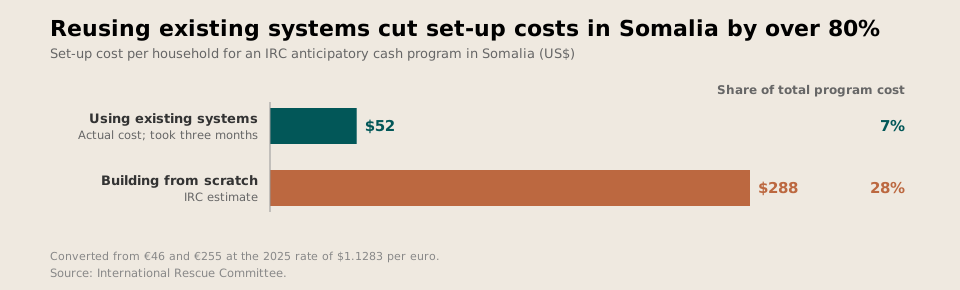
In Somalia, we layered our program onto resilience and early-warning systems already in place.8 As a result, setting up the program cost roughly $52 per household and took three months. It would have cost an estimated $2889 per household to build the same capability from scratch. We estimate that use of preexisting systems lowered the set-up costs from 28% of total program cost to 7%.
Reusing existing systems reduces setup costs.
We were certainly not the first to work with existing systems. When the World Food Programme delivered forecast-triggered cash ahead of Bangladesh’s 2020 monsoon, it relied on widely used mobile money channels; during Nepal’s 2021 floods, the Nepal Red Cross Society routed cash through the government’s Social Security Allowance system.
But our Somalia research program is among the few to quantify this reuse dividend, as well as to note that “working with existing systems” isn’t the same as “free.” Where a system already exists like in Somalia, this can be a powerful model.
When systems don’t already exist, the sector defaults to a “build” and “fuel” model. Under this model, the humanitarian actor invests up front in standing up frameworks and triggers from scratch (“build”) then releases money to households (“fuel”) when a trigger fires. But for many organizations and contexts, an up-front investment can be hard to justify, difficult to finance10 and time-consuming to establish.11
A leaner approach, e.g., standing up a hazard-specific contingency plan once a long-range forecast flags a high-probability threat, may help12 stretch resources further and respond faster.
This is what we did in Guatemala: free long-range forecasts from Columbia University’s climate institute flagged a high-probability flood season four months out; the open-source GloFAS flood platform pinpointed when to trigger; and cash and early-warning texts moved through a bank and a messaging platform we already worked with. The only thing newly built was our contingency plan, which spared us the cost of building our own trigger mechanism.
3. Fast action runs on patient money.
The two lessons above assume funding that (1) persists between shocks and (2) can move on a forecast. But the humanitarian system currently runs the other way around: it releases money once a loss has already occurred and been formally recognized (e.g., via a famine declaration or an emergency appeal). Under current rules, most humanitarian funding runs on an annual basis (or shorter) and is often tied to a donor fiscal year and specific geography. Many donors now say they want to act before a shock, yet the funding landscape does not reflect this. Some donors’ financial rules even prevent them from directly disbursing ahead of a shock at all.13
Increased use of two funding structures could help change this. Multiyear funding lets up-front investment pay off when spread across seasons: build once and activate across multiple forecasts. Pooled,14 flexible funding can do most of the rest: release money on a forecast, move as the forecast shifts and spread the risk of a trigger not firing across multiple seasons. Our German Federal Foreign Office funding spanned several countries, which let us work more probabilistically across them. When Turkana did not have a drought and the Kenya trigger didn’t fire, that money wasn’t “stuck” but could instead go where the need was.
Neither of these funding structures is new. The IRC’s own research on multiyear, flexible funding demonstrates how they lower administrative and cost burdens for both donors and implementers. Self-reporting indicates that in 2024, 14 of 22 donors gave more than 30% of their humanitarian funding as multiyear grants, up from 10 donors in 2023.
Where We Go From Here
The team in Turkana prepared for a trigger that never came. As a standalone project, it can seem like money spent on nothing. But judged as a part of a system — one aimed where hazards recur, based on data and delivery systems that span seasons, and funded to act in advance — it looks like a premium on an insurance policy: one worth paying where hazards recur and hard to justify where they do not.
And even an unactivated trigger can leave something behind. In Turkana, we trained partners in household-economy analysis (a method for estimating what a given shock will cost a household and how much of it they can absorb) and tested new forecast methods. The experience helped reshape how we work, too — concentrating set-ups where forecasts are more likely to trigger.
The real question isn’t does anticipatory action work, but where it fits, what it’s built on and how it’s funded to last. If we get that right, anticipatory action could be one of the more promising innovations in the redesign of a multibillion-dollar humanitarian response system. Get it wrong, and it’s a multibillion-dollar bet that will never pay out.
The authors thank Clare Clingain and Mikaela Cochran-George for the research and analysis underpinning this article and Emily Barnes, Ben Excell, Miles Murray and Anneleen Vos for their technical review. Any errors are our own.
Justin Labeille is a Senior Director at the International Rescue Committee’s Airbel Impact Lab, where he leads the Best Use of Resources team. He previously directed cost-effectiveness evaluations at GiveWell and Giving Green, and held global research and policy roles at Living Goods, Innovations for Poverty Action, and J-PAL.
Paige Kirby is a Senior Advisor at the International Rescue Committee’s Airbel Impact Lab, where she works to change how funders use cost evidence. Previously, she led work on economic resilience and sovereign debt at USAID, managed foreign assistance budget execution, and worked in policy and applied research at Development Gateway and the OECD.
If you have comments on this article, or wish to contribute to the discussion, please email them to letters@indevelopmentmag.com. Responses will be featured in a letters section.
Anticipatory action spans modalities, including cash and in-kind aid, and covers response to a range of hazards, including climate, health and conflict-related shocks. In this article, we’ll primarily focus on cash transfers for climate-related shocks. ↩︎
The main exception to this is Germany, a donor which has set (and met) its own quantitative 5% target. ↩︎
From this, as Derbyshire et al. note, an open question remains whether anticipatory action’s data-driven triggers build on — or around — that knowledge. ↩︎
Note that learnings from Turkana have informed an agile IRC approach that has been activated six of seven times. ↩︎
Afghanistan, Chad, El Salvador, Guatemala, Iraq, Nigeria, Somalia and Kenya. ↩︎
Each household received roughly $244 in total, constrained by the size of our funding envelope. With a fixed budget, implementers often must decide whether to transfer more money to fewer households or transfer less money to more households — and in this case, we chose the latter. ↩︎
Through the Building Resilient Communities in Somalia (BRCiS) consortium, funded by the UK Foreign, Commonwealth & Development Office (FCDO). ↩︎
In original currency, EUR46 and EUR255 — flipping 0.8862 2025 exchange rate used here to be 1.1283 EUR to USD. ↩︎
This type of model can also leave gaps in areas where no framework exists but climate shocks still occur. In Afghanistan, for example, the UN’s 2025 Humanitarian Needs and Response Plan anticipatory action framework was limited to northern areas. ↩︎
The six- month-long Turkana program set-up sounds lengthy but was actually quite quick by anticipatory action standards! ↩︎
Cost savings from such an approach would come by assembling readiness from preexisting parts, though we can’t yet say whether this approach beats build and fuel on cost-effectiveness. ↩︎
DG ECHO’s anticipatory funding reaches NGOs largely through pooled structures rather than direct grants. In 2024/25, the body commissioned a study whose objectives included analyzing ECHO’s legal and administrative frameworks and assessing the feasibility of a dedicated instrument to finance the fuel component of anticipatory action. ↩︎
Pooled financing is where several donors contribute to a shared fund that disburses against agreed criteria, rather than each donor individually disbursing their own grants to implementers. ↩︎
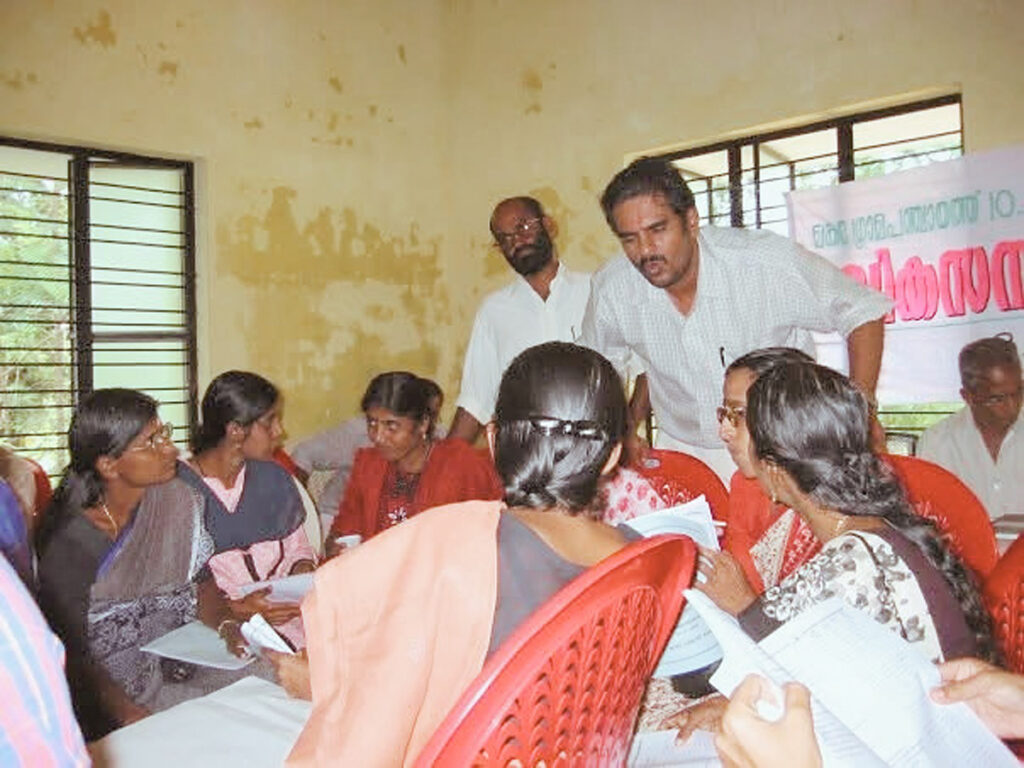
In 1992, India amended its constitution to create some 250,000 elected village governments covering roughly 800 million people — the largest exercise in democratic decentralization in human history. The effects of this 73rd Amendment have varied enormously across states. In Kerala, an extraordinary People’s Campaign in 1996 created a system of nested participatory planning. Street-level groups deliberate on their needs, which are passed on to a ward-level assembly, then percolate upward to a village assembly where all expressed needs are prioritized and matched with budgets. Over the course of the year, the agreed-upon projects are implemented and monitored in active collaboration with citizens.
Neighborhood meeting (Ward Sabha) in Kerala, 2003. Photo by Vijayendra Rao.
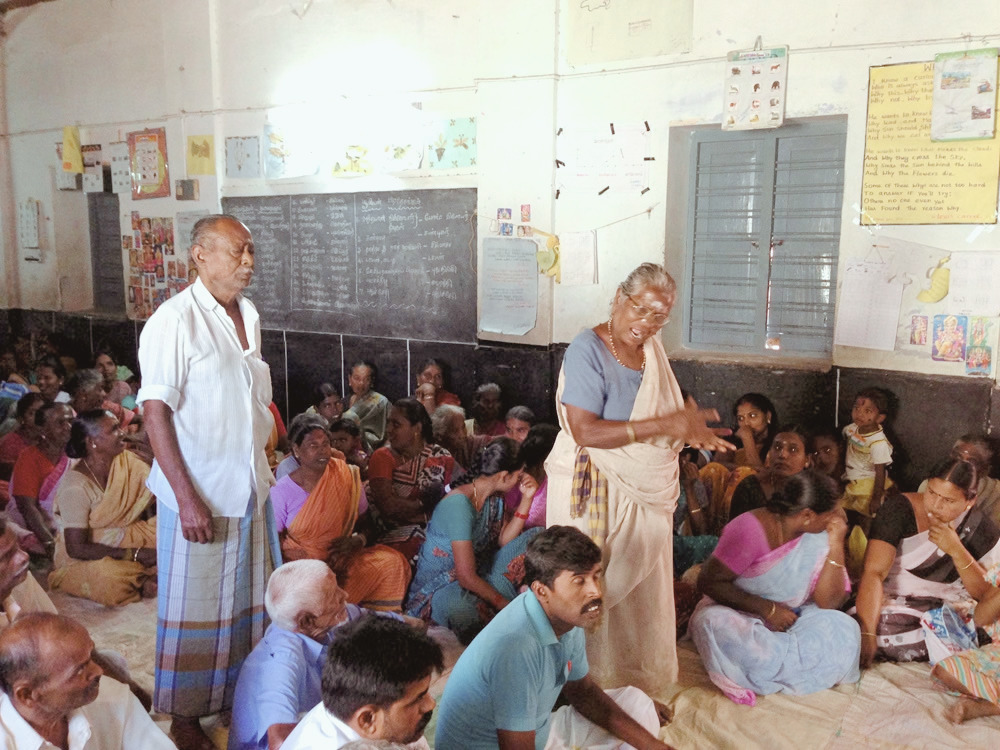
In other states, the same assemblies, created by the same amendment, are ceremonial rooms where nothing important is decided. In the 300 village-meeting transcripts that Paromita Sanyal and I analyzed for “Oral Democracy,” we found that differences in literacy, caste or wealth inequality did not explain how well these village assemblies worked. They were driven by whether the state government actually wanted decentralization to work – whether it devolved real money and real authority to the assemblies. The same constitutional amendment produced very divergent realities.
Gram Sabha in Tamil Nadu, 2012. Photo by Vijayendra Rao.
But understanding this divergence in the quality of deliberation has not been prioritized by mainstream economists and policymakers — because it would be a measure of process. Over the last century, the policy options on offer from economists for tackling poverty and inequality have overwhelmingly been focused on outcomes — resulting in what I call outcome-policies.
An outcome-policy manipulates the levers of government — transfers, taxes, expenditures, regulations — to hit a target and is judged by whether it hits it. Conditional cash transfers are judged by whether children stay in school; estate taxes by whether they improve intergenerational mobility; health insurance by its effects on health and hardship.
Outcome-policies are tied to metrics, which is much of their appeal. When the politics are favorable, they are relatively easy to enact by legislative or executive action. They are also easy to reverse.
A process-policy is a different animal. It tries to change how change happens: to equalize power in how decisions get made, each increment building on the last. Its proximate effects are subtle and hard to measure, and its full impact takes years to show. Precisely for those reasons, changes from process-policies tend to last longer than those from outcome-policies. Process policies change the machinery that produces outcomes rather than the outcomes themselves. Constitutionally protected deliberative bodies, participatory budgeting systems, adaptive systems of implementation — these are process-policies.
In the essay that preceded this one, I argued that development economics research has built a wall between itself and the people it studies. Policy has the same distance problem that research does, but the stakes are higher, because policy can directly and substantially affect people’s lives at a scale that research cannot. The distance, though, is not just a matter of bad implementation. It is built into the frameworks we use to think about what policy is.
The Three Dominant Ways of Thinking About Policy
Policies for welfare, growth, inequality and poverty are conditioned by three broad paradigms, all mostly derived from economics.1 All three are outcome-oriented at heart.
The neoliberal paradigm starts from deep skepticism that social science can understand complex human interaction well enough to engineer a better world. So it falls back on first principles: laissez-faire markets, free trade, human rights, electoral democracy. Free markets deliver growth; elections keep governments honest. The proponents of this paradigm have some empirical evidence for this: over the long run, democracy may indeed cause growth, and there is evidence that growth is an important determinant of poverty reduction.
This is the view that underlay the Washington Consensus of the 1980s and 1990s. Its answer to poverty is to maximize growth and equalize access to human capital, and there is something to it — but the effect of growth on poverty depends on how unequal a place is to begin with, and there is strong reason to believe that neoliberal policies increase inequality and erode social support. This can be by, for instance, creating opportunity markets that commodify access to basic needs like education and housing. Also, note that the largest reduction in poverty happened in China, which is not a democracy and grew and reduced poverty by making policy adaptively and experimentally, adjusting as it went.
The deeper limitation of neoliberal policymaking is disciplinary. Rational-choice individualism has no comfortable place for social exclusion or cultural and political inequality, so every socially driven argument — for gender equality, for social cohesion — has to be smuggled in through a growth prism. (Hence the slew of 1990s papers arguing that women’s education is good for GDP.) Welfare gets measured in income and consumption and poverty becomes a line denominated in dollars and cents, and a large survey industry exists to determine it.
The neo-Keynesian paradigm is the counter. Markets fail — through externalities, information asymmetries, market power — and the social sciences can tell the state how to correct them. Growth still matters, but there is acute awareness that markets do not deliver basic services to the poor and that discrimination is systemic. Household surveys now collect data on gender, religion, race and caste; equality of opportunity is a stated goal, backed by law and affirmative action.
The result is the intellectual justification for interventionist government — the London Consensus is the most recent comprehensive statement of this, with its slate of minimum wages, progressive property taxes and public investment in everything from infrastructure to nutrition. Along the way, the paradigm has developed a deep knowledge of government failure and clientelism. But even as it has sought to understand government failure, it does not seek to fix it through process. Instead, it builds on expert diagnoses by economists and social scientists — the state corrects, the citizen receives.
The third paradigm — neopaternalism2 — is arguably a more stringent extension of the second, and it has exploded in influence over the last two decades. It starts from the opposite end from neoliberalism: an abiding faith in the power of social science and data — behavioral experiments, randomized trials — to give direction to policy.
It takes its cues from public health, with a firm commitment to “evidence-based” everything. Its behavioral foundation is the research on scarcity: the poor face such punishing constraints on time and attention that they are steered into suboptimal choices, so the freedom to choose means little when the ability to choose is itself constrained. That is the justification for the top-down push — the nudge — away from actions, norms and practices that the policymaker has determined are harmful.
I want to be fair to this world, because it is the one I have been surrounded by and worked in for decades, and its advantages are real. The trials generate vast amounts of data about the conditions of the poor, well beyond income and consumption. They create a culture in which policy has to be justified with evidence rather than hope or idealism. And they weed out the bad intervention ideas.
But the disadvantages of this model of the world have been well catalogued, and two matter most here.
The first is overreach: policy driven by the demands of scientific technique rather than technique driven by the needs of policy — the tail wagging the dog. If all evidence must pass through a randomized trial, interventions that cannot be randomized disappear from the menu. And because a good trial needs good implementation — a messy rollout contaminates the design — trials effectively assume away what Albert Hirschman argued 60 years ago is the central problem of development policy: the complicated process by which ideas become action on the ground.
The second is context. An intervention that works in one place may fail in another. The randomizers’ answer is to run trials across many settings and at much larger scale, which works for simple interventions but breaks down for complex ones — the interventions tailored for, and especially by, communities, where designs vary too much for any sample to have adequate statistical power.
So neopaternalism drifts, by the logic of its own tools, toward interventions that are simple, uniform and predictable. It is a paradigm far more comfortable with certainty than with reflexivity. Culture enters the analysis as a set of “traits” to be scored good or bad; the study of social life becomes part of the expert’s apparatus for nudging people toward welfare as the expert defines it. Nobody asks the poor what they want. And it is not a rhetorical flourish to say that. It is a fairly precise description of the method.
As I write, British and American aid budgets have been gutted, and two economists I respect — Rachel Glennerster and Dean Karlan, who served as chief economists of the two countries’ aid agencies — have jointly responded with a call for “radical simplification”: take what money is left and spend it on a short list of proven, cost-effective “smart buys” — malaria nets, nutrition supplements, structured lesson plans, cash transfers — at large scale, shorn of the complexity that makes programs “expensive to design, hard to manage, and almost impossible to evaluate.” They have a point, up to a point.
Mission creep is real, and it is often driven by donors, as anyone who has watched a project buckle under the weight of a phalanx of consultants knows. Reducing mission creep and focusing on what you meant to do in the first place has value. But look at the third item on their charge sheet. “Almost impossible to evaluate” is a statement about the evaluator’s preferences and their expert-driven worldview; it prompts the question of “evaluable by whom?”
When the menu of interventions is restricted to what a randomized trial can certify, it fills up with simple, uniform, predictable interventions, and the complex policies with subtle effects and unpredictable trajectories — which can displace the steady state and shift to a better development path — gradually fall off it. But many effective programs are not simple and they can take decades to bear fruit. Indeed, it would be impossible to price the net gain per unit.
But consider who paid for these programs. The policy reforms of Kerala were not financed out of the bilateral aid budgets (now being gutted); they were political projects of Indian state governments, built (largely) with domestic money and domestic legitimacy. The principal financier of process-policy is (often) the national state, not the donor.
Radical simplification may be a good way to triage for shrunken bilateral aid budgets, but it can say much less about what governments and multilateral institutions should do with their own budgets.
Seeing Like a Policymaker
Why do three paradigms that disagree about almost everything else converge on focusing on measurable outcomes?
James Scott’s “Seeing Like a State” showed why: states can only govern what they can “see,” so they work hard to make society “legible” — standardized categories, uniform measures, administrative grids.
There is nothing inherently wrong with this. Without legibility, there is no taxation, no public health, no welfare state. But the categories are not just descriptions; they are instruments that remake the world in their own image. And what gets stripped out along the way is what Scott, borrowing from the Greeks, called métis (common sense). This is practical, local, experience-based knowledge, provided by those who know the area and the place.
His examples have become famous. German foresters replaced messy, diverse woodlands with neat rows of Norway spruce that could be counted and taxed. Brasília’s grid-based urban structure, shaped like an airplane, replaced the messy reality of settlements that grow organically.
Legibility is all over the policy world. A market price is legibility: it compresses a tangle of preferences and systems of production into a single number. A poverty line is a legible expression of poverty — which is a complex, multidimensional experience. Randomized control trials are also an exercise in legibility — making behavior legible by stripping away context and subjecting lives to a treatment variable.
None of the above paradigms disagree about legibility. They argue only about who should make the policy — the market, the ministry, the experimenter.
And none of them ask the people, who are ostensibly the beneficiaries of the policy. The outcomes may be legible, but there is little effort to make them legible to those the policy affects. Seen from this angle, radical simplification is not radical at all — it is the neopaternalist paradigm’s default option made legible by a budget crisis. In some ways it represents a return to the expert-driven, top-down vision for policy that organizations like the World Bank were criticized for pushing on the world in the 1970s and 1980s.
Elections Are Not Enough
All three paradigms have the same problem — who checks the policymakers? All three paradigms also have the same answer: democratic electoral accountability.
Neoliberals and neo-Keynesians lean on universal franchise to keep governments aligned with citizens’ interests. Neopaternalism leans harder still: Cass Sunstein’s libertarian paternalism is explicitly premised on democratic constraints keeping the nudgers benign.
But the electoral check is not perfect. Elite capture and clientelism are pervasive. Democratic backsliding is relatively common. And we now live in an age of surveillance capitalism, in which the capacity to track people with extremely precise data threatens to delegitimize democratic processes altogether. If the ballot box is the only check the three paradigms recognize, then as the ballot box weakens, so does the legitimacy of the entire policy edifice built on top of it.
Jeep used for a village council election campaign, Karnataka, 2003. Photo by Vijayendra Rao.
This is not a problem confined to poor countries. The question of who checks the policymakers is becoming urgent everywhere — from the United States to Hungary.
Meanwhile, civil society is not limited to the ballot box. Across the world, at every level, people have organized themselves into bodies that monitor power between elections — what John Keane calls monitory democracy: citizen committees, self-help groups, minipublics, social audits, watchdog NGOs. Such forums sometimes emerge organically, but they can also be created: development organizations have spent hundreds of billions of dollars inducing participation.3
These institutions exist even in authoritarian settings. In rural China, citizens’ groups working with sympathetic civil servants have built accountability without democracy inside systems of authoritarian deliberation. In other words: a paradigm of action that runs on process rather than outcomes already exists. It is time to give it a name and a description.
Reflexive Policy
I call the fourth paradigm reflexive policymaking. Reflexive is used in the sense the word carries in sociology and anthropology: a reflexive practice is one in which the professional treats the boundary between herself and the people affected as a problem to be worked on, not a wall to be maintained.
The idea is a close cousin of Robert Goodin’s reflective democracy: an effective democracy has to cultivate its citizens’ capacity to “deliberate within,” to run other people’s situations through their own heads. Deliberating within is what makes cognitive empathy possible at all. The policy challenge is to produce it at scale: to redesign decision-making so that politicians, officials and citizens develop cognitive empathy for one another, horizontally and vertically.
Grand as that sounds, the practice is concrete, and pieces of it are operating all over the world. Four processes recur.
The first fills in the blank space between elections with continuous dialogue between citizens and governments — deliberative systems anchored in some officially sanctioned civic space, a forum or a regularly scheduled public meeting, where an ordinary citizen can directly influence the decisions that bear on her life. Forums alone are not enough; they have to sit inside a culture of dialogue in which speaking and listening become everyday practice. That is what Kerala built, and its neighbors did not.
The second equalizes power in decision-making directly, by giving voice to disadvantaged groups — and, more radically, by reserving seats for them, as India has done for women and lower castes in its village governments. Reservation is itself an admission that deliberation carries no automatic guarantee of equity — an all-male council can ignore women’s concerns, and a government run by upper castes may ignore the concerns of lower castes, no matter how many times they are brought before them.4
Process-based policy does not assume that people will always govern justly; rather, it claims that for a government to be legitimate, it must be more directly run by the governed. They are better placed than the experts to define the problems about which they have more information and are better placed to address them; having citizens determine foreign policy is obviously not optimal, but having them run local schools is.5
Village council president, Ujjire, Karnataka, 2003. Photo by Vijayendra Rao.
The third builds feedback loops, within government and between government and citizens, so that decision-making becomes adaptive: try, learn, adjust — instead of design, implement, evaluate, stop.
The fourth uses technology to give people control over their own data, to strengthen collective action and equalize access to public services rather than to surveil. The current excitement about AI-mediated deliberation falls under this category too, with this caveat: use the machines to scale our ability to listen and learn, not substitute for it.
The Sandwich
The capacity to participate is not something that communities alone can control. It is a political relationship spread across three layers.
There has to be a responsive state at the top, with the political will to devolve real power and the fiscal capacity to back it with real money. There has to be a motivated and organized citizenry at the bottom — cohesive enough to act collectively and deliberative enough to work through disagreement. And there has to be a working middle: the district office, the field facilitator, the state ministry — an intermediary tier that translates citizens’ voice upward, and the state’s authority downward, thereby protecting local citizens from having their interests captured by local elites. Ghazala Mansuri and I, borrowing from Jonathan Fox, called this the “sandwich” in “Localizing Development.”
Every case of process-policy that works at scale has all three layers, and every visible failure has a hole in one of them. This is the pattern that Mansuri and I found in reviewing the evidence on participatory development, which has a large, mixed and often disappointing record. What was clear, however, was that the successes and failures could be explained — where the top was missing, participation degenerated into empty consultation, and the community meeting became a place for cheap talk. Where the bottom was thin, collective action became difficult to organize. Where the middle was broken — and in many countries the middle is the weakest layer — elite capture became much more likely and even well-designed policy harder to deliver.
This, in retrospect, provides insight into why so much donor-induced participation has disappointed. Donors build the bottom — generally the cheap layer, the one you can deliver on a project cycle. But they skip the political work at the top and the institutional work in the middle. A sandwich with one layer is not a sandwich — and the whole thing fails.
Kerala, to return to the opening puzzle, is what it looks like when a state builds the whole sandwich. The People’s Campaign organized the bottom, while the ruling coalition supplied the political will and intellectual direction for the top layer. And it did one other thing: it staffed and funded the cadres in the middle. Participatory planning works in Kerala because the street-level groups feed into the ward-level assembly, which in turn informs the village assembly. Each layer of the sandwich is linked in a feedback loop with the others.
The sandwich applies everywhere. Indonesia’s Kecamatan Development Program (KDP) began in 1997 as a pilot in 48 villages, having been designed by the anthropologist Scott Guggenheim and colleagues in Bappenas, the Indonesian planning ministry. It grew out of an ethnographic study of how Indonesian villages organized themselves, which found that the culture of gotong royong (mutual assistance) in Indonesia created village-level institutions with a much greater capacity for durable collective action than the user groups that projects kept creating.
Mosque built with gotong royong in Kalimantan, 2005. Photo by Vijayendra Rao.
Its design was not dissimilar to Kerala’s People’s Campaign. Block grants went directly from the central government to the kecamatan, the subdistrict. From the neighborhoods and hamlets up, villagers deliberated on proposals and sent a delegation of at least six representatives, three of them women, to an inter-village forum where they, drawing on gotong royong norms, deliberated and voted on which proposals to fund. Once the forum decided, nobody higher up could alter the decision. Facilitators recruited from NGOs and the private sector took the information and worked with village organizations to implement the agreed-upon plan, circumventing the village head’s tendency to capture such decisions. As Guggenheim puts it, the state’s job was to do less rather than more: keep the money moving, audit it and stay out of local decision-making.
That is the sandwich. Reform-minded bureaucrats in Bappenas and the Ministry of Finance at the top, with the World Bank supplying money and air cover. A tier of trained facilitators in the middle. And at the bottom, villages with long traditions of collective action and their own ways of managing and implementing a common fund. The layers of the sandwich held long enough for norms to shift. KDP reached 2,000 villages by 2002, 6,000 by 2006, when it was renamed PNPM Mandiri, and 60,000 by 2011. In 2014, Indonesia turned it into the Village Law, which made a block grant to all 75,000 villages a permanent entitlement in the national budget. A donor-supported experiment became a permanent part of the state.
Meanwhile, Brazil’s Porto Alegre is an example of the reverse. Its participatory budgeting was a celebrated case of citizens directly deciding how public money gets spent. But after the Workers’ Party (PT) lost the mayor’s office in 2004, the project was largely dismantled. The bottom was still there; the top lost interest, and the middle was rendered ineffective. This is why reflexive policy requires donors, organizers, politicians, bureaucrats and citizens working together long enough for norms and expectations to shift and reach a sustainable equilibrium.
A Revolution by Stealth
Consider Jeevika, the rural livelihoods program launched in 2006 in Bihar. The state was then, by almost any measure, the hardest place in India to attempt anything of the kind. Rural poverty stood at 55.7% against a national average of 41.8%. Per capita income was a third of the national average. Only 37% of women were literate, only 1% had access to microcredit and two-thirds of rural household loans came from moneylenders charging 100 to 200% a year.6 Alleviating rural poverty in this context would be a tall order.
Furthermore, Bihar was a difficult, highly unequal, patriarchal and caste-ridden context. Into this, Jeevika introduced something deceptively modest: self-help groups (SHGs) of 10 to 15 women, meeting weekly to save and lend among themselves, subsequently federated into village organizations and cluster-level federations. Shruti Majumdar, Paromita Sanyal and I spent four years doing qualitative fieldwork (embedded with a randomized control trial that ran for 18 months) on how the project worked between 2010 and 2014. This fieldwork became our new book, “Revolution by Stealth”.
Jeevika offered cheap credit, insurance and income generation, with no language of women’s rights or resistance anywhere in sight.7In a short period of 18 months, the program refinanced 28% of household debt into SHG loans that charged a much lower interest rate of 24%, undercutting the previously available interest rates by 150 percentage points or more. There were also “general equilibrium” effects — competition from Jeevika reduced the rate charged by moneylenders by 35%.
Jeevika did not present itself as a challenge to the local order. It did not name a villain. Its targets were two things: poverty and the moneylender. It explicitly brokered the acquiescence, if not the acceptance, of the village head (mukhiya) and the other local power brokers by offering the village a better life without creating a revolution.
Women’s SHG, Muzaffarpur, Bihar, 2010. Photo by Vijayendra Rao.
The gender transformation came (much) later, and it came not from persuasion or an explicit effort to change norms, but from repeated practice that turned into ritual. Jeevika brought women together, regularly, in groups with rules. Week after week, they would meet, sing, save together; they’d lend to each other, deliberate, manage their accounts, bargain. Week after week, they’d meet. Participation built confidence and women’s voices. This repeated practice built radically new social roles and reworked relationships within households and communities.
As one bewildered male respondent quoted in our book put it: “(Chief Minister) Nitish (Kumar) has turned women into men.”
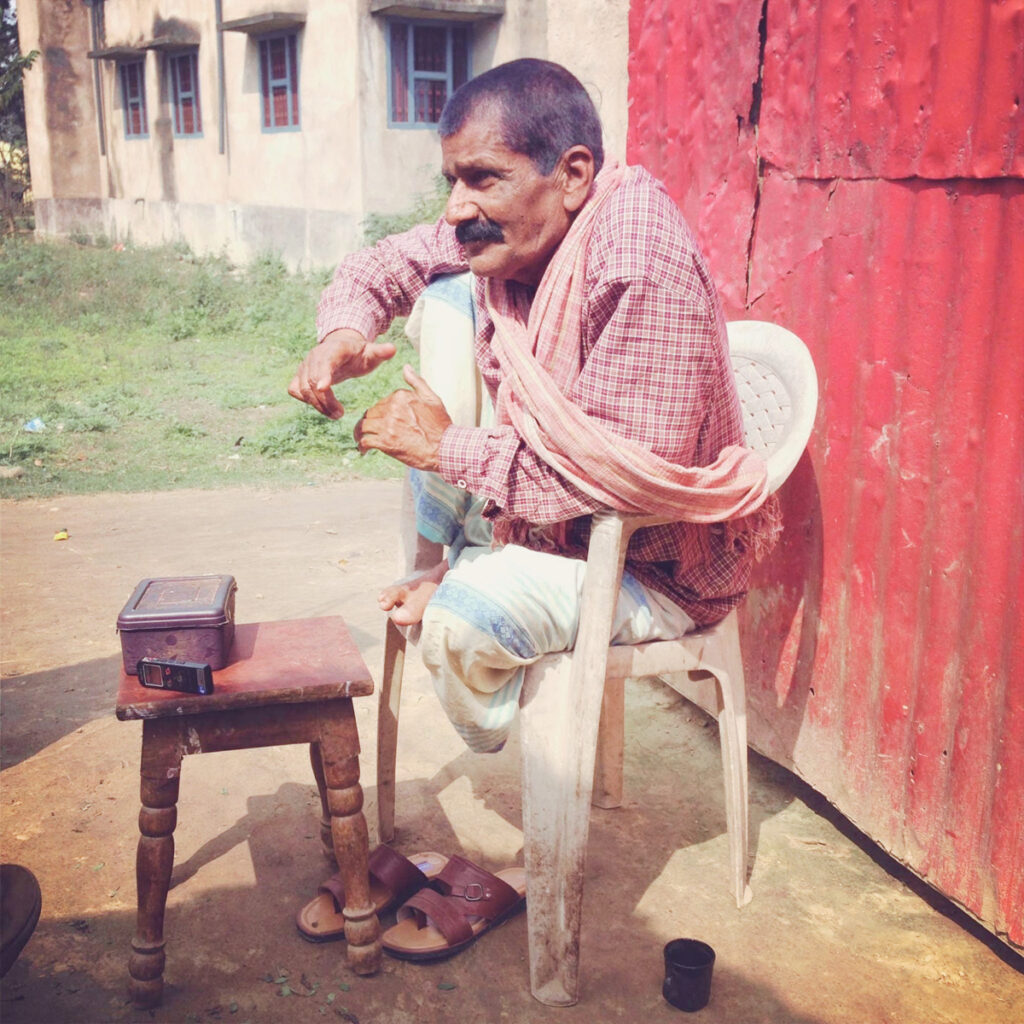
Village moneylender in Bihar, 2012. Photo by Shruti Majumdar.
That was the sandwich. The chief minister embraced Jeevika early and gave it sustained political protection from the top. It attracted the best young Indian Administrative Service (IAS) officers, professional staff and a network of facilitators to run the middle. And the didis themselves — the women of the SHGs, federated upward — became the organized bottom.
There was some resistance, of course, and there still is. But over the four years we came to read the backlash differently: it is not a sign that things are failing; it is what change looks like when power and identity are being renegotiated.
We also came to think differently about culture. It is not a set of cognitive biases to be nudged away. Culture can be changed, but it is a slow process; change requires protection from local elites and political interference.
Nothing about Jeevika looks like a radically simplified intervention. Almost everything about it is process-policy — no single outcome target, no lever pulled from the capital, just a rearrangement of when, how and how often people meet, who meets whom, who holds money and who gets to speak. And it produced cultural change in gender relations. Evaluations that revisited the original RCT sample almost 10 years later found that the program had caused 126% more low-caste women to run for political office and improved women’s ability to share risk, while radically transforming credit markets in one of the most patriarchal places on earth, on a timescale the standard paradigms would have said was impossible.
Doing by Learning
None of this is easy to do at scale, and much of it is not even easy to measure. That is rather the point, though. Process-policies shift trajectories in unpredictable ways, so evaluating them means watching processes move: how decisions get made, how power relations shift, how narratives and discourse change.
These things do not sit in administrative data and clean survey answers. They require qualitative work and narrative analysis coordinated with quantitative methods in genuinely mixed-method designs, which are not the norm in development economics.
For several years at the World Bank, colleagues and I tried to build this way of working into the machinery of Jeevika and its Tamil Nadu counterpart, through something we called the Social Observatory.
The idea was to move researchers from being overqualified outsiders who fly in whenever a survey needs doing to something like the project’s own think tank, with the aim of improving implementation by creating a culture of doing-by-learning. A team of economists, sociologists, political scientists, public health specialists and data scientists embedded within the project helped build decision-support systems so that staff, from the village level up, could act on good, fast data. (This was instead of yet another management information system nobody paid attention to.)
Qualitative process monitors visited a rotating random sample of villages every quarter and fed what they found back into design. Impact evaluations varied by how the answer would be used — quick impact evals when the project needed an answer soon, long mixed-method ones when it needed to understand outcomes and mechanisms.
The aim was to turn research from a tool for assessment into a tool for implementation. A paper that we originally wrote in 2015, drawing on the qualitative work, was critical of how the project’s second phase was being implemented, showing that the reflexive, co-produced process followed in the first phase was being neglected in the pursuit of higher enrollment numbers. The project responded with a concerted effort to give field staff more room to use their judgment. It improved the management information system and the process-monitoring system, strengthened the feedback loops between them and the facilitators, and created forums where facilitators could learn from and advise one another. The result was that facilitators moved away from an exclusive focus on the number of women enrolled toward a more adaptive and reflexive way of working with each village.
Policy, done this way, becomes constant adaptation rather than a one-shot deal. (Incidentally, this also protects against policy stasis: it kept the program responsive to changing conditions on the ground.)
What Would It Take To Do This?
Now: the honest accounting of such policymaking.
Reflexive policymaking requires very long time horizons. It is a “slow-cooked” way of doing policy, as opposed to the simple, easily scaled McDonaldization that pervades policy work. It requires a certain tolerance for mess, because reversing inequalities in power and agency is a contentious, uncertain business.
But the deepest obstacle to implementation of process-policies is that governments — and quasi-governments like the World Bank and donor agencies — are not set up for process-policies. The logic of bureaucracies, and of the political environments they answer to, pulls toward interventions that produce quick, measurable impact without threatening the status quo. Process-policies fail on all three counts: they are slow, they are hard to measure and they threaten the status quo more or less by definition.
Part of the problem may be how policy professionals are trained. (There are other equally important reasons.) Schools of public policy are generally staffed (with the occasional infusion of a “professor of practice”) by academics trained in economics or another social science discipline. Their knowledge of policy comes almost entirely from bringing academic expertise to implementers who choose to seek their advice, not from being embedded in the world of policy. So the courses that policy schools teach are, for the most part, variants of academic economics or political science, subject to the same fads as the academic departments and to the same pathology of belief: that to be a good policymaker you have to be an academically gifted expert immersed in the latest techniques and theories. There are very few courses that teach you how to sit through a village meeting, and only a small minority focus on the nitty-gritty of process issues.8
In practice, there is already some process-policy in place. Almost all policy in any country involves some amount of all four paradigms. Markets do coordinate dispersed knowledge; states do correct market failures; evidence can improve design. My claim is not that reflexive policymaking should replace all other types of policymaking. Rather, it is narrower: the three dominant paradigms would all benefit from more reflexivity. Reflexivity is neglected precisely because it is hard to measure, and in the current policy culture, what is hard to measure gets treated as unserious.
Process-policies mostly come into the world through years of unglamorous effort by activists working at a small scale in social movements and NGOs. Given what is happening to democratic institutions, and to inequality, it is time to bring them into the mainstream of the policy craft.
In concrete terms, every large program should budget for embedded learning. The structure of that learning should not be determined in advance; it should be process-oriented. It also does not suffice to only do randomized trials that give us a measure of outcome at the end of the project cycle.
Donors must also fund the middle tier — the facilitators, the district staff, the connective tissue — instead of mobilizing communities and walking away. Projects should be given time to evolve and adapt rather than be judged on whether they follow a predetermined trajectory of change. And schools of public policy should require — alongside the econometrics sequence — that their graduates actually spend time in the places where they will likely work. None of this is impossible, or even particularly difficult, to do. It is merely beyond current practices.
Whose policy counts? The three dominant paradigms answer, in effect: the market’s, the ministry’s, the expert’s. The people the policy is for appear as consumers, recipients and subjects, respectively; they are not shapers of policy.
There may be a different answer. Policy counts when the people it is meant to serve can shape it, contest it and correct it — when the woman who was dragged out of my focus group in Karnataka, whom I described in my previous essay, has somewhere to take what she knows. Research that does not listen produces papers about a world it has not understood. Policy that does not listen produces programs that are neither tailored to people’s needs nor able to adapt across place and time. Policy that listens can shift the political, social and cultural equilibrium — and that is what makes change last.
Vijayendra Rao is a development economist who combines econometric methods with ethnography. He spent 27 years as a Lead Economist in the Development Research Group at the World Bank and is currently the Roberta Buffett Distinguished Scholar-Practitioner in Residence at Northwestern University and Distinguished University Fellow at National Law School of India University. His interests include gender, culture, participation, deliberative democracy, political economy and innovations in mixed methods. His latest book, “Revolution by Stealth: How Women’s Groups Catalyzed a Cultural Transformation in Bihar” (with Shruti Majumdar and Paromita Sanyal), was published by Cambridge University Press in 2026.
If you have comments on this article or wish to contribute to the discussion, please email letters@indevelopmentmag.com. Responses will be featured in a letters section.
These are “ideal types” and may blur into each other in practice. ↩︎
To quote Thaler and Sunstein, “a policy counts as ‘paternalistic’ if it is selected with the goal of influencing the choices of affected parties in a way that will make those parties better off.” ↩︎
There is a very large (and growing) literature on women’s and caste reservations in India that show that they are — on balance — equalizing both on policy choices and deliberation. This paper summarizes the literature. ↩︎
Decision-making should, as much as is within the realm of feasibility, follow the principle of subsidiarity: “central authorities should perform only those tasks which cannot be performed effectively at a more intermediate or local level.” ↩︎
See the first chapter of Revolution By Stealth for citations and broader discussion on conditions in Bihar in 2006. ↩︎
Women’s SHG programs in India are government-run non-profits that should not be confused with microcredit or microfinance programs. As we document in Revolution by Stealth, group-based credit and savings are just the start, used as an initial incentive to develop a federated community of women — running into the millions — creating women’s social capital that is in turn used as a platform to run all manners of “vertical” interventions including nutrition, health, schooling, food security and income generation. ↩︎
Pain control is often treated as a luxury, leaving millions in low- and middle-income countries to suffer needlessly.
Dr. M.R. Rajagopal is haunted by the memory of his cousin’s nightly cries echoing through his village. His cousin had no pain relief for flare-ups from a rare skin cancer on his scalp, which caused him immense pain. And his cousin was not the only person he was unable to help; his memoir details other occasions he was unable to do more for people in his care. In his early career, he was too cautious in administering morphine — an opioid — to a man who had burns on 70% of his body; he was afraid of creating an addict. For months, his patient was kept in agony with only a few hours of daily pain relief. Years later, the man bumped into Rajagopal and told him the ordeal almost destroyed him. Rajagopal was shattered — but the experience changed his approach to pain forever. Dr. Rajagopal went on to become a pioneer in modern Indian palliative medicine.1
These anecdotes are from more than 40 years ago, but the patterns are hardly a thing of the past. Across rich and poor countries alike, people are still routinely failed through a lack of access to proper pain relief.2
Having no access to pain relief can be agonizing. Cancer patients in Vietnam describe waiting for others to die so that they could get the leftover morphine. Kenyan patients speak of their wish to hasten their deaths due to their inability to find peace from pain. I experienced uncontrolled and agonizing pain myself when, as a child in Uruguay, I had second-degree burns on both legs. Without appropriate pain relief, my pain was more than just physical. As I counted down the hours to the next dressing change, the anxiety I experienced was just as distressing and memorable as the deep burn of the gauze coming unstuck from my raw flesh.
Some form of suffering is a core experience for most of us around the world. Depending on the country and survey, between 5% and 10% of people from the UK, US and Middle East report having pain that impedes their daily functioning. More than two-thirds of advanced cancer patients have serious pain, and recent estimates suggest over 70 million people endure at least one day of serious health-related suffering a year.3
As populations grow older and we make gains against communicable disease, the burden of disease is shifting to chronic diseases like cancers and other diseases of old age, which can be painful and long-lasting. In much of the world, where people still can’t access good-quality healthcare, many conditions that are easily treatable remain serious causes of pain. We need better systems to help people deal with pain and death in a dignified way.
From Plants to Pills
For as long as we’ve been able to feel pain, we’ve tried to soothe it. Plants have been our best friends in this effort. The oldest evidence of plants being used as analgesics dates back at least 5,000 years. The poppy (Papaver somniferum) features prominently in history, with Sumerians using milk of the poppy as early as 4000 B.C. Egyptian texts dating back to 1500 B.C. also describe using poppies for pain relief. Opium comes from poppies — it is the dried latex from its seed pods. Its potent pain relief qualities made it central to trade — and, later, wars. In 1806, a few decades before the First Opium War, the German pharmacist Friedrich Sertürner would isolate a key compound from opium. This compound would be marketed as morphine, after Morpheus, the ancient Greek god of dreams.
Willow was also used as pain relief, appearing in the historical record at around the same time as milk of the poppy. Later, researchers would modify some of the compounds found in willow and market the resulting drug as aspirin around 1899.4 By 1950, it would be the most frequently sold painkiller. Heroin was introduced about the same time as aspirin, and was initially touted by Bayer as the non-addictive alternative to morphine — a claim that quickly fell apart.
Later drugs have increased our capacity to manage pain — paracetamol and ibuprofen are among the most recent of the commonly used pain relief drugs, entering commercial circulation in the 1950s and 1960s. Each new drug has expanded our pain treatment repertoire — some drugs work well for cancer pain, some for acute trauma and others for childbirth.
These drugs and our evolving scientific understanding have dramatically improved our ability to treat pain. Opioids are particularly helpful for cancer pain; the UK’s National Institute for Health and Care Excellence (NICE) suggests that pain is difficult to control in just 10% of advanced cancer patients — for the vast majority, there are actionable steps that can be taken to alleviate their suffering.5
But in other corners of the world, patients with painful conditions remain woefully underserved. The standard of care in low-resource settings is worlds apart from what we would call ideal treatment. Estimates from 2020 showed that 84% of the world’s population lived in countries where opioid medications for pain control were not readily available. There is little hope of matching the type of pain to the best medication for that type of pain; across secondary and tertiary hospitals in Gombe, a rural Nigerian state, clinicians report having to use paracetamol and ibuprofen for all pain relief, including automobile accidents and even childbirth.6
For the Few, Not the Many
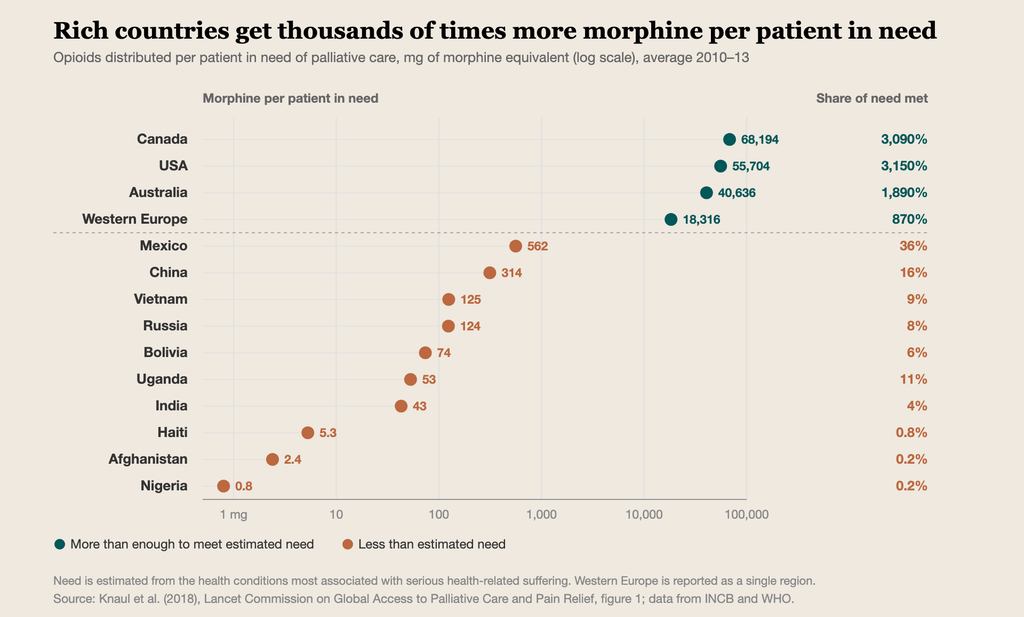
In some settings, suffering from a painful medical condition can be like a sentence to ongoing torture. This torture is far more common in low- and middle-income countries (LMICs) than in rich ones. 99% of children with serious health-related suffering are in LMICs. The lack of treatment for pain is especially common for the most severe types of pain, such as postsurgical and cancer pain. In Haiti, for instance, 99% of severe pain relief needs are unmet.7
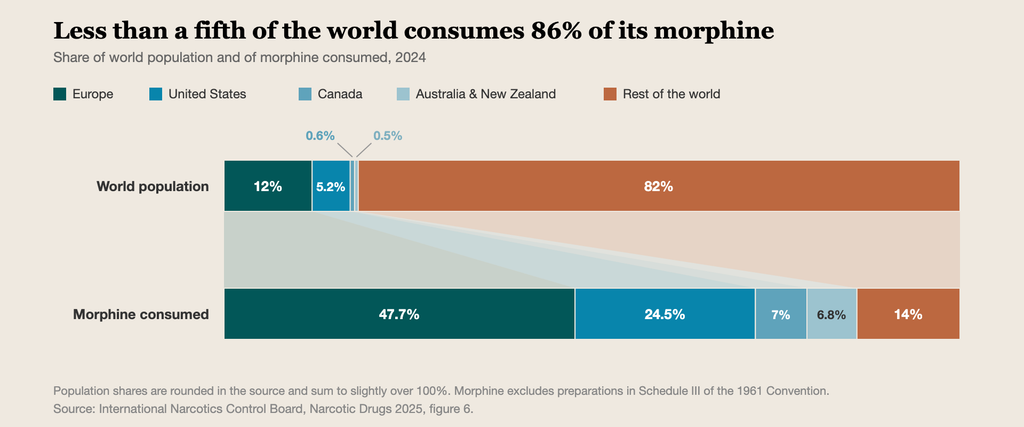
Worldwide, the top 10% of countries by opioid consumption consume as much as 90% of all distributed opioids (converted into doses with the potency of morphine).
Wealthy countries are much more likely to prescribe pain control than poorer ones.
To put this into perspective, one paper estimates that the average yearly controlled opioid consumption is 32 mg per person worldwide, but Germans consume around 480 mg per person. Note that this is not due to Germans overconsuming opioids; it is simply that pain elsewhere is not treated.
In many low- and middle-income countries, much need for pain control remains unmet.
Many issues in global health and development can be boiled down to lack of money, but the lack of pain control is not one of them. Morphine is among the cheapest essential medicines out there; oral morphine for 10 days costs about the same as a loaf of bread. Instead, lack of pain management is driven by a fear of opioids’ side effects, accentuated by the opioid epidemic in the United States and the closely related War on Drugs.
Traditionally, clinicians have avoided using opioids as much as possible, as they can cause central nervous system depression. This reduces the rate of breathing and in doing so could potentially hasten death. As recently as 2012, a third of medical ethics educators in the United States believed this to be the case. However, while it is true that morphine and other opioids have a narrow therapeutic index, meaning that the safety margin for their use is fairly small, it is not true that they hasten death when correctly administered.
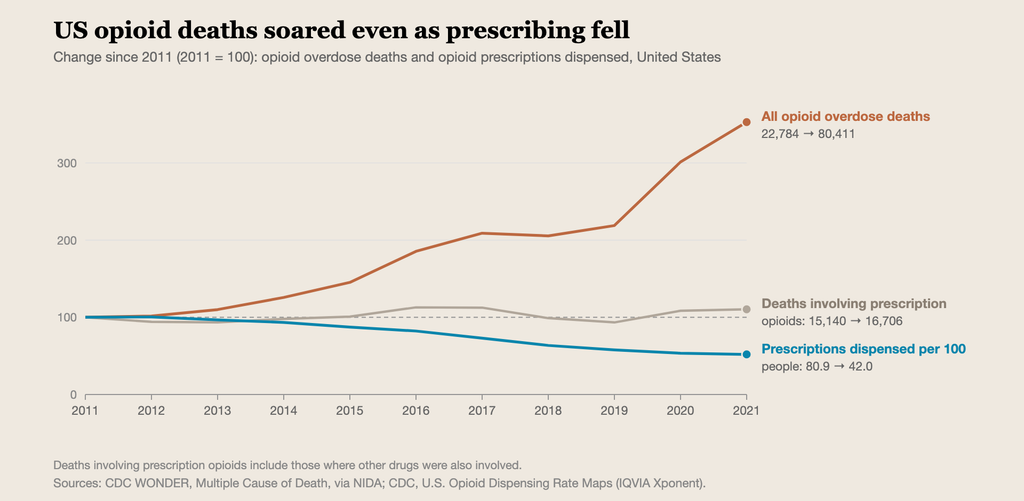
Doctors’ fears of overusing opioids have only increased with time. Opioids are addictive, and overuse is dangerous. The United States has experienced significant public health harm from the overprescription of opioids, with the opioid crisis peaking at perhaps 80,000 opioid-caused deaths per year. The start of the crisis was caused by the unscrupulous drug pushing of pharmaceutical companies for types of pain where opioids are not very helpful. In response, doctors became much more hesitant to prescribe. Indeed, doctors could even be prosecuted for overprescription.
But while this first wave of the opioid crisis in the U.S. was driven by the prescribing dynamics of doctors, this was not the lasting mechanism for increased opioid deaths into the 2020s. Between 2011 and 2021, opioid deaths tripled, even as opioid prescriptions decreased by nearly 40% during the same period. Pain medication might have kicked off the epidemic, but it was not the lasting driver.
While the US opioid crisis was triggered by overprescription, deaths did not decline as prescriptions did.
Still, fear of overusing pain medication became widespread. Some Iranian patients conceptualize their pain as divine intervention, while many other patients fear that relieving their pain would leave them addicted to the analgesics on offer. In Rajagopal’s own state of Kerala, doctors report that patients often reject palliative medicine. Fear, rather than cost-benefit analysis, drives medical decision-making.
It is true that prescribing opioid pain medications comes with risks. Estimates of the true rate of opioid use disorder as a consequence of prescribing are very heterogeneous. One study has estimated the prevalence of problematic pharmaceutical opioid use at 9.3% in patients with non-cancer pain, while other studies estimated the risk as 0.2% for individuals with no preexisting addiction issues. Even a 0.2% risk of addiction is not trivial, but it must be weighed against the harm of leaving patients in debilitating pain.
Crucially, opioid pain medication must be treated like all other possibly addictive pain medications — worth the risk in some circumstances, but not in others. Different cases require different approaches. And when opioids are used in end-of-life settings, there are fewer concerns about addiction — if a patient is dying, even addiction might be a reasonable choice to make the last few months of their life more bearable.
But despite these nuances, over time, regulation has tended to tighten restrictions on pain relief, further constraining who can access relief.
Restrictions begin at the international level. Countries must report their need for opiates to the International Narcotics Control Board before importing them. Unfortunately, countries often underestimate their own needs for opioids and fear being seen as lax on drug control. Thus, they rarely choose to deviate from their current level of imports — even if it is far too low. Furthermore, since pain medication is not seen as “lifesaving,” it is an easy place for governments to cut corners.
Prescribers are also severely limited. It is not uncommon for certain frontline practitioners who have prescribing powers, such as nurses, to not be allowed to prescribe strong pain relief. In such scenarios, it is a blanket ban — and not clinical judgment — that drives care.
The fear of diversion also often means clinicians can’t carry pain relief to the last mile. Instead, patients must go to a central medical store for pickup. In some areas, this can mean that patients in severe pain must travel for hours to get medication. In countries where there’s no access at the last mile — for instance Malawi, where rural clinics can’t stock strong pain relief — this can further increase the difficulty in obtaining proper medication, requiring people to travel for days to access care.
The pendulum on accessing opioids is starting to swing back now; the International Narcotics Control Board has acknowledged its overzealousness in cautioning against the use of opioids. Decades of regulations are difficult to untangle, though, and have lasting effects on clinical practice.8
In many countries, the bureaucratic procedures one must follow to prescribe opioids remain difficult to navigate, too few clinicians are allowed to prescribe and updates in regulation take too long to trickle down to clinical practice.
Instead, clinicians lean heavily on ibuprofen and paracetamol. However, these medications are only suitable for fairly mild pain; for postsurgical pain and cancer pain, they barely make a dent.
Most Suffering Is Unnecessary
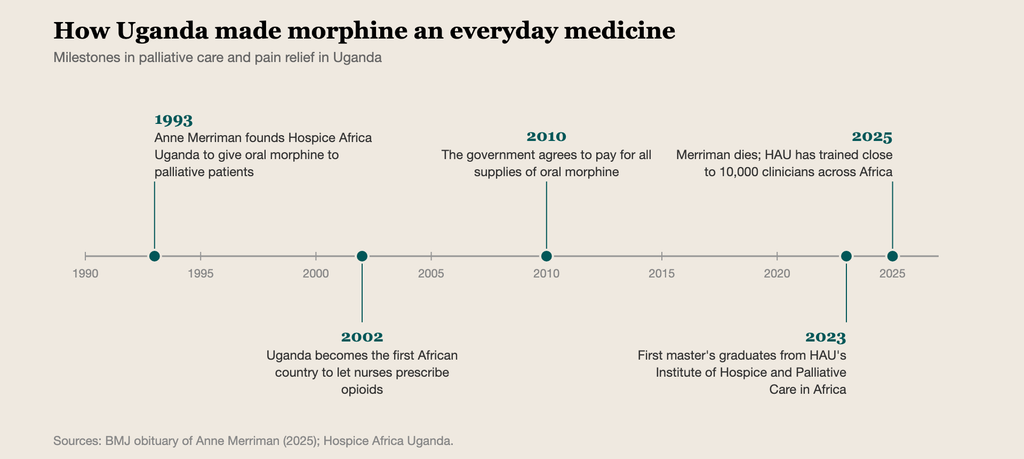
When medication makes it to the patient, alleviating suffering can be relatively straightforward. Dr. Anne Merriman, another well-known name in the field of palliative care, set up Hospice Africa Uganda (HAU) in 1993. She wanted to establish a community hospice service that would distribute oral morphine to palliative care patients.
Initially, this goal seemed impossible. When HAU was founded, it was not even legal to import powdered morphine. Merriman’s first win was lobbying the Ugandan government to allow the importation of powdered morphine.
Reconstitution of powdered morphine for administration is relatively simple; according to Merriman, it is “easier than baking a cake”. All it takes is powdered morphine, little bottles, a preservative and some food coloring to mark the strength of the resulting solution. And it is extremely cheap, meaning that enough morphine to support pain relief for a day can cost less than a dollar. By 2025, when Merriman passed away at the age of 90, HAU had treated tens of thousands of patients and trained close to 10,000 clinicians across Africa to reconstitute and administer morphine.
Alongside its direct work, HAU continued to lobby the Ugandan government to improve access to pain control through policy change. In 2002, Uganda became the first African country to allow nurses to prescribe opioids. In 2010, the Ugandan government agreed to foot the bill for all supplies of oral morphine.
Uganda has improved access to palliative care over the last several decades.
Production also continued to improve. Those who were making the oral morphine in a kitchen sink in the early 1990s would have been shocked to know that today HAU has an automated morphine production unit that supplies all accredited Ugandan medical facilities.
Palliative care would also become a stronger part of the medical agenda in Uganda. Policies such as task-shifting, community outreach and setting up production units seemed to work well for Ugandan patients and would become a blueprint for other countries in the region. In 2023, HAU’s Institute of Hospice and Palliative Care in Africa had its first cohort of master’s students graduate.
Certainly, these low-tech solutions to plug opioid gaps are less interesting to pharmaceutical companies and philanthropists than developing new (and more profitable) drugs. But for decades, the medication development pipeline hasn’t produced much of note. Many efforts to work on specific “analgesic targets” other than mu-opioid receptors9 failed to deliver any results. The new drugs that have come on the market have often been developed for other ends and then repurposed, with little progress on purpose-developed non-opioid medications.10 Physicians have been stuck with opioids and a few non-opioid drugs — usually significantly less powerful than opioids — for pain management.
What Would It Take to Prioritize Pain?
Even in countries with excellent medication availability, progress in palliative care is often stuck for deeply human reasons: misconceptions, regulation, governance and lack of training. The barrier to good care is not medicine innovation but rather the lack of prioritization of pain control as a key part of treatment. Moreover, we need to change how people conceptualize palliative care. It is viewed as reserved for frail and dying people, which is perhaps why in the United States fewer than one in five young adults with advanced cancer get appropriate palliative care as part of their treatment.
Worldwide, most clinicians are still not properly trained in pain management and pain management specialists are very rare. Mozambique, a country of 35 million people, has just two physicians specializing in pain management. Zimbabwe, a country of 17 million people, has just two pain specialists. Pain management is often viewed as unimportant.
Unlike more easily measured conditions and health states, pain is difficult to quantify and measure due to its subjectivity. For philanthropies and policymakers, then, it can be difficult to make a case for grants to reduce pain. This is not helped by the fact that modern medicine tends to focus on cures rather than relief of symptoms, ignoring how much the latter can improve quality of life, even if the underlying disease is unchanged.
But properly managing pain can make a huge difference in quality of life. When my mother-in-law, a former nurse, was dying from amyotrophic lateral sclerosis (ALS) in Jamaica, she suffered debilitating pain from the disease’s effects on her nerves and muscles. Our entire focus became making her days (slightly) more comfortable. It took a long time to find doctors and nurses who’d prioritize her comfort and symptom management, but once we did, it was transformative. I will always remember how at peace she felt when she was finally in the hands of competent and caring professionals. We treasured that time; when she was able to relax in this way, she shared jokes and laughs with all of us. Other families deserve the same level of care, and the chance to find moments of joy with their loved ones.
To make this happen, identifying the right gaps at the national, subnational and bedside levels will be key. In some settings, the most pressing need will be addressing supply chain breakdowns for opiates; in others, it will be undoing aggressive scheduling and regulatory restrictions.
It likely won’t be that expensive, though. It would cost just $1 million to provide pain control to all the children in low-income countries who need palliative care; perhaps $150 million for enough morphine to reach all the patients who need it. Per capita, universal palliative care in lower-middle-income countries would cost under $1 per year. This is a very small amount and would be relatively easy for governments to cover, but the challenge of relieving pain remains deeply neglected by policymakers.
At the local level, some religious and charitable organizations provide places of respite for a handful of terminally ill people. Internationally, just a few organizations work on coordination and education. The problem’s multifaceted nature and resistance to being easily quantified should not detract from the need to increase funding and renew efforts to improve clinical attention to pain.
Progress will take time, as Rajagopal would come to understand as he sought to expand palliative care across India. But change is possible: in the more than three decades since Rajagopal started campaigning for better palliative care, his organization has made significant progress, including helping to amend the Narcotic Drugs and Psychotropic Substances Act for better access to pain treatment. Kerala, the state where Rajagopal practices, has essentially eliminated morphine stockouts. Other countries can make the same progress.
We should not condemn hundreds of millions to suffer; we must treat pain as seriously as we treat disease.
Morgan Fairless is Research Director at Ambitious Impact, a charity incubator. His team identifies and prioritises high-impact charity ideas across global health and development and animal welfare. His writing focuses on underappreciated issues affecting low- and middle-income countries.
If you have comments on this article, or wish to contribute to the discussion, please email them to letters@indevelopmentmag.com. Responses will be featured in a letters section.
Rajagopal co-founded Pallium India and helped establish other palliative care centers. His efforts in palliative care have shaped policies affecting millions across Kerala and India as a whole. The modern field of palliative medicine itself only took its first steps in 1967 with the creation of St. Christopher’s Hospice in South London; when Rajagopal started his medical career in the 70s, the World Health Organization analgesic ladder — commonly used as a tool to teach clinicians how to address pain and breakthrough pain with escalating strength of medication — did not exist. It would not be introduced until 1986. ↩︎
The International Association for the Study of Pain defines pain as “an unpleasant sensory and emotional experience associated with, or resembling that associated with, actual or potential tissue damage.” This consensus definition, which had previously remained unchanged for over three decades, now acknowledges that pain is not simply a measure of physical damage. Like all feelings and perceptions, pain is a complex experience produced by the mind. Nociceptors provide information to the brain, but that information is not pain in itself. The brain will take those stimuli and integrate them with context, memories and expectations to produce the experience of pain. ↩︎
This is calculated using a set of conditions that cause pain and IHME’s Global Burden of Disease. As such, these could be a substantial underestimate if the set of conditions is not complete. ↩︎
Aspirin would turn out to be the gift that keeps on giving. Due to its antiplatelet properties, it has turned out to be highly useful to prevent and treat some cardiovascular conditions. Nowadays, aspirin is a mainstay of preventative medicine. ↩︎
In London last year, I was awestruck as I witnessed my wife cheerfully rank every opiate pain medication she’d been given in her palliative cancer care (her drug of choice was oxycodone, while fentanyl remains “overrated”). ↩︎
I learned this through interviews with clinicians in a recent visit. ↩︎
As per Knaul et al. 2018, “the amount of morphine-equivalent opioids distributed in Haiti is 5 mg per patient in need of palliative care per year, which means that more than 99% of need goes unmet.” ↩︎
Prescription rules are particularly constraining in settings with few doctors or specialists. If nurses or other professionals are not allowed to prescribe, it can take too long to get a prescription set up. Changes in prescription rules interplay with professional identity and pride. In Malawi, updates to allow nurses to prescribe opiates were not initially adopted by the college of nurses. ↩︎
There has been a recent bright spot – in January 2025, the FDA approved suzetrigine (Journavx). It is a first-in-class non-opioid drug. However, it is suitable only for acute pain and costs around $15/pill. ↩︎
In Development and Asterisk are running an essay contest on how transformative AI will affect low- and middle-income countries.
AI is a transformative technology. To date, though, there has been relatively little exploration of what advanced AI will mean for developing countries.
In Development and Asterisk are running an essay contest on how transformative AI will affect low- and middle-income countries, and how they might respond. Essays may focus on a particular country, region, or group of countries, and should be between 2,000 and 5,000 words. We are particularly keen to see submissions from authors based in low- and middle-income countries.
Please feel free to submit on the relevant topic of your choice. Potential topics could include, but are certainly not limited to:
How will AI drive convergence or divergence between rich countries and developing countries?
What will be the labor market impacts of AI in a particular country? Which sectors will expand and which will contract?
How will AI change the political economy of the developing world?
How will governments likely use AI, for good or ill?
What policies are needed for low- and middle-income country governments to prepare for a transformative AI scenario? What capabilities would be needed to enact and maintain these policies?
How will AI affect conflict in low- and middle-income countries?
What are the primary barriers to the diffusion of AI-based health technologies and how can these barriers be reduced?
How do people in low- and middle-income countries currently view the relative benefits and risks of AI?
How might AI interact with the social fabric of low- and middle-income countries in ways that are underreported and/or differ from what we would see in the Global North?
Where should philanthropic funding from AI companies and employees go to accelerate development? Are there particularly promising AI-specific opportunities?
Some responses to transformative AI may already be sensible development policies. Essays discussing these policies should explain how AI changes their importance, urgency, or design.
We’re looking for essays that are deeply researched and contain original analysis. Reporting is encouraged but not necessary. All selected essays will be fact-checked and edited before publication.
Winner (1): $10,000 per essay + publication in both Asterisk (print and online) and In Development
Runner-Ups (2): $5,000 per essay + publication in both Asterisk (online) and In Development
Honorable Mentions (2): $2,000 per essay
Separately, the African Tech Futures Lab offers $2,500 for the best essay by an African national. This reflects their aim that Africans help define the future of the technology. This prize can be combined with the above prizes; thus, if the overall winner is an African national, they would receive $12,500.
AI policy:
You can use AI to research, to translate an essay written in a language other than English, and for feedback on your essay. However, we do not accept submissions that include AI-generated content beyond translation.
Rules and submissions:
Essays should be in English.
Pieces can be co-authored.
Each person may appear on only one entry, whether as a sole author or a co-author.
Entries must be previously unpublished (including on personal blogs or newsletters).
If you have additional questions, please email essaycontest@indevelopmentmag.com.
The contest will be judged by:
Clara Collier
Clara Collier is the editor in chief of Asterisk Magazine, “the little magazine of the San Francisco Bay Area”. She holds an MA from Oxford University and a BA from Yale University.
Lauren Gilbert
Lauren Gilbert is the editor in chief of In Development and a non-resident fellow at the Centre for British Progress and the Energy for Growth Hub. Her writing has appeared in The Economist, Foreign Policy, The Washington Post, Works in Progress, and Asterisk. She previously worked as a program manager at Renaissance Philanthropy, a research fellow at Open Philanthropy, and a theoretical neutrino astrophysicist.
Oliver Hanney
Oliver Hanney is a contributing editor at In Development and the Managing Editor at VoxDev, a platform which features the latest research in development economics through articles, blogs, podcasts, videos, and living literature reviews (VoxDevLits). He hosts the weekly Ideas in Development podcast, and is particularly interested in AI, growth, and how research shapes policy.
Shahrukh Wani
Shahrukh Wani is Head of AI Policy Partnerships at the International Growth Centre (IGC) at the LSE, where he leads work to help LMIC governments use AI in policymaking and public services. Over the past decade, he has worked with governments in Afghanistan, Pakistan, Uganda, Rwanda, Ethiopia and Zambia on policy reforms. Born and raised in Pakistan, he now lives in London.
Deena Mousa
Deena Mousa is a Program Officer at Coefficient Giving, where she leads its work on AI for global health and economic development. She also writes for outlets like The Economist, National Geographic, and Scientific American, and authors Under Development, a newsletter on emerging technology and global development. She holds a BA in Ethics, Politics, and Economics from Yale.
Joseph Levine
Joseph Levine is a development economist researching the societal impacts of transformative AI at Google DeepMind. He is also completing his DPhil in the economics department at the University of Oxford, focusing on public and welfare economics. Before starting his PhD, he consulted on technology policy and financing in the space industry.
Rose Mutiso
Rose M. Mutiso is the Founder and Executive Director of the African Tech Futures Lab. She is also the co-founder and former CEO of the Mawazo (“Ideas”) Institute. Previously, she served as the Research Director of the Energy for Growth Hub, and as a Senior Fellow focused on energy and innovation policy in the U.S. Department of Energy and U.S. Senate. She currently holds joint appointments as Science Advisor to the Energy for Growth Hub and Senior Fellow of the Conceptual Investigations Unit at Stanford University.
Rafael Cariello
Rafael Cariello is the managing editor of In Development. He has worked as a reporter and editor for Folha de S.Paulo, Brazil’s largest newspaper, and for piauí, its leading long-form magazine. Rafael holds a BA in History and a PhD in Economics from the University of São Paulo. Born in Rio, he is based in São Paulo.
To receive new posts and support In Development, consider becoming a free or paid subscriber.
Cheap lifesaving drugs already exist. A better injection device could get them to patients in time.
In the U.S., over 1.5 million people are prescribed an epinephrine autoinjector, such as an EpiPen — a small pen designed to deliver a single dose of adrenaline. People carry it in case of anaphylaxis, a severe allergic reaction to foods, medications, insect stings or other materials that can become fatal within minutes. Treating anaphylaxis, though, has become remarkably simple: pick up an EpiPen, remove the cap, push it against the thigh and hold for a few seconds.
Using one requires no preparation. Inside the pen, a hidden needle deploys into the muscle, delivering 0.3 mg of epinephrine. Epinephrine cues the body’s “fight or flight” response, tightening blood vessels and causing the heart to beat harder and faster. Within minutes, the collapse in blood pressure reverses and the airways relax. The person can breathe again. Anyone can do it; no trained medical professional is needed.
This is new. For most of medical history — and still today across much of the world — treating anaphylaxis has required a trained healthcare worker to carefully draw medication from a glass vial into a syringe, with steady hands, at the correct dose, during a life-threatening emergency. The autoinjector transformed this complex procedure into something almost anyone can perform for anyone, in seconds. This is a remarkable feat of medical engineering.
But the use case for autoinjectors is not limited to anaphylaxis. In wealthy countries, autoinjectors — and similar technologies like reusable pens — are increasingly used for non-urgent, chronic therapies like GLP-1 medications and autoimmune disease treatments. This has drawn considerable commercial investment, resulting in expanded manufacturing capacity and reduced costs per unit.
This additional scale could allow us to return the technology to emergency use, where it could transform patient care in low- and middle-income countries (LMICs).
Where Autoinjectors Began
The autoinjector was not the first attempt to simplify emergency injection. Its predecessor was the syrette, a squeezable tube of medicine — similar to a tube of toothpaste — fitted with a needle. Developed by Squibb around the start of World War II, the syrette was primarily used to deliver morphine to soldiers.
To use one, a soldier broke an inner seal with a wire pin, worked the needle under the skin and squeezed the tube empty. This was an advance over drawing up medicine from a vial into a syringe, but it was still far from ideal. Successful administration relied on a series of fiddly steps being executed rapidly and correctly, no less by a frightened person in the chaos of battle. Imagine squeezing a whole toothpaste tube into your thigh during an emergency!
Seeing this, National Institutes of Health (NIH) cardiologist Stanley Sarnoff sought to create a device that could allow one to inject an antidote in a single motion. In the 1950s, he and his wife founded Rodana Research (later renamed Survival Technology) to build it. A patent he filed in 1953 described the first modern autoinjector concept: a spring-driven hypodermic injector designed so that “a person unskilled” could give an injection “either to himself or to another person.” Loaded with a 2 mg dose of atropine, the device was later commercially marketed as the AtroPen.
The invention soon spread beyond the battlefield. By the early 1960s, NASA was equipping astronauts’ emergency medical kits with autoinjectors to deliver anti-motion-sickness drugs, stimulants and vasoconstrictors for shock. Survival Technology also adapted the device to deliver epinephrine instead of atropine. The underlying challenge was the same: a soldier under chemical attack and a person in anaphylactic shock both needed a drug that worked fast, transported easily and required no training to give. A new glass-cartridge design, developed by one of the company’s engineers, Sheldon Kaplan, became the EpiPen — patented in 1977 and approved by the FDA in 1987.
Originalpatentfor “Hypodermic injection device having means for varying the medicament capacity thereof” submitted by Kaplan et al. on May 14, 1976, Patent 4,031,893.
In parallel, a second family of injection devices — pens — was being developed for routine injections. The key design difference was that users pushed the needle in by hand rather than relying on a spring-loaded mechanism to deploy it. Novo Nordisk built the first pen in 1985 — the NovoPen — allowing people with diabetes to administer insulin daily without having to use a vial and syringe.
Autoinjectors followed pens into non-emergency markets in the 2000s, starting with Abbott’s Humira Pen and Amgen’s SureClick, both for treatment of arthritis. Humira went on to become the highest-grossing pharmaceutical drug of all time, with over $200 billion in cumulative sales. Such a lucrative market made it worthwhile to develop and sell these drugs in higher-cost autoinjector formats. It is unsurprising, then, that between 2000 and 2023, around 40% of FDA-approved injectable biologics1 were delivered by autoinjector, and almost all for chronic maintenance treatment — not emergencies.
The Neglected Applications
In emergency medicine, autoinjectors are most useful when:
There is no oral option for treatment. The drug either isn’t absorbed fast enough by mouth to work, or an oral drug doesn’t exist.
Minutes matter. Timely administration of the treatment has a critical impact on patient outcomes and mortality. This is often linked to the first; if an oral drug isn’t fast enough, it is likely that minutes will matter.
No clinician is in reach. The person best placed to give the treatment is usually a parent, a bystander or the patient themself — not a clinician requiring access to an intravenous (IV) line.
Where all three hold,2 an autoinjector may be the only realistic way to get lifesaving drugs into the patient. Yet despite having been developed more than half a century ago, they are now rarely used in emergency medicine outside of anaphylaxis.
This is because the set of circumstances described above is relatively uncommon in developed countries. Most people have fairly easy access to clinicians; they are a 911 call away. However, it happens far more often in LMICs. Life-threatening injuries are more common, and people are often far from a trained clinician when they strike.
Consider tranexamic acid (TXA) as an example. It is a cheap, off-patent, proven drug that controls bleeding. It is highly effective at reducing deaths from bleeding in two settings: traumatic hemorrhage, or severe blood loss after an injury such as a road traffic accident, and postpartum hemorrhage (PPH), or severe bleeding after childbirth. And it is hardly a new treatment: TXA was discovered in the 1950s by Japanese medical researcher Utako Okamoto and her husband Shosuke Okamoto to treat PPH.
Traumatic hemorrhage is responsible for about 2 million deaths each year and is a leading cause of preventable death, while PPH is the single largest cause of maternal mortality worldwide. The CRASH-2 trial, which followed just over 20,000 trauma patients, found that TXA given within the first hour cut bleeding deaths by roughly a third (RR 0.68). The WOMAN trial, which followed just over 20,000 postpartum hemorrhage patients, found similar results: TXA given within three hours of birth cut deaths due to bleeding by 31%.
But the benefit is acutely time-sensitive. A pooled analysis of the CRASH-2 and WOMAN trials found the odds of survival were over 70% higher with immediate treatment. The benefit dropped by roughly 10% for every 15 minutes of delay.
TXA is far less effective when administered later.
If a new mother experiences hemorrhage shortly after childbirth in a well-equipped hospital, this is manageable — TXA is often on hand and it only takes a nurse a few moments to insert an IV line. Yet readiness across healthcare facilities varies enormously across LMICs, where the share of facilities able to provide basic emergency obstetric care can range from 2% to 79%. Many women do not give birth in facilities at all: in sub-Saharan Africa, a third of births occur outside a facility, and nearly three in ten women of childbearing age live more than two hours from their nearest hospital. So although TXA was discovered over 50 years ago and is available cheaply as a generic, few of these women receive it — no one present at the birth is trained or equipped to give an intravenous drug.
The benefits of a better way of administering TXA are even more obvious for trauma care. After a car accident, it is not possible to carefully prepare an IV line on the side of the road. Well-stocked ambulances are rare in many LMICs, where patients are often transported by family members, neighbors or private vehicles. Where prehospital services do exist, intravenous TXA is rarely given: in South Africa, only 2.8% of trauma patients at risk of hemorrhage received TXA before reaching a hospital.
Autoinjectors could close this gap. TXA does not have to be delivered by IV; a trial has found intramuscular TXA reached therapeutic levels in the blood within minutes and achieved bioavailability close to that of intravenous administration. This means it could be given via prefilled syringes in two 5 mL injections, or — with further engineering to concentrate the formulation — as a single autoinjector. Both are technically feasible, and an autoinjector would allow a wider range of people — lower-cadre health workers, birth attendants, family members — to administer it. Such a device could be carried to home births, or given on the spot in facilities where no one is trained to place an IV line or a line is not yet set up — in both scenarios, a potentially lifesaving intervention. From our own back-of-the-envelope estimates, if a TXA autoinjector were stocked in these settings, 3.2 times more women experiencing PPH would receive TXA, and they would receive it 1.5 hours sooner on average. This could avert 20% of deaths from postpartum bleeding at a cost-effectiveness of $155/DALY (disability-adjusted life year).3
Faster administration of TXA could be a highly cost-effective intervention. The difference between the y-axis value and the corresponding x-axis value is the $/DALY of improving time to TXA administration by that difference. For example, it costs $150/DALY to reduce time to administration by an hour (60 minutes, y-axis) for women who currently receive TXA at two hours (120 minutes, x-axis). The “Never” column represents women who currently receive no TXA at all. See model here for assumptions.
Yet because most of the benefit would be in LMICs where procurers have limited purchasing power, firms have few incentives to invest in developing cheap autoinjectors for TXA. After all, they could spend R&D dollars on chronic diseases more common in rich countries,4 where the ROI on spending is likely to be higher.
Development of a TXA autoinjector has begun, but it is unlikely to address these particular issues. Current development is oriented towards trauma care gaps in high-income countries — accidents, mass-casualty events and battlefield injuries. A device built for these buyers may not transfer well to LMICs: It may assume climate-controlled storage in ambulances and stockpiles, use costlier components like automatic needle shields, electronic voice or light guidance or be engineered to withstand battlefield conditions — a level of robustness not needed for an at-home birth. And there is little incentive to strip these features out when high-income procurers are willing to pay for them.
As with anaphylaxis and bleeding, snakebites can be fatal and require immediate treatment with lifesaving antivenom. In one Indian study, mortality was 0.8% when antivenom was given within six hours of a snakebite but increased to 38.5% when treatment was delayed beyond 12. Yet because antivenom is administered intravenously, snakebite victims must get to a clinic before they can receive it.
Antivenom is more effective the sooner it is administered.
This creates two delays in treatment: once in getting to a facility, and again after arriving. Because snakebites occur overwhelmingly in rural areas with long travel times to care, many victims never reach a healthcare facility in time. An estimated 77% of snakebite deaths in India occur outside a hospital. Even when patients reach healthcare facilities, a study in South India found that only 39% got antivenom at the first one they visited. Most were bounced around two or three more facilities before getting a full dose, often because facilities had no one on site trained to give it. These barriers to timely treatment help explain why snakebite has proved unusually challenging to address: although mortality has declined over the past two decades, progress has been too slow to meet 2030 WHO goals.
It has long been assumed that only slow, intravenous administration would work, because antivenom molecules were too large for reliable absorption through muscle. But a 2021 human study, which compared intravenous and intramuscular administration of antivenom, found intramuscular patients fully recovered without needing repeat doses. A 2025 large-animal study offers a mechanism behind this: Intramuscular antivenom neutralized venom more completely and just as fast as, if not faster than, intravenous antivenom did. It may do so partly because it’s absorbed into the lymphatic system — the same route much of the venom itself travels through. The evidence is still preliminary, but if validated further, it could remove the requirement for an IV line.
This suggests that it may be possible to bring snakebite treatment out of the clinic and into the hands of farmers and local emergency responders. While antivenom remains costly, and finding ways to lower prices is important, cheaper vials help little if patients cannot access them in time. The evidence here is less advanced than it is for TXA, but it certainly bears more investigation.
Nor are these the only examples where autoinjectors could save lives. Several other drugs may fit the same profile — they are fast acting, poorly suited to oral dosing and most likely to be needed when there is not a clinician on hand. These include intramuscular artesunate for severe malaria and magnesium sulfate for eclampsia, a leading cause of maternal death. Even atropine — the nerve-gas antidote that inspired the first autoinjector — could find a new purpose. Atropine is also an antidote to organophosphate pesticide poisoning, a major cause of fatal pesticide self-poisoning that accounts for more than 100,000 deaths globally each year. These drugs are already cheap and easily available; what’s missing is an affordable, readily available device that allows them to be administered in the way that is needed.
How?
An obvious objection to the use of autoinjectors in LMICs is cost. A two-pack of brand-name EpiPens may cost more than $700. But the billed amount in rich countries is not the same as its manufacturing cost. Engineers who took apart a brand-name EpiPen estimated the manufacturing cost of a two-pack at about $11.70 (2026 dollars). Another analysis put the bill of materials for an open-source, 3D-printed autoinjector at around $5.50,6 with 57% of the cost attributable to a single steel spring. This doesn’t include all costs — shipping, medication, R&D — but it is suggestive that significant cost reductions are possible.
Indeed, we are already seeing monumental cost reductions in the self-administered injections industry.7 When Novo Nordisk’s semaglutide patent expired in India in early 2026, multiple manufacturers launched generics within months. While list prices for Mounjaro and Wegovy exceed $1,000 per month in the U.S., weekly GLP-1 injections in India can be obtained for a fraction of that cost — some therapies delivered through reusable pens are priced at about $4-68 per week. If the all-in cost of therapy is $24 per month, clearly the pen costs less than this.
The manufacturing cost of an autoinjector is much lower than the retail price.
As demand for GLP-1 medicines increases, production capacity and sophistication will increase too. Novo Nordisk has committed more than $23 billion to expand production capacity.9Ypsomed, another major manufacturer of autoinjectors, is investing nearly half a billion Swiss francs to increase its annual production capacity by up to 500 million pens and autoinjectors.
While some of this investment is for reusable pens rather than autoinjectors, both are built by the same industry — firms like Ypsomed manufacture both, using shared components and fill-finish lines. Indeed, most growth is happening in the format needed for emergency use cases — immunology biologics and the newer obesity drugs are mostly delivered through single-dose, disposable devices. While these devices may not have the spring mechanism of an EpiPen, they are still vastly faster and easier to use than inserting an IV. Cost savings that widen profit margins could instead be passed on to reduce prices.
All of this means that autoinjectors are likely to become increasingly cheap and easily available.
What’s Still Needed
Despite the advances in manufacturing making cheap, easily available autoinjectors a possibility, it is not inevitable that they will be used to save tens of thousands of lives. In fact, far from it.
Why is this the case? We are not missing the drugs themselves — they already exist, and many are decades old and off-patent. What’s missing is a market large enough to pull research and development toward a delivery device suitable for LMICs.
Right now, autoinjector R&D is geared towards rich-world markets, which combine a greater willingness and ability to pay with lower barriers to entry. Indeed, autoinjectors accounted for around $160 billion in drug sales in 2024,10 and autoinjectors are the dominant delivery platform in immunology, the second largest therapeutic market. Profit margins are relatively high for these drugs.
Markets in LMICs are very different. Though the overall market size is potentially large, selling products there requires navigating many different approval systems with limited commercial return on investment. The profit per device would be much lower than that earned on, for instance, the Humira Pen. As a result, development for these settings is far from the minds of R&D departments at pharmaceutical companies, who see a simple equation of costs greater than expected returns. This is despite the tremendous potential for impact in these settings — the DALY burden from maternal hemorrhage and road injuries is over 50 million annually in LMICs.11
For autoinjectors containing TXA, antivenom and other medicines to be developed for LMICs, this equation must be rebalanced; otherwise, “technically plausible” is where the technology is likely to remain.
Philanthropic capital could be used to ease this transition. There are several ways such capital could engage.
One would need to begin by establishing the groundwork. This includes identifying the high-burden indications where an autoinjector would be cost-effective and building the evidence base for them. This could include funding clinical trials to advance promising candidates, commissioning health technology assessments to make the procurement argument or developing demand forecasts to give investment certainty to firms and manufacturers.
From there, the right market-shaping approach is trickier. Getting a device into a user’s hands is an end-to-end process: proving the safety and efficacy of intramuscular delivery, engineering a device that is robust, heat stable and cheap enough for LMIC conditions, taking it through licensing and regulation, coordinating with manufacturers, getting onto treatment guidelines, establishing procurement channels, training health workers and building trust in the communities that would use it. When these steps are profitable, they are normally incentivized and coordinated by the forces of the free market. Where they are not, there are two broad approaches.
The first is to coordinate the chain itself: Choose a firm or product and fund each step directly, through grants, contracts, milestone payments and procurement commitments. There is precedent for this: PATH’s Uniject — a prefilled, single-dose, auto-disable device — was developed in the 1980s and 1990s through a public-private partnership. The device has enabled traditional birth attendants to immunize pregnant women against tetanus, carry hepatitis B vaccines to rural births and administer oxytocin to women at home right after delivery. Uniject itself cannot hold enough volume for even a concentrated TXA formulation, but the model behind it could be repurposed — today with partners such as the Drugs for Neglected Diseases initiative (DNDi), Unitaid, MedAccess or PATH again. The model is demanding, though, which partly explains why no organization has repeated it for autoinjectors: The funder carries the coordination, and the risk of backing the wrong firm or design.
The second is for a funder to try and recreate the forces of a profitable, free market themself through mechanisms like advance market commitments (AMCs). An AMC is a binding promise to buy a product that meets a set specification, at a set price, from whichever firm delivers it. The funder picks no firm, funds no individual step and does not pay out any money if the product is not delivered to users. Instead, firms organize themselves (as they do in high-income, profitable markets) to carry out the R&D, regulatory work and manufacturing, all in competition for the committed purchase. While more costly than other mechanisms, an AMC for a low-cost antivenom or TXA autoinjector could give firms a reason to build one while shielding funders from downside risk if the product turns out to be ineffective.
Regardless of the market-shaping mechanism used, it is important to not let opportunities to cost-effectively save lives pass us by. Autoinjectors were invented to expand lifesaving medical access; we should continue to look for ways to use them to do so. From battlefields in France in the 1940s to rural Nigeria today, they should be used to make it easier to treat urgent medical issues.
Akhil Bansal is a practicing physician in the UK’s National Health Service, and a global health researcher. He is a fellow at both the Center for Global Development and at Renaissance Philanthropy. Georgia Bradley is a researcher at Dartmouth College. Both Akhil and Georgia are part of the Market Shaping Accelerator, a joint initiative of the Center for Global Development, the University of Chicago, and Dartmouth College.
If you have comments on this article, or wish to contribute to the discussion, please email them to letters@indevelopmentmag.com. Responses will be featured in a letters section.
There is a fourth condition, which is that the dose of medication needed is larger than a milliliter. This prohibits the use of existing, prefilled syringe mechanisms like Uniject. ↩︎
Compared to the standard of care, in which some women in these settings get referred to facilities and receive TXA. For our rough back-of-the-envelope calculation and assumptions, see here. We value the price of an autoinjector at $10/dose. ↩︎
For instance, immunology, oncologics and antidiabetics therapies ↩︎
These are preferred to targeted antivenoms, which are often impractical. This is because snakes are rarely brought in to hospitals with the victim and the differences in clinical syndromes separating one snake from another are nuanced and not well known. ↩︎
The original estimate of CA$6.83 (reported in 2023) was converted to U.S. dollars using the 2023 CAD/USD exchange rate and inflation-adjusted to 2026 dollars. ↩︎
Including pens, prefilled syringes and autoinjectors. ↩︎
Semaglyn by Zydus has a 15 mg reusable pen for 2,200Rs/month; at the maximum dose of 2 mg/week, this is 550Rs/week, or $5.70. Semasize by Alkem is 450Rs/week, or $4.67/week. ↩︎
Including acquisitions; see Novo Holdings’ 2024 acquisition of three Catalent manufacturing sites ($11.7 billion) and 2024 plans for DKK 80 billion into expanding own API production capacity ($12.2 billion) ↩︎
Total, global therapeutic drug sales for autoinjectors in immunology, antidiabetics, anti-obesity meds and respiratory agents were approximately $95B-105B, $30B, $22B and $8B. ↩︎
Coming to 47,192,584 DALYs due to road injuries and 2,979,097 DALYs due to maternal hemorrhage as of 2023, global burden of disease across low socio-demographic index (SDI), low-middle SDI and middle SDI. ↩︎
In 1995, seven in 10 Nepalis lived in extreme poverty. By 2022, fewer than one in 40 did.
I. A Remarkable Story of Extreme Poverty Reduction in Nepal
Over 1995-2022, Nepal lifted 2.5% of its population from extreme poverty each year. Compared to the giants of extreme poverty reduction — China, Indonesia, Vietnam, Bangladesh, and India — Nepal’s pace is matched only by China. The extreme poverty rate in Nepal now is lower than in the considerably richer Indonesia, India, and Bangladesh.
Nepal’s journey out of extreme poverty also looked very different from that of these other countries. These countries — responsible for the global decline of extreme poverty from 43% in 1990 to 10% in 2025 — did it through sustained growth, foreign direct investment, export expansion, and industrialization. Nepal had almost none of that:
Real GDP per capita grew by 8% annually in China and by over 4% in Vietnam, India, and Bangladesh. Nepal grew by just 3.1% on average.
Foreign direct investment was important in Vietnam and China, averaging 5.4% and 3% of GDP, respectively; in Nepal, FDI averaged just 0.2%.
Nepal’s growth rate was slower than peer countries and it had low FDI.
Exports as a share of GDP soared in Vietnam and increased steadily in China, India and Bangladesh until the 2000s. In Nepal, exports fell from a high of 25% in the mid-1990s to below 10% today.
Manufacturing-led industrialization flourished in Bangladesh and Vietnam and remained strong in China and Indonesia over this period. In Nepal, industry’s share of GDP fell from about 20% in the mid-1990s to about 10% today.
Large-scale safety net programs targeting the poor were key in Indonesia and Bangladesh. In Nepal, such programs were not scaled and sustained.
Nepal has had little industrial or export growth, but remittances have grown substantially.
By nearly every conventional measure, Nepal moved backwards, except for one: its poverty rate fell.
So, what happened? Large-scale migration!
Beginning around 2001, Nepali workers began leaving for the Gulf States and Malaysia in substantial numbers. The share of Nepalis living abroad doubled from 3.3% to 6.9% between 2001 and 2011, where it has remained since. Remittances, which averaged only around 1.5% of GDP before 2001, rose sharply to roughly a quarter of GDP since 2009.1
Nepal’s escape from extreme poverty was built not on factories or foreign investment but on the export of labor. Is this replicable elsewhere? Maybe.
II. The Spectacular Rise in Gulf and Malaysia Migration
Historically, India was the predominant destination for Nepali migrants. Somewhat unusually, Nepal maintains an open border with India, which has facilitated the movement of workers between the two countries. As a result, international migrants accounted for about 3% of Nepal’s population between 1960 and 2001, with India remaining the destination of over 77% of Nepali migrants. This migration was largely relatively local, mostly from western Nepal to nearby Indian cities.
By 2011, Nepal’s migration map had changed dramatically. Although 2.5% of Nepal’s population still lived in India, migration elsewhere had expanded dramatically. Six in 10 migrants from Nepal lived outside India by 2011, with the share increasing to two out of three migrants by 2021. The shift was driven by rising migration to the Persian Gulf — especially Qatar, the United Arab Emirates, and Saudi Arabia — and to Malaysia, which together accounted for half of all Nepali migrants by 2011.
Far more Nepalis migrate to the Gulf today than did 25 years ago.
Although the overall migration rate remained broadly unchanged between 2011 and 2021, destinations continued to diversify. The share of Nepali migrants in developed economies — across North America, Europe, Australia, and parts of Asia — rose to 18% from 3% in 2001 and 8% in 2011, led by Australia, the United States, Japan, the United Kingdom and South Korea.
The geography of migration in Nepal has changed – Gulf migrants come from across Nepal.
The Initial Push and Pull
The sharp rise in migration after 2001 was due to a confluence of push and pull factors. Nepal’s first decade of democracy after 1990 had not delivered the prosperity and economic opportunities many expected. Industrial growth, led by export-oriented carpet manufacturing, rose in the early 1990s but lost momentum very quickly.2
Deprivation and frustration, especially in the poorest parts of the country, helped fuel the Maoist insurgency. By the late 1990s, the insurgency had made large parts of the country unstable. Things continued to escalate after the army was deployed in 2001. The years that followed were the bloodiest of the conflict, until its resolution in 2006.
As conflict and joblessness pushed workers out, rising demand for low- and mid-skilled labor in Malaysia and the Gulf pulled them in. Facing acute labor shortages in manufacturing, plantations, and construction after the 1997-98 financial crisis, Malaysia opened its doors to Nepali workers in 2001. At the same time, an infrastructure and real estate boom across the Gulf countries drove demand for construction, hospitality, and domestic workers from South Asia, including Nepal.3
The System That Made It Persist
Private recruitment agencies mushroomed to match the demand with supply, numbering over 800 by the 2010s. To find prospective workers, these agencies — concentrated largely in Kathmandu and a couple of other cities — relied on tens of thousands of individual agents whose networks permeated villages and communities with little or no prior experience of international migration.
The government took steps to facilitate migration. Decentralizing passport issuance to district offices in the early 2000s meant that prospective migrants no longer had to travel to Kathmandu to obtain one. The Foreign Employment Act of 2007 sought to facilitate labor migration while making it safer, better managed, and more decent. Agencies like the Department of Foreign Employment and the Foreign Employment Board were established to regulate and monitor the sector and improve migrant welfare. Bilateral labor agreements and memoranda of understanding were signed with destination countries to better regulate migration.4
With this, international migration from Nepal took off and kept rising. Nepal issued about 2,000 labor permits for migrant workers in 1995; by 2005, it was issuing more than 140,000. The Maoist conflict ended in 2006 and elections were held in 2008, but outmigration continued to surge. Passport issuance was recentralized during the transition to machine-readable passports from around 2010 to 2015, yet migration kept growing. After a brief slowdown during the COVID-19 pandemic, the numbers rebounded and exceeded pre-pandemic levels, with about 800,000 permits issued annually in recent years.
Labor migration from Nepal has consistently increased over time.
Once networks, recruiters, systems, and expectations were in place, the original triggers mattered less. As long as overseas demand remained strong and promised higher wages, people continued to migrate for work.
The Appeal and Reach of Gulf-Malaysia Migration
Nepali migrants have three tiers of possible destinations — India, Gulf-Malaysia, and developed countries — with different sets of costs, risks, and return.
India offers the lowest-cost, lowest-barrier option, given the open border, proximity, and established migration networks. This makes it accessible to poorer households, but the earnings gains are only modestly higher than in Nepal and job prospects are uncertain.
Higher-income destinations in North America, Europe, and Australia offer greater returns, but high costs and barriers related to visas, documentation, education, and financing keep them out of reach for most households. For many, student migration is the only viable pathway, further raising costs and delaying returns. These destinations are only accessible to the wealthiest Nepalis.
The Gulf countries and Malaysia offer a more attractive option for many households. Earnings are three to four times higher than in Nepal with very little uncertainty. Unlike migrating to India, where workers have to search for a job upon arrival, migrants already have a job lined up in advance before traveling to the Gulf countries or Malaysia. Recruitment agents help take care of passports, documentation, employment contracts, and visas. Although upfront costs of $1,000-2,000 are substantial, the credible prospect of steady overseas income made migration bankable. Many households borrowed to finance migration, and local moneylenders were willing to lend against expected earnings abroad and regular remittances sent to the family left behind. For moneylenders, lending to a migrant with an employment contract in Malaysia, for instance, presumably posed less repayment risk than financing migration to India or a business venture in Nepal due to the uncertainties involved.
Poorer Nepalis migrate to India; richer Nepalis to developed countries.
High labor demand, combined with affordability, made Gulf-Malaysia migration available to a broad segment of Nepali households. More than 2,000 migrants now leave for these destinations each day, from all socioeconomic groups and virtually every part of the country.
The temporary nature of Gulf-Malaysia migration also mattered for remittance flows. With no pathway to residency or citizenship, workers had little incentive to relocate their families or invest abroad for the long term. After covering basic living costs, most earnings flowed back to Nepal as remittances. This combination of scale, accessibility, and remittance intensity transformed the economic landscape of Nepal.
III. The Transformation at Home
The opportunity to work abroad in the Gulf and Malaysia transformed Nepal. But there was no export boom, no large industrial parks, and no major poverty-targeted transfer programs. Instead, transformation began closer to home, with millions of households with family members abroad.
Transformation of the Family
The most immediate channel for impact was the higher earnings abroad. In low- and mid-skilled jobs in the Gulf and Malaysia, Nepali workers could earn three to four times more than at home.5 These transfers raised consumption, helped repay migration loans, kept children in school, improved diets, financed home repairs, and helped families cope with shocks.
Higher incomes also translated into greater investment in children’s education, especially for girls who were lagging behind. With more resources and higher expected returns, families were better able to keep children enrolled and cover education costs. A 10 percentage-point increase in the probability of migration to the Gulf and Malaysia raised child enrollment by 4 percentage points and increased girls’ schooling by 0.26 years, making education one of migration’s most important long-run development channels.
Transformation of the Local Communities
Beyond the immediate household, migration also reshaped local economies. With new income from abroad, families could purchase more things, raising demand for local goods and services. At the same time, the departure of young men tightened the labor markets, creating opportunities for women and poorer workers that remained.
By 2011, nearly half of Nepal’s around 4,000 villages had at least a quarter of their young men aged 15 to 40 living abroad. A 10 percentage-point increase in village migration rates raised wages for those who stayed behind by 25% and increased labor force participation by about 4 percentage points. This created opportunities even for households without migrants. Participation gains came mainly from women entering non-farm work and men working more in agriculture, while wage gains were strongest in agriculture for both men and women and in non-farm work for women.
Higher remittances increased local demand for shops, transport, restaurants, construction and other services. They also provided households, both migrant and non-migrant, with capital to start or expand businesses to meet the growing demand. In addition, returnees often brought back savings, exposure, and ideas for ventures they could pursue in Nepal.
Overall Impact on Poverty
Together, these effects improved living standards across the board and drastically reduced extreme poverty. Villages with higher migration rates to the Gulf and Malaysia saw larger reductions in poverty. Rising migration rates to these destinations alone explained 40% of Nepal’s poverty reduction between 2001 and 2011.
Where more people migrated to the Gulf, declines in poverty have been more pronounced.
Three factors were critical to this transformation: scale, affordability, and large earnings gains. Migration to India had only the first two, and so did not produce the same poverty impact. By contrast, Gulf-Malaysia migration reshaped local economies within a decade. Household by household and village by village, it became Nepal’s most important engine of poverty reduction.
IV. The Costs of Migration
The impressive poverty reduction story of migration has not been without tradeoffs. Millions of Nepali workers took a gamble: borrowing heavily, trusting recruiting agents to place them in jobs in unfamiliar countries, and spending their prime years away from family. This was not easy, it wasn’t smooth, and it had some important consequences beyond the reduction in poverty.
The Lives of the Migrants
The most salient risk is migrant deaths. Two thousand people leave every day, and about four of those will come back in a coffin, devastating their families. This translates to an annual mortality rate of 0.65 per thousand.6 Is that a high rate? Turns out it’s not. The annual mortality rate for Nepali men of the same age composition as migrants in Nepal is 2.3 per thousand, 3.5 times higher than that of migrants. In fact, the mortality rate of Nepali migrant workers is lower than that of men in Canada (0.8 per thousand) or the United States (1.4 per thousand) with the same age composition.7
While the mortality rate itself is not unusually high, the causes of migrant deaths deserve closer attention. Almost two out of five deaths are officially attributed to “natural causes,” cardiac arrest, or heart attacks; more than one out of five to traffic accidents and suicide. Understanding the specific mechanisms behind these sudden and catastrophic events is essential for prevention. Perhaps, better information, education, and training — particularly on hydration, heat management, stress, and mental health — could help save lives.
Abuse and Exploitation
Abuse and mistreatment are also widely reported, including contract substitution, excessive fees, unpaid or delayed wages, passport confiscation, unsafe worksites, and crowded housing. The same intermediation system that made migration accessible at scale also created space for exploitation. After all, recruitment agents and agencies know a lot more about the actual conditions than the migrants, and they exploit misinformation in their favor.
If other countries wish to emulate Nepal, they must be aware of these risks. Stronger monitoring of recruitment agencies, better enforcement against abusive recruiters and employers, and clearer information for prospective migrants can improve worker welfare. Prospective migrants, especially going abroad for the first time, value practical information: Even basic information on average wages and mortality risks can influence their decisions and behavior.
Changing Social Fabric
Perhaps migration’s greatest non-economic transformation has been its effect on family structure. Migrants are overwhelmingly men, and many spend long stretches of their young and most productive years away from spouses, children, and parents. These absences have consequences.
Migration might lead to greater empowerment and agency for women, especially wives who manage remittances, household budgets, and make farming and business decisions while husbands are away. Women may also make decisions differently, often in ways that favor children’s health and nutrition. This change, if it translates to participatory decision-making when husbands return, could strengthen family welfare and improve women’s well-being. But years of separation can also strain marriages.
Migration has also reshaped family formation. Evidence from a similar context in Bangladesh finds that unmarried men delay marriage and remain for longer in extended households with parents and siblings. The family may also move to cities and the plains. Over time, these private decisions add up to broader changes in household structure, intergenerational support, and rural settlement patterns. The 2021 census already documents population decline in 34 of Nepal’s 77 districts, mostly rural hill and mountain districts.
These changes may also interact with Nepal’s rapid fertility decline and affect sex ratios at birth. The prospect of male migration could further increase the economic value of a son, and accentuate the already strong preference for sons. Extended male absence may further accelerate fertility decline. Together, lower fertility and stronger son preference can intensify pressure to have a son and increase the risk of sex selection at birth. By 2021, Nepal had 112 males born for every 100 females — a ratio comparable to some of the worst-performing Indian states. Migration may not be the only driver, but it could be exacerbating an increasingly worrying trend.
Some are also concerned about the macroeconomic impacts of remittances. Evidence, beyond speculations drawing from increased consumption and wages, is, however, absent.8
V. Path Forward
In many ways, one might have expected Nepal to have seen stagnation, or even a growth in extreme poverty over the last two decades. There was widespread conflict in the 2000s, a major earthquake in 2015, and perennial instability of governments throughout. There were none of the usual indicators of structural transformation — no export growth, no industrialization, no East Asian miracle.
And yet: Extreme poverty is now rare. Nepal’s experience shows that migration can be a powerful driver of poverty reduction. It did not replace the need for growth and job creation at home, but provided sustained high incomes to the masses when domestic opportunities were limited. Millions of Nepalis have benefitted.
Can this model work for other low-income countries? It seems possible other countries may look to Nepal, for two reasons.
First, the development paths followed by China, Vietnam, Bangladesh, India, and Indonesia are becoming harder for today’s low-income countries to replicate. The prospects for growth by focusing on expanding rapid, labor-intensive, export-led industrialization look far worse than they did in the 1990s. Automation, artificial intelligence, protectionism, supply-chain disruptions, and geopolitical uncertainty are all reshaping global production in unpredictable ways. Countries that missed that wave will need other ways to deliver sustained income gains for poor households. Expanding access to better labor markets abroad offers one credible pathway.
Second, demographic divergence across countries has created a stark gap between where jobs are and where workers are. Wealthy, aging economies face growing labor shortages in care, construction, hospitality, and other labor-intensive services.9 Many developing countries, by contrast, have large and growing youth populations but too few jobs.10 Well-managed migration can connect workers where opportunities are scarce with jobs where labor is needed.
No country should build its entire development strategy around a single sector, product, or pathway. Nepal’s experience shows that well-managed labor migration can be a powerful complement to domestic job creation and poverty reduction. For many low-income countries facing limited domestic opportunities, migration may be an area they cannot afford to ignore.
Maheshwor Shrestha is a Senior Economist in the Social Policy unit at the World Bank. He has led policy dialogue and programs on social protection and youth employment across countries in Sub-Saharan Africa, East Asia, and South Asia. His research focuses on migration, labor markets, education, health, and social safety nets in developing countries.
If you have comments on this article, or wish to contribute to the discussion, please email them to letters@indevelopmentmag.com. Responses will be featured in a letters section.
At 24.2%, Nepal ranks fourth among all countries in terms of remittances as a percent of GDP since 2010. Tajikistan, Tonga, and Kyrgyz Republic are the top three countries. ↩︎
At its peak in the early 1990s, the hand-knotted carpet sector employed over 250,000 workers and accounted for two-thirds of all exports. The sector was established by Tibetan refugees and had strong links to markets in Europe. However, starting in the mid-1990s, the sector faced reduced demand from abroad, in part due to concerns around the use of child labor and competition from other countries in the region. ↩︎
Migration to the Gulf countries and Malaysia also increased from countries like Bangladesh, India, and Pakistan over the same period, perhaps in similar or even larger numbers. But relative to the population, Nepal’s outmigration was much higher. By 2024, the expected number of international migrants was 5% of the population in Bangladesh, 1.3% in India, and 2.7% in Pakistan, compared to 8.9% in Nepal. Likewise, the impact of migration and remittance in Nepal is a lot more salient. ↩︎
The first Bilateral Agreement signed was with Qatar in 2005, followed by South Korea and the United Arab Emirates in 2007, and Bahrain in 2008. To date, Nepal has signed agreements with about a dozen destination countries in and beyond the Gulf countries and Malaysia, including South Korea, Japan, and the United Kingdom. ↩︎
Based on average wages in Nepal and reported wages abroad. Rigorous evidence from Bangladesh for migrants in Malaysia finds a similar wage premium. ↩︎
Mortality rate here is calculated based on data from 2009 to 2013. The comparison mortality rate is also around the same time. ↩︎
The comparison here is not meant to be a causal comparison. For instance, migrants are likely to be healthier than non-migrants of the same age and have a lower ex-ante mortality rate. But benchmarking helps move the dialogue beyond the headline numbers to more useful diagnosis and solutions. ↩︎
The typical argument for a potential Dutch disease effect is more complicated in the context of Nepal. Nepal’s exchange rate is pegged to India’s rupee, which significantly dampens the exchange rate appreciation effect. Also, unlike in the context of a typical resource curse setting where a small segment controls the resources and forex inflows, remittance flows to millions of individuals. So, the distortionary political economy impacts of the powerful elite controlling a large export sector is also absent for Nepal. ↩︎
Some estimates suggest that the European Union will need 131 million workers from outside the Union by 2050 to maintain today’s working-age-to-elderly ratio. ↩︎
Manufacturing may no longer be the growth engine it once was. What should governments in low-income countries bet on instead?
For much of the 20th century, manufacturing occupied a unique place in development thinking. After all, it was the engine that had transformed Britain, Germany, the U.S., Japan, South Korea and, more recently, China. Factories solved several development problems at once, by combining rapid productivity growth and the ability to employ millions of workers with little formal education. As people moved from farms to factories, wages rose, exports expanded and a growing middle class started to emerge.1
But today’s manufacturing is different, and many economists no longer believe that this model, which has been the single greatest force lifting people out of poverty, can be replicated. This is not because manufacturing has become unproductive: quite the opposite. Factories have only become more automated and technologically sophisticated. As a result, they do not create as many jobs as they once did. Competing in global markets increasingly requires advanced capabilities, reliable infrastructure and dense supplier networks — the factors that many low-income countries lack and struggle to build. Meanwhile, China has become an extraordinarily efficient competitor in precisely the labor-intensive industries that once acted as the first rung of poorer countries’ industrialization ladder.
This is borne out in the data, which reveals a growing disconnect between manufacturing output and manufacturing employment. Countries can succeed in attracting modern factories, integrating into global value chains and expanding exports, but that no longer seems to generate the broad-based employment growth that characterized earlier episodes of industrialization.
The figure that follows illustrates this fact. It plots the manufacturing shares of total value added and total employment against GDP per capita from 1950 to 2010. It does so separately for two groups of countries, early vs. late starters, defined according to whether and when they graduated from lower-middle- to upper-middle-income status, a threshold of income per capita of $4,000. In early starters, the manufacturing shares of employment and value added were much closer to one another than in later starters.
Manufacturing was a better source of jobs for early industrializers. Source: Francesco Amodio, Pamela Medina and Monica Morlacco, “Monopsony Power and Structural Change,” Mimeo, unpublished (2026). See also Laura Alfaro, Marcela Eslava, Martí Mestieri and Luis Feliz Sáenz, “Jobless Industrialization,” Mimeo, unpublished (2023).
Mexico’s experience since joining NAFTA illustrates this tension. It is now a manufacturing powerhouse that is deeply integrated into North American supply chains. Yet the productivity gains generated inside export-oriented firms have spread far less to the rest of the economy than many had hoped. In Ethiopia — one of the few African countries to have pursued an aggressive industrial development strategy — manufacturing employment has expanded, but increasingly through smaller, less productive firms, as opposed to the kind of large-scale industrial transformation that powered East Asia’s rise.2
Production grew – but jobs stayed relatively flat.
These experiences have led many economists — including Dani Rodrik, who was once one of manufacturing’s most influential champions — to reconsider an idea that had seemed self-evident. If factories no longer absorb labor on the scale they once did, perhaps they should no longer sit at the center of governments’ development strategies. Instead of trying to recreate yesterday’s model, governments should focus on raising productivity where most jobs are, and will be: in retail, transport, hospitality, construction and other labor-absorbing non-tradable services.
The crux of the argument, however, is this: Can targeted interventions in the space of non-tradable services really allow low-income countries to embark on a transformative development path? Can this sector ever absorb large numbers of unskilled workers into better jobs on a scale comparable to manufacturing in the past?
The Race Between Productivity and Demand
The patterns we have seen unfolding in manufacturing over recent decades force us to confront the question of what comes next. Suppose (and it is a big “if”) that a government succeeds in making retail, restaurants, transport and other labor-intensive service sectors more productive. Firms adopt better technologies, improve their management and organize more efficiently. Workers become more productive and earn higher incomes. The question then becomes: Will these sectors continue to generate large numbers of new jobs? Or will they simply provide the same services with fewer workers?
The answer lies in a surprisingly simple piece of arithmetic. Employment in a sector is determined by a race between two forces, productivity (how much each worker can produce) and demand (how much consumers want to buy). If productivity grows faster than demand, firms eventually need fewer workers. If demand grows faster than productivity, employment expands.
This simple intuition helps explain why productivity improvements do not always translate into more and better jobs. Raising productivity increases incomes and living standards, but it does not automatically create jobs on the scale needed for transforming the lives of millions of people. For that to happen, productivity gains must be accompanied by a rapid expansion in demand.
So, where does that demand come from?
Factories Didn’t Just Make Goods: They Created Customers
The underappreciated reason why manufacturing acted as an engine of growth, beyond the well-known story of how it raised productivity inside factories, was that it fostered demand that allowed the rest of the economy to grow alongside them.
The story of industrialization is a story about ordinary workers earning regular wages. As millions of people left low-productivity agricultural work for factory jobs, they became customers — they bought shoes, clothes, cars and furniture, they rented homes, took buses, ate in restaurants, repaired bicycles, visited doctors and sent their children to school. The productivity gains achieved inside factories spread through the incomes factories generated. Every productive factory job created demand for many other activities, in manufacturing itself but also in local services. Manufacturing workers were the customers of other manufacturing firms and workers, all allowing shopkeepers, transport companies, restaurants, repair services and countless other businesses to expand.
This success was built on combining several features in a single package: access to large markets through trade, rapid productivity growth, stable wage employment for workers with relatively little education and broad-based increases in demand. Those elements reinforced one another. Higher productivity supported higher wages. Higher wages expanded domestic demand. Stronger demand created opportunities for new firms and new jobs throughout the economy.
Can Services Create Customers?
Perhaps surprisingly, the answer might be yes. Recent research has shown that productivity improvements in consumer services can generate self-reinforcing growth.3 As workers move into modern service firms, out of more traditional, lower-productivity activities, they earn higher incomes and spend more on other modern services. Restaurants attract more customers as they improve their quality, retailers lower prices and expand their market as they become more efficient. And rising incomes make households willing to purchase services that were previously unaffordable. Through this feedback loop, with productivity improvements generating new demand that in turn supports further productivity growth and employment, services can play the role manufacturing traditionally played.
If these virtuous cycles are strong enough, labor-absorbing services could become a genuine engine of development. But for governments, that begs the question of whether, and how, they can reliably set these mechanisms in motion.
Governments cannot simply legislate “higher productivity in services.” They must choose concrete policies, whether that’s entrepreneurship training, credit subsidies, management consulting or support for new platforms and technologies. Over the past two decades, development economists have evaluated many of these interventions. Some have produced meaningful improvements for particular firms or entrepreneurs, while others have helped modern businesses to grow or adopt better management practices.
Yet the broader picture is more sobering. Training interventions, for instance, have generated only modest average effects.4 The entrepreneurs who benefit most are often those who were already relatively capable. Microfinance programs also increase profits only among businesses that were already the most profitable, while encouraging the entry of new, less profitable businesses.5 Generally, productivity increases among service/retail-type microenterprises have rarely translated into substantial job creation. Many of them have occurred not because their working owners possess untapped entrepreneurial talent but because they lack better employment opportunities.6 Helping some of these firms become more productive is not the same as creating a new engine of mass employment.
This distinction is key. Manufacturing’s historical contribution was that, in raising the productivity of firms, it raised the productivity of ordinary workers, at scale. It took millions of people with limited formal education and placed them in organizations where technology, specialization and scale made them dramatically more productive. That was the foundation on which the broader multiplier was built. There are reasons to believe that, while present, non-tradable services cannot generate virtuous cycles that are sufficiently large, broad and predictable to anchor a national development strategy.
Could artificial intelligence change this? There is little doubt that AI has the potential to make service-sector workers more productive. Think about health or elderly-care workers becoming capable of performing basic diagnostics. But, as with other technologies, whether this will increase the demand for labour depends on whether the gains are sufficiently diffused to generate additional demand. In the case of robots and manufacturing, for instance, evidence shows that adoption reallocates labour from directly replaced tasks towards complementary ones, with muted overall employment effects.7 The impact of AI will similarly depend on whose skills it complements and whose it substitutes for. And then there is the key question of ownership. A substantial share of the resulting surplus is likely to accrue to the owners of models, computing infrastructure, data and complementary capital located outside low-income countries. To the extent that these gains do not translate into higher local incomes, another potential channel of demand and employment generation is weakened.
What Should Governments Bet on Instead?
Imagine that you are the finance minister of a low-income country. After months of negotiations, you have finally persuaded parliament to fund an ambitious economic development program. The budget you’ve been allocated is substantial. The political support for your agenda may not come again. You have one opportunity to place a big long-term bet on your country’s future.
Where do you put the money?
Looking just to the success stories of the past century, perhaps you’d decide on an industrial park, or an export processing zone, or maybe generous incentives to attract manufacturers from abroad.
But if traditional manufacturing no longer works as the primary engine of development, and if labor-absorbing services are unlikely to become one, governments need to think differently about industrial policy. They should not ask which sectors employ the most workers today but start asking a different question: Which sectors create opportunities for everyone else? The sectors that matter most may not be creating jobs within themselves but can trigger a chain reaction of investment, production and consumption far beyond their own boundaries.
High-value agriculture is one example. Modern exports of premium blueberries or other soft commodities bear little resemblance to traditional farming. They require sophisticated logistics, quality certification, cold chains, financial services, marketing and increasingly complex supply networks. Their success creates demand for a wide range of activities that lie outside agriculture itself. My own research on Uruguay illustrates this.8 During the 2010s, rising demand from China transformed the country’s beef exports. This export boom also generated substantial gains for domestic suppliers, especially in services. Expanding exporters increasingly needed logistics, transport, finance, professional services, maintenance and countless other inputs, all of which increased demand for those operating outside of the beef sector. In fact, firms that never exported anything themselves were often the largest beneficiaries.
The same logic applies to highly sophisticated manufacturing. Modern pharmaceutical production, for example, may never directly employ millions of workers. But what it can do is stimulate an ecosystem of research, engineering, logistics and specialized suppliers, alongside a host of other complementary activities.
The value of these types of sectors lies in the opportunities they generate elsewhere in the economy — and different sectors can perform this same function. By injecting purchasing power into the domestic economy, they create demand beyond those firms that are directly involved, making new forms of business viable across a variety of sectors.
How To Think About Industrial Policy
When seen through this lens, the core questions ministers should ask of industrial policy are: If this sector succeeds, who earns more? Who supplies it? Who spends more because of it? Who gets hired next?
These shift the focus from sectors to spillovers — from direct employment to indirect opportunity — as a sector’s importance lies not only in the jobs it creates within its own boundaries but in the chain reaction it sets off across the rest of the economy.
Historically, manufacturing combined productivity growth, access to global markets, rising wages and strong domestic linkages in a way that no other activity could match. This combination of factors made it a powerful engine of development. But it was never the factories themselves that were sacred; their importance lay in the functions they performed for the wider economy.
Those functions still matter. The question is whether other sectors can perform them just as well and whether development policy can effectively identify, and support, those high-potential sectors.
So debating whether developing countries can “skip the factory” is the wrong place to start. The world has changed. Labor-intensive manufacturing is no longer the reliable escalator it once was, and governments shouldn’t spend the next 20 years betting solely on yesterday’s model. But development has perhaps never been about choosing between manufacturing, services or agriculture. It has really been about identifying the specific activities capable of setting off a chain reaction, by raising productivity, generating incomes and creating customers, thus opening opportunities for the rest of the economy.
The challenge now, for every country, is to find what can do what factories once did.
Francesco Amodio is a development and labor economist and Professor of Economics and International Development at McGill University. His research studies the private sector in low- and middle-income countries, with a focus on firms, productivity, trade, industrial policy, and labor markets, and on how industrial development can generate economic growth and reduce poverty. He is co-founder and co-director of the MONT² Econ Lab, a joint initiative of McGill University and the Universidad de Montevideo, and is affiliated with BREAD, CEPR, IGC, IZA, and the ROCKWOOL Foundation Berlin.
If you have comments on this article, or wish to contribute to the discussion, please email them to letters@indevelopmentmag.com. Responses will be featured in a letters section.
Francesco Amodio et al., “Industrial Development,” VoxDevLit 22, no. 1 (2026). ↩︎
Xinshen Diao, Mia Ellis, Margaret McMillan and Dani Rodrik, “Africa’s Manufacturing Puzzle: Evidence from Tanzanian and Ethiopian Firms,” The World Bank Economic Review 39, no. 2 (2025): 308-40; Francesco Amodio, Elia Benveniste, Hoang Pham and Marco Sanfilippo, “Industrial Policy and Local Manufacturing,” Mimeo, unpublished (2026). ↩︎
Matthew Schwartzman, “From Street Markets to Shopping Malls: The Modern Service Multiplier,” Mimeo, unpublished (2026). ↩︎
David McKenzie et al., “Training Entrepreneurs,” VoxDevLit 1, no. 4 (2025). ↩︎
Abhijit Banerjee, Esther Duflo, Rachel Glennerster and Cynthia Kinnan, “The Miracle of Microfinance? Evidence from a Randomized Evaluation,” American Economic Journal: Applied Economics 7, no. 1 (2015): 22-53. ↩︎
Kevin Donovan, Will Jianyu Lu and Todd Schoellman, “Labor Market Dynamics and Development,” Quarterly Journal of Economics 138, no. 4 (2023): 2287-2325; Emily Breza and Supreet Kaur, “Labor Markets in Developing Countries,” Annual Review of Economics 17 (2025): 747-76. ↩︎
Rodimiro Rodrigo, “Robot Adoption, Organizational Capital, and the Productivity Paradox,” unpublished manuscript (2022); Gustavo de Souza and Haishi Li (2025), “Robots, Tools, and Jobs: Evidence from Brazilian Labor Markets,” Federal Reserve Bank of Chicago Working Paper (2025): 2023-42. ↩︎
Francesco Amodio, Giorgio Chiovelli and Serafín Frache, “DP20078 Beefing Up the Service Sector: Commodity Export Booms and Production Network Spillovers,” CEPR Discussion Paper No. 20078 (CEPR Press, 2025). ↩︎
The Trump administration’s dismantling of USAID was sudden, strange, intense and, at best, questionably legal. It raised a host of America-specific issues: the limits of executive power, the role of Congress, the potential negative consequences of very sudden stops in government programs and the power of the judiciary to prevent or remediate organizational damage.
But USAID isn’t the only aid agency to have suffered major upheaval.
Since 2009, many countries have eliminated or downgraded their historically free-standing, semi-autonomous or ministerial-level development agencies. In 2009 the semi-autonomous New Zealand aid agency, NZAID, was (re)merged into the Ministry of Foreign Affairs and Trade and downgraded to department status. In 2013-14, the Australian aid agency, AusAID, was, summarily and without any consultation, merged into the Department of Foreign Affairs and Trade. In 2013, Canada’s development agency, CIDA, was merged into the Department of Foreign Affairs, Trade and Development. And in 2020, the British Department for International Development (DfID) was merged into the new Foreign, Commonwealth and Development Office.
Changes to development assistance are not just a feature of the Anglosphere. Denmark’s separate Minister for Development Cooperation was abolished in 2024. The Dutch government issued a policy statement on February 20, 2025, that announced a structural budget cut of €2.4 billion and a major shift in the purposes and content of aid, with a declared focus on promoting Dutch interests. The German coalition government recently reformed its aid agency to be more aligned with national interests. In June 2026, the Swiss government proposed a shake-up in their aid structure with the objective of more effectively promoting Swiss economic interests.
The OECD reported that preliminary figures suggest international development assistance in constant dollars fell by $48.7 billion from 2023 to 2025, a 29 percent drop, the largest in history.
Aid agencies have been downscaled across the developed world.
Discussing the events around USAID in isolation misses the bigger picture. I argue that for the last few decades, the national organizations of foreign assistance have pursued a fundamentally misguided political strategy. Aid agencies narrowed the focus of bilateral assistance to just direct actions — rather than actually assisting developing countries in making progress on their broader national development goals.
This had the positive effect of making their contribution to specific outcomes more legible and hence easier to sell. But this narrower focus also weakened core elements of political support, which eventually resulted in organizational downgrading and budget cuts.
By cutting off their political support — their lifelines — they committed assisted suicide.
Why Development Aid?
The field of “development” arose as a geopolitical response to the formal decolonization of the post-World War II period. It was widely acknowledged that the world as a whole would benefit if the newly independent states could become “developed” as well.
Initial approaches focused on structural transformation and growth, under the assumption that countries that have achieved higher levels of national development — more productive economies, more capable administration, more responsive polities — would also improve the wellbeing of their citizens.
This assumption was largely correct. In general, countries that have experienced the structural transformations of national development have seen enormous progress in material well-being, essentially eliminating extreme poverty, achieving universal schooling, increasing life expectancy and limiting their burden of disease.
Over time, though, this structural transformation approach fell out of favor. It was perceived as ineffective, difficult to evaluate and benefiting the elite of developing countries. In the decades since 1990, aid has instead focused on mitigating specific, direct harms to human well-being that are the result of a lack of national development. This shifted development assistance from the broad, systemic transformation of countries — what Fukuyama calls “getting to Denmark” — to projects focused on the targeted (at countries and individuals within countries) mitigation of specific harms (e.g., health/nutrition/education/access to credit/lack of skills).
I call this alternative approach to the provision of development assistance the Projectized and Targeted Countering of Harms (PATCH). I use this jargony acronym as it comes with no baggage (like labeling development assistance as “charity”) and it encompasses both “humanitarian” work responding to crises (earthquake, weather, conflict) and the more routine programmed assistance of this type (e.g. health clinics, schools, job training, micro-finance).
The PATCH approach had three big political advantages in donor countries.
First, you can take a picture of PATCH. I am not being facetious when I claim this as a benefit. Channeling bilateral assistance into specific projects allows agencies to claim attribution for impact. They can literally show taxpayers a picture of a particular smiling child sitting in a classroom or a woman and her enterprise after getting micro-credit. This is vastly more photogenic and at least seems more concrete and tangible than actions to strengthen the capacity of a central bank to manage inflation or of ministries to choose, plan and implement their own projects.
Second, it is legible. PATCH responds to the old saying that “international aid transfers money from poor people in rich countries to rich people in poor countries.” Agencies can show an accounting paper trail of their transfers to specific beneficiaries, who are not rich.
Third, in countries that lag in national development, there really are urgent harms to be addressed. By targeting pressing needs in hard-pressed places, the modest resources provided by the donor can “make a difference.” One need not get a country to the GDP per capita of a development success like South Korea or create government-wide gains in state capability. For PATCH to be accounted a success it would suffice to just achieve limited project goals against serious harms.
But this also lowers expectations — rather than striving for an education system that produces world-class scientists, the donor could help achieve the last mile of universal completion of primary school by targeting the out-of-school populations.
The Millennium Development Goals of 2000 were the paradigm: They focused on only a few very low-bar goals. Within health there were only targets and tracking for limited health outcomes — child mortality, maternal mortality and three named diseases. Core aspects of a functioning health system were apparently beyond the pale of development assistance.
When the donor funds a well-designed project and it is implemented well, PATCH can be very effective at mitigating harms and making the world a better place. This has enormous appeal to those donor country voters whose motivation is altruism. Indeed, many make the case that the shift away from broader goals to a narrower PATCH approach made bilateral development assistance more effective, accountable and “evidence based.”
But foreign aid has never just been about altruism. Historically the three legs of political support for development assistance were: (i) foreign policy interests, (ii) private sector business interests and (iii) global altruism (general and specific). PATCH bilateral foreign assistance may have increased the support of those committed to global altruism, but it also reduced support from two of the three legs of the stool. A one-legged stool is not stable — and now it has fallen over.
Foreign Assistance and the Goals of the Foreign Policy Interests
The foreign policy establishment in a donor country is supportive of bilateral assistance to the extent it is seen as a useful tactic in advancing the donor country’s overall global strategy. When bilateral assistance augments a donor country’s influence, foreign policy interests can be a powerful domestic political ally.
This motivation was key to support during the Cold War era. Many Western governments, including the U.S., saw foreign assistance as helpful in preventing alignment with the Soviet Union, an argument made explicit in JFK’s 1961 speech announcing the creation of USAID. As the USSR was actively engaged abroad, the U.S. and other countries had to do the same.
After the Cold War ended, there was no longer a clear ideological enemy. The foreign policy goals of the donor countries became more diffuse and differentiated. Some countries focused on maintaining strong relationships in their regional blocs, but many others maintained a global perspective. They would continue to view foreign assistance as a means of generating “soft power.”
But the PATCH approach is not very good at creating the soft power that the foreign policy establishment craves, for three reasons.
First, PATCH simply does not focus on those with power in recipient countries. While some types of such assistance may help create a generally favorable view of the country in the typical citizen, this need not translate into power with the right people in the right places. Even in a democracy like the U.S., the influence of general public opinion on government policy is not very strong and is especially weak on foreign policy issues. In weak political systems, one could imagine public opinion would matter even less. When assistance is maximally targeted to the mitigation of harm, the flip side implication is that the elites (or even middle class) will benefit the least.
Furthermore, PATCH assistance often does not align with the goals of the government at destination. These governments are often interested in sustained, rapid, broad-based economic growth and in system-wide improvements in key sectors like infrastructure (water, power, transport), security, law and order, and education and health. Assistance that does not contribute to these core agendas necessarily produces less soft power to influence recipient government behavior on issues the foreign policy elite care most about.
Second, PATCH has an inherent limitation as a tool of soft power for donor countries’ global agendas. It tends to focus on countries that are struggling and, almost by definition, these are not countries that are globally powerful and influential.
There may be some overlap between the countries most in need of support and those most important to donor countries, but any such overlap is by coincidence rather than design. For instance, the UK’s 2011 bilateral aid review resulted in DFID prioritization of 28 countries, of which 18 were in sub-Saharan Africa, six were South Asian, two were former USSR and two were in the Middle East. This may have been effective prioritization for mitigating the harms of the lack of national development but it is hardly the list of places a great power would like to have influence in.
Targeting extreme poverty makes this trade-off particularly clear. Suppose, in the interests of focusing assistance on extreme poverty, a bilateral agency targets those countries with more than 20% of their population in extreme poverty. Technocratically this is not unreasonable. But this well-meaning targeting of poverty would leave 21 of the 28 largest developing countries — in population terms — off the list. The seven high-poverty countries of Pakistan, Nigeria, Ethiopia, DR Congo, Tanzania, Kenya and Uganda are indeed countries facing formidable challenges but they do not add up to a global foreign policy strategy. They include less than 10% of the total population of developing countries — and even less of global power.
Extreme poverty is concentrated in a handful of countries, largely in Africa.
Foreign policy interests, by contrast, tend to focus on relationships with large and powerful countries. These are less interested in the relationship with Malawi and more interested in the relationship with China. PATCH does not promote the donor country’s national interests, and thus foreign policy interests rightly have little interest in it. Targeting the mitigation of harms cannot deliver globally important “soft power.”
Consider a thought experiment: Imagine there is a one-hour, one-on-one meeting between the head of state of any of the large developing countries in the figure above and the head of state of a large donor country (U.S., UK, Japan, Germany, the Netherlands). For which of these countries can you even imagine the leadership of the developing country wanting the donor country’s bilateral assistance on the meeting’s agenda?
One might argue that the goals of PATCH and the foreign policy elite overlap in war, conflict and failed state situations. In situations like these, the humanitarian needs are immense and the projectized approach is the only workable channel. However, aid agencies that focus on PATCH often struggle when they try to provide anything besides immediate humanitarian relief.
PATCH can succeed in providing critical services but doesn’t necessarily help governments build sustained capability — or even survive as a state. The USAID and World Bank-funded Basic Package of Health Services (BPHS), which started in 2003, is a good example. Health conditions in Afghanistan improved enormously and the BPHS is seen as highly effective. However, it was implemented largely via NGO contracts and hence neither contributed to the legitimacy of the Afghan government nor built durable local capability. Individual Afghans benefitted substantially, but the Afghan state had essentially no stakes in the program.
After nearly $60 billion spent on reconstruction (not including either U.S. military expenditures or support to military and security forces), the Afghan state collapsed in a matter of days.
National Economic Interests
Soft power is all well and good, but it cannot be measured in dollars. It is not surprising legislators say things like: I agree that our assistance produces important benefits for people in the recipient countries, and I can understand that it might augment our country’s global power, but what are the concrete benefits to my constituents? Politicians love win-win situations as much as the rest of us; in an ideal world, foreign aid would bring in both soft power and at least some dollars into the national economy.
Historically, there was an easy answer to this. Foreign assistance that focused on economic growth raised the exports of the donor countries and hence created jobs in two ways.
First, investment in infrastructure (roads, power plants, dams, ports) was key to raising and sustaining growth in developing countries. These investments required sophisticated capital goods that the donor countries tended to produce — and bilateral assistance programs could even steer the choice towards the donor country (with mechanisms ranging from direct tying of assistance to donor country purchases to just nudges).
Second, the result of economic growth was higher incomes in the recipient country. With higher incomes, people consume more imports; and exporting firms in the donor countries were at least potential indirect beneficiaries.
If a country’s key companies get additional sales from aid, this provides a powerful constituency for aid. Growing home firms may even increase the number of jobs in legislators’ constituencies, making aid useful to the legislators.
However, the PATCH approach does not claim to promote economic growth and hence cannot claim to be instrumental in promoting donor country exports. Though there are private sector firms (both nonprofit and for-profit) that implement projects and this creates some jobs, these firms are small and are essentially clients of the assistance agency and hence bring little or no additional power to the politics of aid. There is a substantial political difference between foreign aid augmenting the sales of large domestic firms — bringing power from outside the aid industry —– and firms whose main source of revenue is aid contracts.
This weaker connection to private interests makes aid much more politically vulnerable. It is notable that reform and restructuring of assistance agencies nearly always explicitly highlights the goal of greater alignment with the donor country’s national interests and often mentions promotion of country exports as a goal of assistance.
Assisted Suicide: Did Bilateral Assistance Decline Because It Got Better at Doing Less?
One might believe that the death of independent aid agencies came as the inexorable consequence of geopolitical changes. Perhaps a downgraded importance of bilateral assistance was an inevitable product of the end of the Cold War.
Another view is that “international development” has been a victim of its own success. It is true that since 1990 extreme poverty has been dramatically reduced, child mortality has declined and the number of children never attending school has fallen to very low levels. It might be argued that this would inevitably, and rightly, reduce donor countries’ commitments to international development.
I don’t think either of these is the entire reason for the decline in bilateral aid. I believe the shift from broad development assistance to the narrower PATCH strategy intensified political support among some constituencies but reduced it among others. In the pursuit of greater legibility, aid agencies lost the support of key parts of the aid coalition.
First, the PATCH approach was of little interest to nearly all developing country governments who saw this mitigation approach as, at best, only a small component of their own more ambitious agendas. This had the domestic consequence that the foreign policy establishment no longer saw their country’s assistance agencies as an important component of their country’s global strategy. This cut off one leg of political support.
Second, the move away from a focus on broad-based economic growth to PATCH meant the domestic “private sector” interest in assistance was reduced to NGOs and contractors. The only supporters left were the pure altruists — never a majority nor a typically powerful group in any country.
Successful public policy requires the maintenance of a sufficient coalition of actors within the actual political decision-making process. Reducing the size of that coalition is equivalent to voluntarily climbing into a slide and pushing off. You cannot be surprised to find yourself at the bottom.
This is not the usual criticism of aid. It did not “fail” nor was it particularly “wasteful” or “ineffective.” My argument is in many ways the opposite. In trying to be more demonstrably successful and cost-effective at producing visible and high-impact benefits, the agenda of assistance narrowed. And even when that approach made bilateral assistance more cost-effective at countering the harms from the lack of development, it had two other effects.
One, it made bilateral development assistance less and less relevant to the actual national development goals of nearly all developing countries. Two, it reduced the support from key domestic constituencies that supported aid because it did good around the world but not in ways that also supported key national interests.
The future of development assistance is not arguing about whether the projects of USAID (or other agencies) did or did not directly contribute to “saving lives.” If bilateral agencies are to survive, they must be able to gain back the support of powerful political actors by supporting donor country national interests. And a key element of that is making development assistance a partnership with recipient countries in promoting a broad vision of national development.
Lant Pritchett has worked in the field of development for 40 years, 20 in the World Bank, 20 in academia (Harvard HKS, Oxford BSG, LSE SPP). He has engaged in research and practice in a variety of domains, including economic growth, education, social protection, governance and state capability, and labor mobility. He was co-author with David Dollar of the 1998 World Bank report Assessing Aid: What Works, What Doesn’t and Why.
If you have comments on this article, or wish to contribute to the discussion, please email them to letters@indevelopmentmag.com. Responses will be featured in a letters section.
Michael Kremer has recently been named the new Chief Economist of the World Bank. On this occasion, we are rerunning this conversation between him and Timothy Ogden in which Kremer discusses his approach to economics, preceded by reflections from Timothy on what has changed in development in the decade since the original conversation.
Tim: The interview reprinted here is an edited version of a series of conversations that began at the end of 2014 and continued well into 2015. All of those conversations were long before a Nobel Prize (yes, yes, I know), the gutting of USAID, DFID and much of the official development assistance world, and, of course, before Kremer would have been considered for, much less appointed, Chief Economist at the World Bank. Perhaps the most jarring part of reading this interview again more than a decade later is how much value Michael put on building up infrastructure that would allow for the use of evidence in policy, when so much of that infrastructure is now destroyed or faces a highly uncertain future.
It’s impossible for me now not to look at this interview, and the current state of international development aid and infrastructure, through the lens of Kremer’s O-Ring Theory. You can read Michael’s defense of RCTs against critics as flowing from the need to painstakingly investigate each crack and bottleneck in the development process and assess whether relieving this or that constraint will flow through to outcomes. But now we can also see how fragile the production chains of building and applying evidence in development turned out to be!
A decade ago I would probably have been more amused by, as opposed to inured to, the irony of the present situation: the context of the interview (and the book as a whole) was an “upstart” group of economists, NGOs and funders pushing against World Bank (among others) orthodoxy centering macroeconomic concerns and pointing toward measurable, implementable interventions like deworming, teaching at the right level, delivering bednets, or cash transfers to the poorest. It worked! AMCs, GiveDirectly, GiveWell, Deworm the World all can be tied to the work of those upstarts. Now as we see a cyclical return of industrial and energy policy to the top of global development agendas, one of those former “upstarts” is taking the post of Chief Economist.
Still, my re-reading gives me some optimism. The key concerns in development policy that Michael describes in the interview—the importance of evidence, of getting incentives right, of innovation, of building institutions, of creating space to scale while recognizing that scale has its own unique challenges—could hardly be more important now. The need to confront uncertain new challenges while old challenges stubbornly linger (despite progress), the ability to combine theory and evidence, to apply judgment to resource allocation while thinking about longer-term and second- and third-order effects, to be realistic about what can be changed while being ambitious about what needs to change, all of these are desperately needed. Michael Kremer has been thinking about them, and doing something about them, for a long time.
Tim: What was on your mind when you started doing randomized evaluations in Kenya? Why were you thinking about randomization and what impact did you think it would have at the time?
Michael: In the early 1990s, academic economists were paying increased attention to the issue of how to get reliable econometric identification. In other words, how to separate out the causal impact of a specific policy or factor from potential confounding factors. For example, researchers were using instrumental variables techniques.
I had gone on vacation to the rural community in Kenya where I had lived and taught high school after college and was speaking to Paul Lipeyah, a Kenyan friend of mine. He had gotten a job with an NGO and told me he needed to pick seven schools for a new child sponsorship program. It occurred to me that maybe it would be possible to choose 14 schools and randomize across them to evaluate the causal impact of the program. My friend took the idea to his boss [Chip Bury of International Child Support Africa] and they decided to go for it.2
Based on this initial work, it became clear to me that randomization could be made a practical tool for development economists, and that collaborations between researchers and NGOs could make it possible to test a variety of different approaches. Randomization was not just for very large-scale, multimillion-dollar evaluations of government programs with research questions determined by the government, but could be implemented through collaborations between academics and NGOs. It could shed light not just on child sponsorship programs but on broader questions. Within education, for example, it could shed light on drivers of human capital acquisition. How much of the poor learning outcomes in developing countries was the result of low levels of resources in schools, for example? What if we could use the fact that NGOs were putting large amounts of funding into some schools and not others, to try to understand whether low learning levels were due to lack of inputs, or whether it was due to teacher training, or poor child health or any number of other possible causes? It soon became clear that many important questions in development economics could be answered this way.
Getting involved in programs on the ground and tying one’s hands by using randomized evaluations forces researchers to confront realities of human behavior, even if they don’t correspond to our models. This can lead to the development of better models over time. When Ted Miguel and I did an evaluation of the deworming program of ICS, we found that deworming provided very substantial benefits—eventually leading to increased productivity in the labor force.3 But despite these benefits, demand for deworming pills fell away sharply when the NGO imposed even a small cost-sharing requirement. A series of RCTs later confirmed a high sensitivity of demand for non-acute health technologies with price.4 This accumulation of evidence helped us to refine our theories of health demand, showing that the human capital theory of investment in health needed to be adjusted. There’s been a very productive interaction between RCTs in development and behavioral economics. This series of results has also had an important impact on policy. The World Bank had been an important advocate of user fees for health, but the most recent World Development Report on behavioral economics signaled an important reversal, making the point that fees can deter usage more than might be expected under a rational model.5
Tim: I’m interested in the ideas that were circulating around you when you started working on field experiments. Was that the critiques of IV and looking for better identification? Were you thinking about lab experiments from Kahneman and others? Or the large-scale experiments in the US?
Michael: In 1994 when I started the work in Kenya, I was very much influenced by the movement for better identification in labor economics and public finance, but not by lab experiments. I see these traditions as independent, although there is now some convergence of the lab experiment and field experiment traditions. For instance, Nava Ashraf’s work combines elements of each in interesting ways.
I also was not reacting to the critics of instrumental variables. Indeed, I think those working on instrumental variables and those of us working on RCTs were motivated by the same impulse, the concern that a lot of empirical work in economics at the time was potentially subject to confounders and required a lot of fairly strong assumptions. That being said, it’s not like IV makes all the problems disappear, and neither does an RCT. I don’t think anybody thinks that RCTs are magical, but they are a really useful tool for getting at causal impact. So I would say I was trying to get at causal impact in a way that was part of a broader movement in the economics profession to get better identification.
My main impulse was practical—to get more believable answers to real-world questions. I have always been mainly interested in the underlying questions of what policies can address poverty and I realized that RCTs were a tool that could be adapted to help answer this question. I was motivated to make RCTs a more flexible and useful tool.
Tim: What, of the very many efforts you’ve been involved in—helping begin the RCT movement, Advance Market Commitments, Deworm the World, Development Innovation Ventures, the Global Innovation Fund—are you most proud of? What do you think will have had the largest impact looking back 20 years from now?
Michael: I see all these initiatives as very closely related. Advance Market Commitments are about finding new ways to promote innovation for development. The others are also about innovation for development. Demonstrating that RCTs could be done, working out the practicalities for how to do this work, training others in the technique, raising funding for others to do it, and helping governments and others use the results in developing their policies are all part of a package. Of course, DIV and GIF support not just RCTs but innovations in development more broadly.
People often underestimate the huge amount of practical R&D that went into finding ways to make it feasible to run randomized evaluations that answer both practical and important theoretical questions in developing countries. The field experiments in the US6 were being done with budgets of $40 million dollars or more. Such evaluations can clearly be very important, as the example of PROGRESA7 demonstrates.8 And by the way, as far as I know, PROGRESA, even though it was going on around the same time I was working on those first randomized evaluations, was also something that was separate. I don’t think they knew what I was doing and I don’t think I knew what they were doing. The initial randomized evaluations with ICS in Kenya were done on very small budgets, and we had to work things out from scratch. Working on small budgets in developing countries led to a lot of innovation about how to maximize power from limited samples, how to measure outcomes, and how to randomize. Another difference is that we were working with NGOs, as opposed to the large-scale government evaluations done in the US. This was true both in Kenya where I started, and then with Abhijit in India a few years later.
Working with NGOs, as opposed to big government evaluations, opened up the ability to answer a much wider range of questions, because NGOs are more nimble than governments and they’re used to trying different things. They’re used to not being able to serve everyone, so it’s more natural for them to be willing to try randomizing the order of phase-in. I helped set up a long-term partnership with ICS in Kenya, and the work Abhijit and I did with Seva Mandir9 also turned into a long-term partnership. Within those partnerships we were able to test all sorts of different ideas from education, to health, to women’s empowerment, to agriculture. Graduate students were able to come and join those partnerships and explore new ideas, and those graduate students became junior faculty and then senior faculty, transforming the field.
I’m also happy that I have been able to work with policy makers to use these results to inform policy. Sometimes this involves scaling of particular innovations—such as deworming or chlorine dispensers—and sometimes it involves developing more general lessons, such as on the impact of price on use of preventative health products or the importance of matching teaching to children’s current learning level.
It takes a ton of effort to scale. That became very clear in the experience of deworming. We presented our results to policy makers and I think they were very genuinely excited about them. But a Permanent Secretary in a Ministry of Education will have many things to deal with, so sustained engagement and support are needed. In the case of deworming, for instance, we co-founded an NGO, Deworm the World, to provide technical assistance to governments to introduce mass school-based deworming programs. It took a lot of work to get the NGO started and to get some large-scale programs going in Kenya and Bihar. But now Evidence Action, which took over the work of Deworm the World, is successfully supporting national programs in Kenya, Ethiopia, and India. They have already reached 140 million children in the first half of 2015 alone.
From my experience working on scaling up deworming, it became clear that there was a need for more institutional support to scale up the lessons coming out of RCTs. When Raj Shah became USAID Administrator and asked me to get involved, this is what I told him I wanted to work on. He was excited by the idea and suggested that I work with Maura O’Neill, who has a background in entrepreneurship. Together we co-founded Development Innovation Ventures within USAID to finance early-stage piloting of new ideas in development, rigorous testing of those ideas, and scaling of those that proved most successful. DIV has funded a lot of RCTs around the world and has helped organizations scale those that work. This is really quite a different model to much of development aid. Instead of aid agencies making top-down decisions about what to invest in and then issuing calls for proposals to implement the vision, this approach involves an open call for innovative ideas, provides resources to support rigorous testing, and then makes further support conditional on results. The DIV approach has influenced the creation of related funds in Peru and Tamil Nadu. DFID was interested in what we were doing, and so over the past few years I have been involved in setting up a new international venture, the Global Innovation Fund, which is supported by the US, the UK, Sweden, Australia, and the Omidyar Network. We just launched it this year, and I am very excited about it.
The modern movement for RCTs in development economics often gets put in the evaluation category, but in fact the movement is about innovation, as well as evaluation. It’s a dynamic process of learning about a context through painstaking on-the-ground work, trying out different approaches, collecting good data with good causal identification, finding out that results do not fit pre-conceived theoretical ideas, working on a better theoretical understanding that fits the facts on the ground, and developing new ideas and approaches based on theory and then testing the new approaches. The idea for DIV and GIF is very much about innovation, so if you need support to pilot your idea before you’re ready to rigorously evaluate impact, DIV and GIF will both pay for that. Then they’ll pay for a rigorous impact evaluation, and if it works, they also go on to the next stage, which is trying to help transition innovations to scale.
So I see getting the modern movement of randomized evaluations started, showing they were possible, working with NGOs, working to try to scale successful development approaches like deworming, drawing out lessons like the sensitivity of preventive healthcare to fees, and then trying to build institutions to keep doing these things as a package that I hope will have lots of impact.
Tim: There’s an implicit theory of change there about the problem being the lack of institutions to generate and use evidence.
Michael: I think that’s right. You can see a lot of what I have worked on as creating an institutional framework to allow ideas in development to be rigorously tested and scaled. Even my early work in Kenya was building the local infrastructure to allow people to run high-quality field experiments—from trained enumerators to systems people could run grants through. Many others have helped set up that infrastructure too and the world has come a long way in the last 20 years. There’s J-PAL, there’s IPA, there’s 3ie, there’s the SIEF program at the World Bank, there’s DIME, so tremendous progress has been made.
Tim: There’s a bit of irony in the “institutions matter” critique that RCTs are paying attention to things that are too small, but the movement has created institutions.
Michael: RCTs can’t be used to answer every issue, but they can shed light on many issues.
Deworming may seem like a small question but evaluations of deworming shed light on the interrelation of health and education, people’s sensitivity to small copays for non-acute health, responsiveness of behavior to health information, and information flow through social networks. It also helped shed light on methodological issues about measuring externalities.
There are now many good RCTs on political economy questions. Ben Olken has done a lot of good work on corruption using RCTs10 and there is a lot of work on making bureaucracies more responsive.11
Some of my work on education that initially started as an evaluation of a textbook program wound up being about institutions. As I mentioned earlier, one of the great things about randomized evaluations is that it forces researchers to get very in touch with the reality of what’s on the ground. Academics are not just sitting around theorizing about the challenges of development; they are getting their hands dirty. Very often in that process they realize their theories are wrong, and they come up with new theories. And then when you test those theories with an RCT, you are often surprised by the result. There is no room to tweak your result to fit your preconceived ideas, it is what it is. RCTs force you to confront reality.
I had taught in a school in Kenya, and seeing how few resources the schools had made me think it must be good to have more resources, including more textbooks. But we found that textbooks only improved test scores for those who were already performing well. That made me think about the issues of fit between the curriculum and where the students currently were.
Textbooks were written at a level far from the level of many students. One of the big lessons from RCTs in education is the mismatch between where curricula are and where teaching is oriented and where the typical student is. There are institutional reasons for that. There are political economy reasons for that. I think we understand a lot more about one of the key institutional problems in education because of randomized evaluations. In that case it didn’t start out with an analysis of the institutional reasons for the mismatch, but the data brought us to it.
We’ve identified a number of very useful interventions, such as remedial education, to address that problem, but it remains a big political economy problem to get those interventions implemented. Those are useful policies to help address this problem, but we probably also need curricular reform, and that’s a harder task. But there’s no reason why if we do have curricular reform, we can’t understand the impact of that with randomized evaluations.
Some other critiques of RCTs, for example, about whether results from one context will generalize to others, are general points about empirical work, not about randomized evaluations.
Tim: I want to go back to the issue of AMCs that we set aside at the beginning of this discussion. There’s a reasonable argument that AMCs increase the number of vaccines and, combined with GAVI, gets a lot more kids vaccinated—and that one of the most important things to happen in development is keeping a bunch of kids from dying or being permanently handicapped physically or cognitively. How would you compare the potential impact of building institutions to generate evidence, versus “we saved a bunch of kids”?
Michael: Institutions to encourage R&D on health products for the developed world include both public biomedical research funding and intellectual property rights to encourage private sector R&D. The idea of AMCs was to expand the set of tools we had available for encouraging R&D. Intellectual property rights systems create R&D incentives but also involve some static distortions, and those can be quite costly. There can also be some dynamic distortions. I had written a paper on the idea of buying out patents—firms could voluntarily sell their patents to governments, which could put them in the public domain.12 That preserves the dynamic R&D incentives created by intellectual property rights but avoids some of the static distortions associated with intellectual property rights, as well as some of the dynamic distortions, like the incentive to develop “me-too” drugs just to get around the patent, and the disincentives to develop follow-on drugs.
AMCs for vaccines have a lot of the same properties as buying out a patent, but it seemed like they were institutionally and politically easier to do.13 There was a huge amount of work to move from an academic idea to something that could be implemented in policy.14 It was great that was done for the pneumococcus vaccine, and then that vaccine was developed.
I think the biggest potential benefit of AMCs would be to encourage R&D for diseases that are a little more distant. In the case of pneumococcus, there was already a vaccine for the strains that were common in the rich world, but there wasn’t one that covered all of the strains that are relevant to a lot of poorer countries. It was a technological challenge that I don’t want to minimize, but it was less of a technological challenge than developing a completely new vaccine. I haven’t spent time on this for a while, though I am writing an academic paper on vaccines and drugs right now. But, in general, I think there’s scope for institutional innovation to come up with new mechanisms to encourage R&D and to make the products accessible. I hope I’ll go back to doing some work on that at some point.
Tim: Do you think about your role in training either directly or indirectly so many of the people involved in doing randomized evaluations? At the risk of goading you into saying some not very humble things, what’s the counterfactual of a world without Michael Kremer?
Michael: It’s been great to work with some amazing graduate students and co-authors over the years, many of whom are now doing incredible things. One of the great things about setting up the operation at ICS in Busia has been seeing these incredibly talented people who are getting training in top-notch institutions and bringing that training face to face with life in Kenya and generating fantastic ideas.
I think that was very valuable for the students, but it’s also valuable for the world insofar as a lot of those students went on to do great things. I’m very happy about that.
Tim: One version of the impact of the field experiment movement is we’ve transitioned from a situation that, in general, serious economists didn’t go to the field to one where they do. Does that resonate with you?
Michael: The world needs all sorts of research.
We need field researchers, theorists, macroeconomists. There’s fantastic work going on in economic history. I think the idea of spending time in the field and being involved in randomized trials and other fieldwork is great, and that is one very important set of techniques and tools. I’m also open to other approaches. I do think that, in general, it is good for development economists to have spent time living and working in developing countries, but that does not mean that every project should be based on fieldwork.
Timothy Ogden is Managing Director of the Financial Access Initiative, a research initiative exploring how financial services can better meet the needs and improve the lives of poor households. He is the author of Experimental Conversations, a collection of interviews with economists conducting field experiments on poverty alleviation interventions. He also serves on the board of GiveWell and is a senior fellow of the Aspen Institute’s Economic Opportunities Program.
If you have comments on this article, or wish to contribute to the discussion, please email them to letters@indevelopmentmag.com. Responses will be featured in a letters section.
This was published as Glewwe, Paul, Michael Kremer, and Sylvie Moulin. “Many Children Left Behind? Textbooks and Test Scores in Kenya.” American Economic Journal: Applied Economics 1 (1) (2009): 112–35. doi:10.1257/app.1.1.112.. While this work was seminal in launching the RCT movement, the paper was not officially published until 2009, well after many other influential RCT papers were published. ↩︎
Miguel, Edward, and Michael Kremer. “Worms: Identifying Impacts on Education and Health in the Presence of Treatment Externalities.” Econometrica 72 (1) (2004): 159–217. doi:10.1111/j.1468-0262.2004.00481.x. ↩︎
Pascaline Dupas has been involved in much of this work, and some of it is discussed in her interview in Experimental Conversations. J-PAL has an overview of the topic with links to many papers here. ↩︎
See particularly chapter 8: “Health.” In World Development Report 2015: Mind, Society and Behavior. Washington, DC: World Bank, 2015. ↩︎
These US field experiments of federal programs are discussed in the interview with Judy Gueron in Experimental Conversations. ↩︎
PROGRESA is arguably the progenitor of modern conditional cash transfer programs, which provide social welfare payments conditional on recipients taking specific actions like keeping their children in school or getting vaccinations. PROGRESA was evaluated using a randomized trial which exploited the need to roll the program out over the course of several years and found significant impact on many measures of interest. The success of PROGRESA inspired the adoption of CCT programs in many countries around the world. ↩︎
For an overview of the PROGRESA program and its impact, see: Skoufias, Emmanuel, and Bonnie McClafferty. “Is PROGRESA Working? Summary of the results of an evaluation by IFPRI.” FCND Discussion Paper 118. Washington, DC, 2001. http://ebrary.ifpri.org/cdm/ref/collection/p15738coll2/id/77118.↩︎
Seva Mandir is an NGO based in Rajasthan, India. It was involved in a number of the early education RCTs as well as the immunization promotion experiment (discussed in the interview with Esther Duflo and Abhijit Banerjee in Experimental Conversations). ↩︎
This includes work in Indonesia on extortion of truck drivers and on corruption in road building and the gap between perceptions of corruption and actual corruption. For an overview, see Olken and Pande, “Corruption in Developing Countries” Annual Review of Economics (2012), Olken, Benjamin A., and Patrick Barron. “The Simple Economics of Extortion: Evidence from Trucking in Aceh.” Journal of Political Economy 117 (3) (2009): 417–52. doi: 10.1086/599707, Olken, Benjamin A. “Monitoring Corruption: Evidence from a Field Experiment in Indonesia.” Journal of Political Economy 115 (2) (2007): 200–49. doi: 10.1086/517935. ↩︎
See, for instance, Banerjee et al.’s work with the Rajasthan police, and Olken’s work on performance pay for tax collectors in India. ↩︎
Kremer, Michael. “Patent Buyouts: A Mechanism for Encouraging Innovation.” Quarterly Journal of Economics 113 (4) (1998): 1137–67. doi:10.1162/003355398555865. ↩︎
Kremer, Michael, and Rachel Glennerster. Strong Medicine: Creating Incentives for Pharmaceutical Research on Neglected Diseases. Princeton: Princeton University Press, 2004. ↩︎
This included not only the original economics papers, but a book (Strong Medicine) and a working group at the Center for Global Development before an organization was created and funded to manage AMCs. See: Levine, Ruth, Michael Kremer, and Alice Albright. Making Markets for Vaccines: Ideas to Action. Washington, DC: Center for Global Development, 2005. ↩︎
We’re back! We will have new articles for you starting next week.
In the meantime, we have reader responses to our previous pieces. We’d love to publish your reactions as well — please email letters@indevelopmentmag.com. Letters may be edited for clarity and to conform to house style.
My name is Augustino (August) Ting Mayai. I am currently the Director General of the National Bureau of Statistics.
I am grateful for your thoughts, shared in your August 6 article. Hon. Margaret is certainly one of a kind, having experienced her outstanding dedication in 2007, when I paid the bureau a visit as a doctoral student at Wisconsin looking for population data for my dissertation. Margaret and fellow demographer Eliaba Damundu gave their all to ensure I had the data I needed to shine light on South Sudan’s health problems. Indeed, it is people like Margaret and Eliaba who make countries and organizations stand out.
I would also like to note that your article is particularly heartwarming. For about 10 years now, the world hasn’t presented much positivity regarding South Sudan. It is encouraging to see that not everyone has given up on us. It has personally energized me as I now prepare the country for its first census since independence.
Augustino (August) Ting Mayai
Director General of the National Bureau of Statistics, South Sudan
Dear editors,
I’m a bit sad and frustrated to be writing this response. I love the idea of this success story in South Sudan, but I was suspicious at the bold claims that when the author was in South Sudan in 2012, “the data” “was extremely high quality” and that “at first pass, at least, it seemed accurate.” These claims unfortunately seem straightforwardly false. When I looked at the data, it seemed to be of low quality.
Although the author doesn’t make clear what “the data” he discusses refers to, an earlier article which he quotes heavily makes it clear that Margaret was referring to her work on the 2008 census. For instance, he says in that article “the first census in 2008 involved 11,000 data collectors … how could Labanya know if her staff had collected accurate data, if there was nothing to compare it to?” If Dan was referring to other data besides the 2008 census, this should have been made clear.
Regarding the 2008 census:
The article states that “People trusted the data they got; donors, government, NGOs seemed to report government data to me without the subtext of an eye roll.” This ignores a pretty significant incident. The government of South Sudan publicly rejected the census’ population count and claimed the real population figure was 50% higher than in the census.
When I looked at the census data, there were three red flags that the data quality was poor:
The Whipple index looks at how many people end their age with a 0 or a 5. Over 175 is the worst category here, and the 2008 census number was 178.4.
The male to female ratio was 108 men to every 100 women. Given poor access to healthcare and an active conflict, this seems very unlikely.
The 2008 census is incompatible with a 2021 population estimate. In 2021, the population was estimated at 12,444,018. For this to be consistent with the 2008 estimate, the population would have to grow 5% per year, given plausible assumptions about migration and mortality. This also seems unlikely.
Either one or both of these studies are inaccurate.
If this is the primary example of high-quality South Sudanese data, it seems to undermine the article’s point.
Furthermore, the specific impressive statistical methods praised happened well after the author was there in 2012. The High Frequency Survey studies took place from 2015 onwards, and were largely reliant on the 2008 census data (already flagged as inaccurate). The World Bank researchers who say the data was particularly accurate are also the ones who conducted the research.
Lastly, I do not think the positive framing reflects the failed institutions which typify South Sudan. Margaret Labanya stated herself that the South Sudanese government undermined the statistics department and effectively ran them into the ground. She says that “those with political power began to marginalize statistics.”
South Sudan is a failed state, with millions of refugees still outside the country. It is a completely savage dictatorship with some of the worst institutions in the world. Though the article is trying to frame things positively, it still feels a bit disingenuous to go a whole article about South Sudan without even mentioning this situation.
In a huge, extremely poor, low-trust country with failed institutions, sending thousands of poorly supervised, largely green enumerators around the country will not generate very good data, no matter how fantastic Margaret or other leaders might be. Indeed, given the situation, I only have more respect for Margaret Labanya.
She herself doesn’t make the author’s bold claims that the statistics are very good. She talks about doing everything possible to get the best stats possible. She’s also willing to criticize the South Sudanese government, which could well have cost her dearly.
The data she helped generate can be at the same time useful, inform to some extent programs and make a difference to people’s lives while still being pretty inaccurate. I think it is better to be honest about these realities rather than sugarcoat them.
Nick Laing
CEO of OneDayHealth
Response from Dan Honig:
I’m grateful to the critique’s author for taking my piece seriously enough to dig into the evidence behind it. On some factual and presentational matters we do disagree, which I’ll come to below. But I want to begin with what strikes me as the most important point in the response: one on which I think we agree almost completely. Margaret is remarkable.
Indeed, that claim is much closer to the central thrust of my article than the accuracy of South Sudan’s 2008 census.
My interest in this story began with something I observed while working in South Sudan in 2012. In a difficult operating environment, I had the experience (rather than systematic research/evidence, to be clear) of receiving government data that was useful, coherent and treated by the people around me — government officials, donors and NGOs — as sufficiently reliable to inform their work. That surprised me.
Years later, while researching “Mission Driven Bureaucrats,” I encountered Margaret Labanya and began to understand one important part of how a statistical agency in such an environment had been able to perform as well as it did. She is an exemplar of what I call a mission-driven bureaucrat: someone deeply motivated by the purpose of her work, who both exercises judgment herself and helps cultivate commitment among those she manages.
I’m uninterested in defending (and did not mean to assert) the claim that every statistic produced by the National Bureau of Statistics, including the 2008 census, must have been accurate. The claim I intended to make (and if this was ambiguous in the piece, that’s on me, and I appreciate the opportunity to clarify) is: Even in a state facing institutional challenges, there can be pockets of genuinely impressive bureaucratic performance. Understanding the people, management and organizational environments that make those pockets possible is an important — and underexplored — part of understanding state capacity. On this, I suspect the author of the critique and I are much closer to agreement.
The Census, High Frequency Surveys and South Sudanese Data
The critique argues that the performance I discuss could not have happened while I was in South Sudan in 2012, because the High Frequency Survey took place from 2015 onward. There were multiple generations of the High Frequency Survey, the first of which occurred before I was in South Sudan (they did not in fact begin in 2015). And, of course, there were other statistics agency products collecting data between the 2008 census and these surveys. It is simply not true that I observed the bureau in 2012 and then retroactively attributed techniques developed years later to what I had seen.
That said, I think the critique has identified a place where my writing could have been more precise. I cite, after discussing Margaret’s approach to building the organization, the High Frequency Survey as evidence. I intended the claim to describe the surprising capacity of the bureau and the quality of a data product that had undergone rigorous external investigation (which is of course relatively rare). I did not intend to certify every statistic the NBS had ever produced, or to seem to use the High Frequency evidence “for” the 2008 census or any other specific output of the South Sudanese National Bureau of Statistics. I could have been clearer that my general claim was that this was an agency producing generally strong data products.
Let’s turn to that 2008 census, to which the critique devotes substantial attention. Let me be explicit: The 2008 census is not what my description of South Sudanese data in the article principally rests upon. That is why I do not mention the 2008 census at any point in the piece. It is possible some of what I was exposed to in 2012 came from that census; but I don’t know that to be the case, nor do I think that my central claims in the article rest upon the answer to that question.
I agree that some of the statistical claims in the critique do seem to suggest flaws in the 2008 census, and I am happy to concede this. I don’t believe myself to have ever made a claim that contradicts this view, in my In Development piece or anywhere else.
And, as the critique rightly observes, Margaret herself speaks less in terms of statistical perfection than of the extraordinary effort required to generate the best information possible under extremely difficult circumstances.
That, to me, is the important takeaway when we look at South Sudan’s statistical products — including potentially the 2008 census. “Data quality” is not a binary in which a dataset is either perfectly accurate or worthless. That the data was useful for decision-making is the main point for informing how we should think about South Sudanese statistics and for what the lessons of Margaret’s time at the agency are for the world, rather than the technical details of a nearly 20-year-old census. The surprising accomplishment was not creating a perfect statistical system; it was building an institution capable of generating information useful enough that actors relied upon it under circumstances in which doing so was extraordinarily difficult.
The critique says that the positive framing of my article feels “disingenuous” given South Sudan’s wider record of state failure and suggests that in such a poor, low-trust country with weak institutions it is simply very difficult to imagine thousands of enumerators producing very good data. And it is true that South Sudan has faced — and continues to face — political, humanitarian and institutional difficulties.
But as I write in the piece, states are not unitary actors. “Juba,” “Washington” or “London” do not reflect just one thing. Within governments that perform badly overall, some organizations perform well. Within high-performing governments, some organizations perform badly. Within individual agencies, some teams flourish while others fail.
Much of my In Development piece is about evidence that the same basic phenomenon appears all over the world. Government performance varies enormously within countries and even within organizations. Where we find pockets of exceptional performance, we very often find committed public servants, effective managers, meaningful autonomy, strong peer relationships and a sense of connection to purpose.
That matters because much of the state capacity conversation starts somewhere else. We see weak systems and reach for more rules, more monitoring, more compliance systems to make sure mistakes cannot happen. Sometimes those things help. But people are not simply inputs into organizational machinery. Their motivation, judgment and relationships affect what states can and do do.
If we thought more seriously about empowered, mission-driven bureaucrats — and about the organizational conditions that attract them, sustain them and help others become more like them — I believe we could achieve much more in our efforts to strengthen state capacity in developing and developed countries alike.
The post conflates two points. One is uncontroversial: Economists should use more kinds of data. Transcripts and open-ended interviews are evidence, and nothing in the credibility revolution excludes them. The Nick Bloom-John Van Reenen management agenda is built on open-ended interviews. Many of us write text-as-data papers.
The second point is ideological: that distance from subjects invalidates research, that respondents should become co-analysts, that separation is a mere “performance of objectivity.” This idea leads researchers astray. I want to be able to check your findings, not replace verifiability with sympathy. If you write a paper, I will not read it if I know you are in advance determined to tell a given story. I don’t care whom you sympathize with; your sympathy reduces verifiability, and the interest of your research. Yes, separation is an aspiration more than it is always possible. But the moment we give up, and we know what the abstract and title will say before we look at the data, then it is research itself that has become performative.
Luis Garicano
Professor of Public Policy at LSE
Dear editors,
I read Biju Rao’s piece on why economists don’t listen with a lot of interest. It captures well the kinds of things my advisors told me when I started my PhD. I’d spent two years in Vanuatu thinking about small island states, how many people a country really needs to run itself and how to get policymakers to engage with economic analyses. When I took some of these ideas to my supervisor, he said “these are interesting ideas … for a newspaper article. Not an economics journal. Your job is to publish in economics journals.” Another mentor reacted to my suggestions with “this is a good idea for sociology. But remember, we’re economists. Our comparative advantage is doing large-n, we have to leave small-n questions to other disciplines.”
So I have a lot of sympathy for Biju’s perspective on this subject. But his piece left me with more questions than answers:
Should we have disciplinary boundaries at all? Is a field defined by its questions or by its methods? One could interpret Biju’s prescriptions as yet another form of economics imperialism. You could hear sociologists and anthropologists scream, “First you came for our questions, you wrote in your papers that yet-little-is-known-about-x when there is a LOT known about the subject in journals you don’t read, and now you’ll take our methods too?” I generally think comparative advantage is good, epistemic humility is good and we should find a way to reward collaborations between economists and practitioners of other social sciences rather than teach economists to do everything.
Is this nature or nurture? I don’t think we can make mixed-methods masters of people who join economics programs. We know that qualitative work is not just about “listening to people.” It is about knowing enough to make sense of what you’re listening to, to form theories based on what you hear and don’t hear. This is a different skill from quantitative analysis and coding. There are other disciplines that are known for those skills, and the people who are interested in those skills often join those programs.
How is cognitive empathy built? Jeremy Weinstein tells his students: You have to be proximate to the politics you wish to study. Somewhat less charitably, where you live has bearing on whose validation you seek and that then affects what you work on and what methods you use.
If I was passing judgement here, I could say that I hope more social scientists like Biju would move back to India over time, but I know life is not so simple. The Global North has far more capital, amenities and freedoms. To the extent that we need capital to do research, it is important to be legible to that capital, and so really the distance that matters is not the distance between economists and the people they study, but between owners of philanthropic capital and the people they want to benefit.