

Even as global progress against poverty seems to slow, India has remained a bright spot. In the last several decades, the now most populous country’s transformation has been nothing short of extraordinary, with per capita incomes increasing by over a factor of six in a quarter century.

The Mystery of Short Indian Children
English
The share of the country’s population living in extreme poverty has been slashed, as has the rate of child mortality, which fell by nearly 80% from 1993 to 2021.
So why are its children so short? Even as India’s per capita income has outpaced the per capita incomes of many of its counterparts in Sub-Saharan Africa, India’s children remain some of the shortest in the world—much shorter than their peers in Sub-Saharan Africa. India is a rising giant, but its children are anything but.
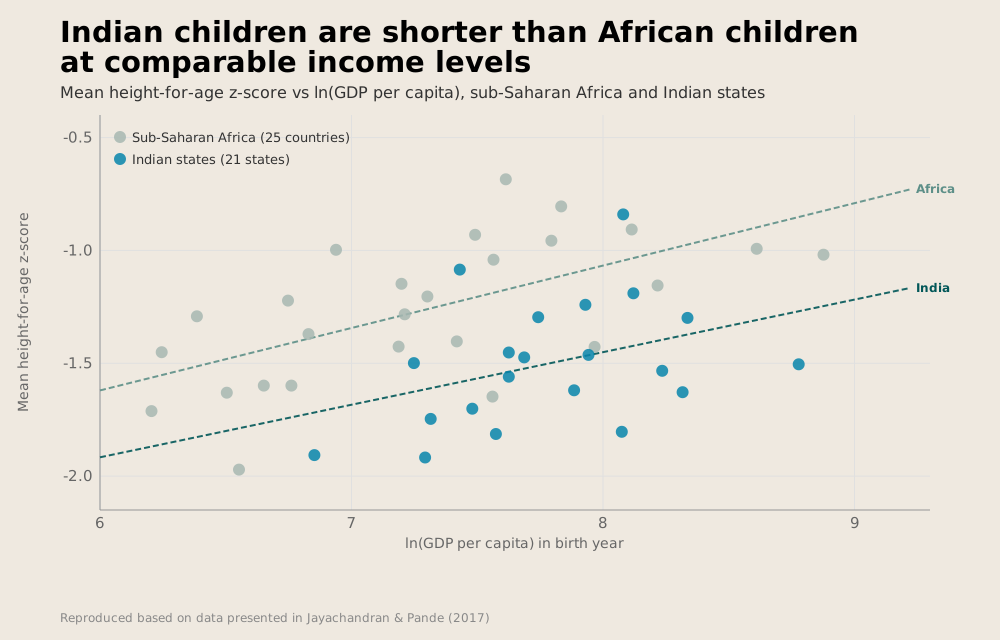
To readers in rich countries, this fact may not immediately come across as cause for concern. Height is a product of genetics, so short Indian children may simply reflect differences in potential heights across ethnic groups. Indians may simply be a short people—genetically prone to being shorter than Africans or Europeans.
Thinking of height as predominantly a product of genetic inheritance, however, is a luxury of having a high income. In the United States—and other rich countries—children rarely eat too little or become too sick to grow to their full potential height. There, height largely is a product of genetics. This is not the case in many poor countries, where malnutrition and childhood disease abound. Many people in poor countries are short in adulthood not because of short parents, but because they do not eat enough or are too sick in childhood to grow. Calories in, centimeters out.
Childhood stunting can have lasting implications. Economists have long shown that taller people earn more. This result is likely not because employers simply prefer tall people; rather, nutrition also matters for cognitive development. Malnourishment starves the growing brain of much-needed energy, and stunting may be a physical sign that children are not achieving their maximum cognitive potential. Furthermore, if malnourished children are stunted both physically and cognitively, effects may persist long beyond childhood. Full nutrition in adulthood may be insufficient to make up for deficits early in life.
Governments therefore care a great deal about how short their citizens are. They also want to know why children aren’t getting what they need to grow. It behooves a government to know if it is childhood illnesses, sanitation or another factor at play. Without this information, they risk not only a physically but cognitively stunted generation. Though heights no longer remain our only measures of population well-being, they are a useful and transparent yardstick. For that reason, measuring them has become a central part of many household survey programs, including India’s National Family Health Survey (NFHS).
Heights are also relatively easy to measure. It is much easier to pull out a measuring tape than collect a blood sample. We can even look at historical data to see the rise and fall of civilizations.
One of the most transparent ways to see the declining fortunes of Native Americans in the American Great Plains is through falling heights. Native Americans were once some of the tallest peoples in the world, a status they abruptly lost with the slaughter of the bison at the end of the 19th century.
So: Rich countries should have tall kids. And as countries get richer, their kids should get taller. But in this simple taxonomy, India is a dramatic outlier. Heights have grown alongside the country’s per capita income, but at a remarkably slow rate—much slower than in other countries.
Is it just genetics? It can be difficult to tell, because you have to disentangle a person from the place where they live. Telling whether a child in Bihar is short because they live in India or are Indian is an impossible task that even the best econometric tools cannot hope to resolve. To find answers, researchers therefore study people for whom person and place are decoupled: immigrants.
Economists Caterina Alacevich and Alessandro Tarozzi do just that, studying Indian families who migrate to the United Kingdom. When they arrive, Indian immigrants are shorter than native Brits. However, remarkably, their young children are as tall as their British peers, catching up in a matter of one generation.
This finding is striking. It does not seem to be simply that Indians are just shorter than Africans (or Brits). Something causes Indian children to stand shorter than the children of other nations. And whatever that something is does not fit in the overhead compartment when flying from Delhi to London.
If it’s not genetics, then what explains the Indian height enigma? One answer may be (eldest) son preference. Thirty-five years ago, Nobel Prize-winning economist Amartya Sen drew the world’s attention to an unsettling fact: The world had fewer girls than it should, with many Asian and African countries having a larger male than female population. The number of “missing women,” and the reasons they are missing, are controversial, but researchers often point to causes like sex-selective abortion or female infanticide.
Even when girls are born, though, they may receive fewer resources. In India, eldest sons in Hindu families often play important social roles, living with aging parents and inheriting property. Eldest girls—or indeed, girls in general—play no such role. This may encourage poor families—with only limited resources—to prioritize eldest sons over other children. In a paper in the Quarterly Journal of Economics, for example, economists Seema Jayachandran and Ilyana Kuziemko show that women stop breastfeeding daughters earlier if they do not have older brothers. Because breastfeeding suppresses ovulation and delays the return of fertility, mothers without sons may wean their daughters earlier in the hopes of conceiving a boy.
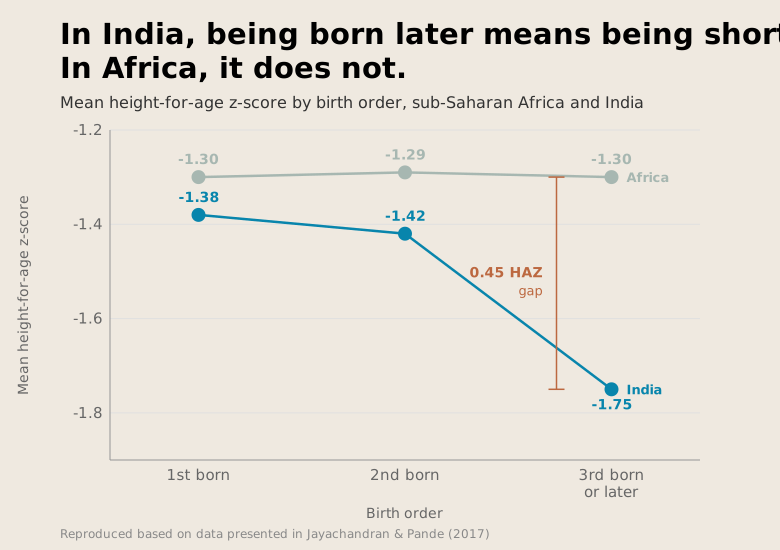
Perhaps it is simply that eldest children, regardless of gender, get the resources. In the American Economic Review, Jayachandran and Rohini Pande argue this is the case in the aptly named paper “Why are Indian Children So Short?” showing that though on average Indian children are shorter than African ones, this is not true for all types of children. Firstborns in India are as tall as their counterparts in Sub-Saharan Africa, but a gaping divide emerges for non-eldest children. Thirdborns and later in India are a third of a standard deviation shorter than their counterparts in Sub-Saharan Africa, compared to no gap for firstborns. Eldest sons are prioritized, and eldest daughters—by nature of their age—are less likely to have an older brother to compete with for resources during the nutritionally vital early years of life. This favoritism may come at the expense of later-born children.
Jayachandran and Pande’s paper has been very influential in academic economics, becoming a somewhat definitive source on the role of son preference in Indian society. However, their claims have not gone unchallenged. Diane Coffey, a sociologist, and Dean Spears, an economist and demographer, both of the University of Texas at Austin, have questioned the birth order hypothesis.
What could explain the fact that firstborn sons are taller than second or thirdborns? One answer is Jayachandran and Pande’s—eldest son preference. Another is that firstborns come from different kinds of families than second or thirdborns. The sample of firstborns across a whole population includes many kids from families with one child. Secondborns, by contrast, come from families with at least two children, and thirdborns necessarily come from families with at least three kids. In a recent paper, Spears and Coffey alongside economist Jere Behrman show that this effect is important in India, where larger families are also generally poorer. In other words, firstborns without siblings are more likely to come from richer families, where it is less likely that children won’t have enough to eat. Jayachandran and Pande are aware of this fact, and adjust for maternal characteristics to try and account for it. However, Spears, Coffey, and Behrman argue that conditioning on family size directly largely eliminates the link between birth order and children’s height.
If eldest son preference is not a silver bullet, then what can explain why Indian children are so short? The best alternative answer we have may lie with where people in India use the bathroom.
Alongside nutritional inputs, children’s heights are a product of their disease environment in childhood. Parasitic worm infections can sap nutrients from growing children, and diarrhea caused by exposure to fecal pathogens can induce violent and dangerous losses of fluids and nutrients. Avoiding these outcomes largely comes down to improving sanitation, which remains poor in many developing countries.
Despite its rapid economic progress, India remains an outlier in sanitation coverage as well. In 2019-21, large shares of India’s population primarily defecated in the open—that is, not in a toilet or latrine, but simply … on the ground. In a densely populated country, this is a recipe for public health concern. Fecal bacteria wreak havoc on children’s digestive tracts, in many cases causing chronic gut infections that limit nutrient absorption. These concerns have prompted global campaigns to eliminate open defecation, from a Gates-funded moonshot to invent a “next generation toilet” to an aptly named theme song and social media campaign from UNICEF India.
Whether, why and to what extent open defecation persists in India are controversial questions, with at times surprisingly vicious politics behind them. In 2019, Prime Minister Narendra Modi declared India “open defecation free”—thanks largely to the Swachh Bharat Mission, an initiative aimed at eliminating the practice in part through the construction of over 100 million latrines.
Many have called this claim into question, in part because of clear evidence to the contrary in the National Family Health Survey (NFHS), a national household survey program, one round of which began that year. Between 2015-16 and 2019-21, the share of households reporting that they practice open defecation fell from 55 to 27%—an impressive drop, but far from elimination.
Importantly, the way NFHS asks about open defecation may also overstate progress. Asking whether each member of a household defecates in the open yields higher rates than asking whether a household collectively does. Even in households where some members use a latrine, other household members may continue to defecate in the open. This would mean that as a percentage of population, far more than 27% could defecate in the open.
Coffey and Spears’s research suggests that this may be more likely than son preference to explain the disappointingly low stature of India’s children.
There is some evidence to suggest it could be. Randomized experiments comprising interventions aimed at improving sanitation coverage have pointed to at times positive effects on children’s heights. Descriptive evidence also suggests that differences in sanitation coverage are more than sufficient to explain the Indian height enigma: If reweighted to take into account India’s density of open defecation per square kilometer, African heights would look remarkably similar to Indian heights.
Though strategies like community-led total sanitation—wherein latrine construction is paired with behavioral change interventions, often aimed to invoke “shame” among those who defecate in the open—can yield meaningful improvements in sanitation, they are far from a silver bullet. Evaluating whether, in an open defecation-free environment, India’s children would grow as tall as their counterparts in Africa is a difficult if not impossible counterfactual to construct.
It is possible that both stories are at least some of the explanation. Indian girls could receive fewer resources than their brothers and Indians might suffer from the likelihood of open defecation. Those aren’t even the only two hypotheses in the literature. Alongside poor sanitation and cultural norms emphasizing the importance of eldest sons, Indian diets are often high in carbohydrates and low on proteins and micronutrients, failing to meet dietary diversity standards. At least descriptively, these patterns can explain some of the disparities in stunting rates across districts of India. But isolating this effect causally is challenging. Diets are difficult to randomly assign, meaning researchers are forced to rely on “natural experiments.” One paper, leveraging exposure to India’s “Green Revolution” as a source of variation, finds that improved yields of wheat and rice reduced heights, perhaps as a result of reductions in protein intake and dietary diversity.
Litigating these debates is a challenge and a parable for just how difficult finding answers to even the most simple and consequential of questions can be. The Indian height enigma is also an allegory for the power of data at a time when the infrastructure essential to measuring progress—both in India and globally—is teetering on the edge.
Prior to the 1980s, the world was remarkably devoid of data on the lives of the world’s poorest people; working out who was most deprived or what people died of was much harder and depended on less systematic information. At that time, we would not even know that Indian children were short, let alone have the ability to determine why. Household survey programs lent researchers new scope to examine the world and uncover paradoxes and facts with remarkably broad implications. A data-rich future is far from assured, however. In India, data collection has also taken a remarkably political turn, with a long-delayed census sparking controversy.
The most recent round of the NFHS—which was released just two months before this piece went to print—provides some promising signs that rates of stunting among India’s children have continued to fall. However, the convenient removal of data points related to sanitation, childhood sex ratios, and anemia—at least in early reports from the survey—will make the causes of this progress much harder to parse. The Indian enigma will likely continue to baffle, especially if the data used to interrogate it is allowed to slip away.
Wilson King is a PhD student in development economics at the University of California, Berkeley. His research focuses on health in low and middle-income countries.

If you have comments on this article, or wish to contribute to the discussion, please email them to letters@indevelopmentmag.com. Responses will be featured in a letters section.