
It was the sort of puzzle that you don’t notice at first. It was Juba, South Sudan, in 2012; a place where and time when, frankly, problems were not hard to find. The perhaps surprising absence of a problem was easy to overlook.

What South Sudanese Data Can Teach Us All, and Why We Should Care
English
I was there helping the government think about the management of its pooled fund — the primary structure via which donors put some funds under some small measure of government control — and working to expand its agency where possible, rather than letting the desires of donor organizations and their representatives be the driving force. Whenever I asked for data to help us better understand context, it was there. It also hung together into a coherent picture — at first pass, at least, it seemed accurate. People trusted the data they got; donors, government, NGOs seemed to report government data to me without the subtext of an eye roll indicating “who knows if this is at all accurate … but here’s what we have.”
This was unusual; when I had worked in other developing countries, the prevailing view was often that the numbers just couldn’t be trusted. No one thought the data in South Sudan was perfect, of course, but it was remarkably reliable for a newly independent country the size of France with the population density of Sweden.
Why Do Some Things Work Surprisingly Well?
This puzzle stayed with me; if it was a mystery novel, it might have been “the curious case of the excellent data.” Some years later I was researching the importance of mission-driven public servants when I asked Fiona Davies for her recommendations of the most impressive, mission-motivated leaders she’d come across in her wanderings through the world.1 Her answer was one name: Labanya Margaret, the longtime director general of the National Bureau of Statistics in South Sudan.2 When I found her, I had found the answer to my puzzle.
Margaret is a true believer in the power of statistics – and one who conveyed that passion, that sense of importance, to her staff. She says that “the data is not for the Bureau of Statistics. It is the voice of the voiceless. The population is the ones saying they did not eat. … The health data says women are dying while delivering.”
As Margaret put it – speaking in the reverent and awestruck tone many reserve for prayer — “Numbers change people’s lives.” For Margaret, good data allows better decision-making – with accuracy key to generating those welfare impacts.
Building up the National Bureau of Statistics in her new nation was no small feat. The country had no baseline data – almost all information was being collected for the very first time. It is hard to imagine a more difficult environment for monitoring performance, and thus for a management strategy focused on ensuring compliance – how could Labanya know if her staff had collected accurate data, if there was nothing to compare it to?
Labanya’s supervisors empowered her to exercise judgment and implement the solutions she thought were most effective. She in turn worked to create a sense of shared mission and collective commitment. Labanya was “loving and respecting” of her staff. She focused on making sure she could “understand the interest of (her) team.” She wanted to “generate and connect with them. Allow them to explain their position to (her).” She remembers, “Whenever we went to the field, I made sure to place (the staff in my mind), to connect the face to the place where I saw him or her.”
Margaret placed great emphasis on living up to her commitments to staff – something that is not always the case in places where employees have little recourse for mistreatment. “When you say you will pay them, you have to pay them on time: ‘We will pay you, and we’re going to pay you $10. It’s $10, not less.’”
And it wasn’t just about the staff. Labanya saw data collection as a joint effort between the many members of her team and the population participating in the survey: “Whatever we had done was not our effort but the effort of a collective team and also their own, the people from whom we collected this information, so we constantly went back to thank them and to really recognize their contribution.” “The numbers are telling exactly what (the people) are going through: the pain they are suffering, the joy and their future visions.”
The result? Data that was extremely high quality. In a context where nothing could be taken for granted — where one couldn’t even rely on the water — they had sent out enumerators to interview the population and bring back information, and it had worked! You need not take my word for it; a Harvard Kennedy School paper describes one of the bureau’s key initiatives, an innovative high frequency household survey, as having “achieved rapid success.”3 World Bank researchers described the survey as innovative and highly reliable – a model for how to collect data in difficult contexts.4
Lots of Stuff Works Pretty Well When You Might Not Expect It – and When It Does, It Reminds Us That Every What Problem Is a Who Problem
Not every agency or every task has the blessing of a Margaret trying to make it work well on behalf of the state. But there is nonetheless a very real sense in which Margaret is typical, not exceptional.
For all the things not working in the world, there are many that do – and where they do, you very frequently find excellent managers who care about the mission and empower their staff in ways that encourage them to feel similarly. Sociologist Erin McDonnell finds excellent mission-motivated bureaucrats who are critical to the capacity of high-performing sections of multiple public organizations in Ghana as well as in Nigeria, Kenya, Brazil, and China.5 Political scientist Merilee Grindle found nearly 30 years ago that management style and (high) performance expectations were key to the cultures of organizations that perform well in a study of 29 organizations across six countries. 6
In contrast, monitoring and control — the workhorse “technology” for trying to improve implementation — very often doesn’t work. A series of carefully identified empirical studies show that an approach based on controlling your employees very frequently undermines performance – and does so even more as tasks become harder to monitor. 7
The difference in management can make a large difference. In one illustrative example, a group of economists found that moving the individuals and organizations at the 25th percentile of effectiveness in Russian public procurement to the 75th percentile would result in 13.9% in savings; this represents about $10 billion a year in potential savings.8
One management aphorism goes “Every what problem is a who problem.” Coined (or at least codified) in a business book by Ben Horowitz, cofounder of mega-successful venture firm Andreessen Horowitz, it is meant to remind the (largely private sector, and in particular technology-focused) readership that it is natural and easy to think of capacity challenges as technical in nature.9 That isn’t true, though, as the evidence shows; capacity challenges are almost always about people, and the environments in which those people are placed.
It’s Not About the Individual; It’s About the Team
One possible way of taking the insight that it all boils down to people would be to try to just figure out who the good ones are and have them do the work. Let’s hire those 75th-percentile procurement agents and fire the 25th-percentile ones!
While it’s certainly true not all people are created equal in ability, motivation or orientation to a given task, this misses Horowitz’s – and the literature’s – point.
Yes, individuals matter. But the way to build sustainable capacity is not to hope to win the “good team” lottery or even think that hiring the best – most skilled, most mission motivated, etc. – is enough. It’s to build and support a group – a unit, an agency, an organization – that collectively has the skills, managerial processes and norms to generate good performance.
The World Bank’s Bureaucracy Lab has created the Worldwide Bureaucracy Indicators, among our best data sources for internationally comparative statistics regarding public sectors around the world.
Dan Rogger, the lab’s colead, summarizes his central conclusion from the lab’s work as follows:
Government Is Fundamentally Diverse
This may seem like a tautology, but it isn’t. We often speak of government as if it were one actor, focusing on the actions of “Washington,” “London” or “Juba.”
But Washington isn’t one actor — it is closer to a society than an individual. What happens depends on what those individuals do. And what those individuals do depends substantially on their work environments, recruitment and orientation.
Those experiences can vary widely across countries. The Global Survey of Public Servants (which Rogger is a cocreator of alongside Frank Fukuyama, Christian Schuster and others) shows that 96% of Romanian public servants trust their colleagues; only 54% of Ghanaians do.
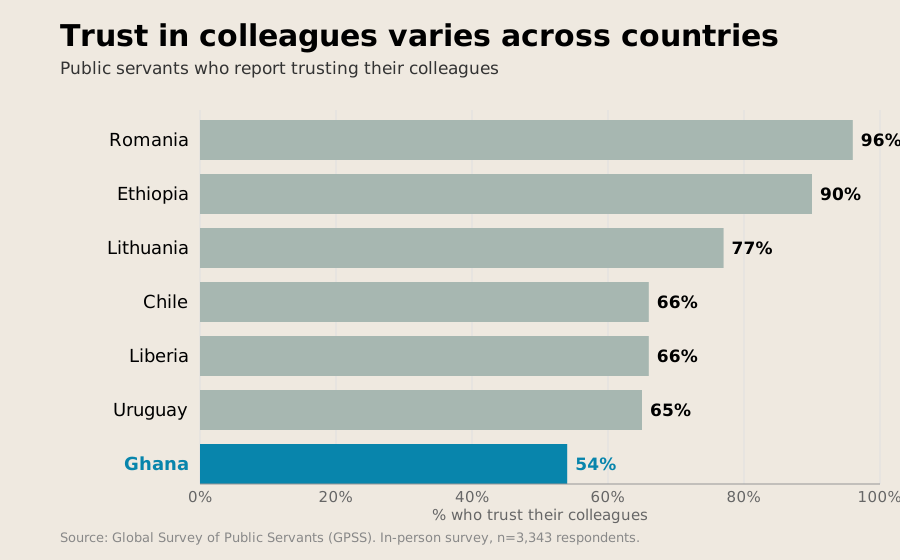
Great; this would seem to suggest it’s right to think of “Washington” and “Juba” — that countries matter. And they certainly do.
But this is just the tip of the proverbial iceberg. We see a similarly diverse range of responses by institution within a country.
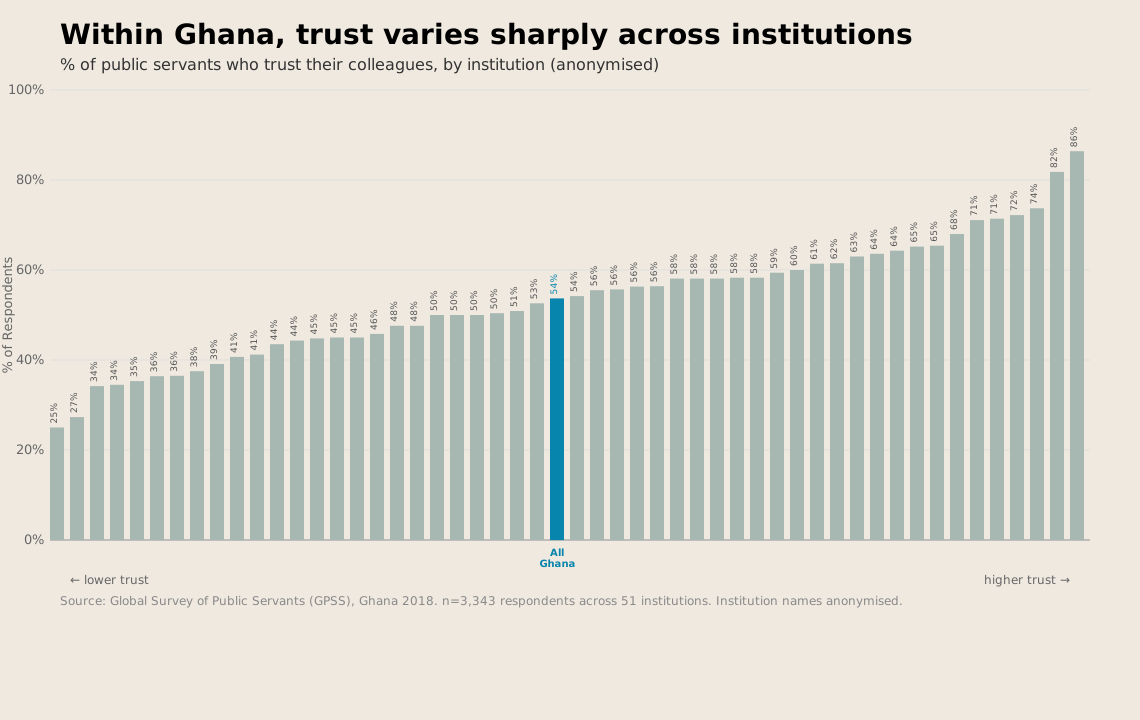
Some institutions are high trust; some are low. Indeed, trust varies more within a country as does between countries.
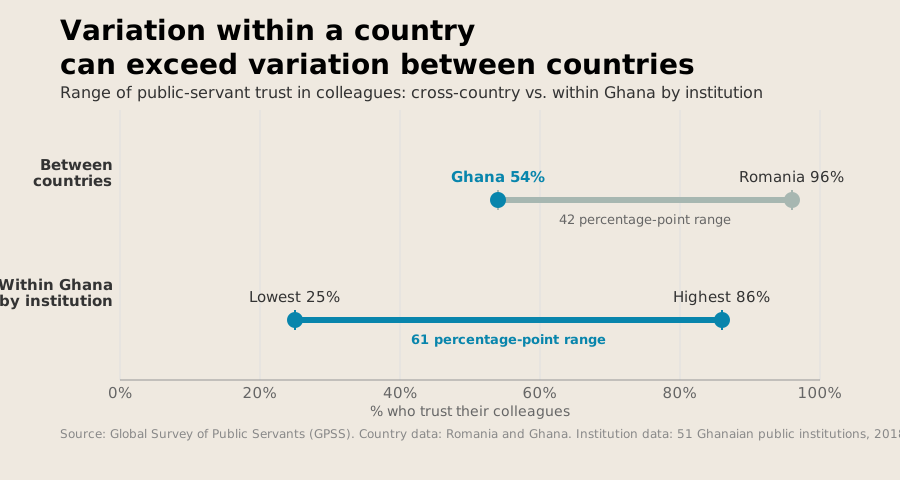
There is no sub-institution data publicly reported in the Global Survey of Public Servants. But if there was – if we could see differences by department – I am very confident we’d see a similar range. If we could go below departments to individual teams, I expect we’d see the same pattern again.
There’s an important takeaway here. When we talk of a government – or what it’s like to work in government – we generalize. That’s not meaningless – there are real ways in which countries differ. But the more we want to build capacity, the less useful these national-level summaries are. We care less about the entire government and more about what is happening within each team in each department.
Sometimes what these teams need is more technical skills — training in Excel or Python or (more likely these days) Claude Code. But more often it requires changing things broader than the knowledge held in one human’s head – it requires changing an organizational system.
Management that empowers – that allows autonomy, cultivates competence and creates connection to peers and purpose – is a powerful tool to improve systems. It both attracts the mission motivated and helps current employees become more mission motivated.10 It can help transform departments from places where people clock in and out to places where employees want to produce the best possible output.
Making the Whole Garment Out of the Fabric in the Pocket
Often people believe that bureaucrats in the Global South are worse at their jobs than those in the Global North. They are more corrupt, less efficient, uninterested in actually doing their job. Conversations in the Global South therefore focus instead on corruption and how control and monitoring can root it out. Indeed, the theory seems to be that the only way to improve their job performance is to control them — make sure they don’t have time to slack off, monitor every task and allow absolutely no deviation from protocol.
But there is no evidence that the people who work for government in developing countries are systematically “worse” in terms of motivation or orientation toward serving the public good than any others.11 Indeed, focusing on control is probably making the government function worse. Few high performers want to work in an environment where their bosses spend every second of the day preventing employees from doing bad things, rather than supporting them to do good things. By trying to prevent corruption, these governments are selecting for the people who are most likely to tolerate micromanagement.
In all countries, the people who work for government are people, in all their diversity and complexity. Few of these people want to be micromanaged. But we collectively fail to imagine empowered, motivated, high-performing developing world government teams. Building teams like this doesn’t require more control; indeed, it requires the exact opposite. It requires building mission alignment and trusting and empowering public servants.
There are myriad ways to support and scaffold an empowerment-first approach. To name just a few: dedicated effort to build “green tape” policies that build a defense for bureaucrats who wish to exercise judgment in service of the mission; peer discussion and empowerment; and management practices that shift culture to make intelligent risk-taking psychologically safe. Emerging technology can be a partner in this; i.e., an AI agent that can be consulted not just for information, but for permission to act in a particular way given the circumstances — enabling public servants to not feel they must risk reprimand to best serve citizens.
It is true there are civil servants who simply don’t have the skills for the job they hold. But even where skills are genuinely missing in the public service, an approach that starts with the under-skilled individual and what will give them a sense of agency, purpose and contribution is still critical. The evidence is clear that people learn best when they are motivated to learn – when they feel the autonomy, the support, the agency to put that learning to use.12 To build capacity means, first and foremost, to start with diagnosis – who the staff are, how they think about their work and what they need to want to move forward.
A capacity-building journey needs a destination – but first it needs an origin, and a pathway there. Margaret faced a seemingly impossible task – but rather than tackle it as a technical problem, she approached it as a human one. She did not prioritize monitoring her team, recognizing the impossibility of such an approach for the task in front of her.13 Instead, she treated her people with respect and dignity – she sought (and often managed) to inspire commitment to the cause that meant so much to her – getting the data right, so that better decisions could be made.
It’s Not Just About the Metrics
Margaret has said that “numbers change people’s lives.”
I find this beautiful – and believe it to be true. But it’s only part of the story. If we zoom out just a bit, we see that it’s the Margarets of the world inspiring and managing in ways that convince the people of South Sudan’s National Bureau of Statistics that numbers change people’s lives, which in turn led to the successful gathering of those numbers.
We don’t just have to wait around for Margarets, any more than Margaret waited around to be blessed with a team that already cared deeply about the transformative power of accurate data. We can cultivate and till the soil in which such organizational cultures grow.
Margaret took a piece of fabric and sewed it into a pocket. With the right approach, capacity-building efforts focused on how to build organizational systems that start by centering the ambitions of the many good humans who populate them might make a whole garment out of the cloth. If we all learn that from Margaret’s example, we might collectively be able to build a better world.
Dan Honig is a professor at Georgetown McCourt School of Public Policy and associate professor at University College London’s Department of Political Science. He works on improving the organization of government – usually by taking more account of the people who work for it – with the aim of bettering citizens’ lives and the relationship between states and citizens.
If you have comments on this article, or wish to contribute to the discussion, please email them to letters@indevelopmentmag.com. Responses will be featured in a letters section.
- I was writing a book on mission motivated public servants and their importance; a full profile of Margaret appears in Dan Honig, Mission Driven Bureaucrats (Oxford University Press, 2024). ↩︎
- At time of writing South Sudan’s minister for trade and industry. ↩︎
- Greg Larson, Peter Biar Ajak and Lant Pritchett, “South Sudan’s Capability Trap: Building a State with Disruptive Innovation,” (CID Working Paper 268, Harvard Kennedy School, 2013). ↩︎
- Utz Pape and Luca Parisotto, ”Estimating Poverty in a Fragile Context: The High Frequency Survey in South Sudan” (Policy Research Working Paper 8722, World Bank, 2019). ↩︎
- Erin McDonnell, Patchwork Leviathan: Pockets of Bureaucratic Effectiveness in Developing States (Princeton University Press, 2020). ↩︎
- Merilee Grindle, “Divergent Cultures? When Public Organizations Perform Well in Developing Countries,” World Development 25, no. 4 (1997): 481-495. ↩︎
- See e.g., Oriana Bandiera, Michael Carlos Best, Adnan Qadir Khan and Andrea Prat, “The Allocation of Authority in Organizations: A Field Experiment with Bureaucrats,” Quarterly Journal of Economics 136, no. 4 (2021): 2195-2242; Imran Rasul, Daniel Rogger and Martin J. Williams, “Management, Organizational Performance, and Task Clarity: Evidence from Ghana’s Civil Service,” Journal of Public Administration Research and Theory 31, no. 2 (2021): 259-277. More research in this vein reported and summarized in Honig, Mission Driven Bureaucrats.
↩︎ - Michael Best, Jonas Hjort and David Szakonyi, “Individuals and Organizations as Sources of State Effectiveness,” American Economic Review 113, no. 8 (2023): 2121-67. ↩︎
- Ben Horowitz. The Hard Thing About Hard Things (Harper Business, 2014). ↩︎
- Honig, Mission Driven Bureaucrats. ↩︎
- See Honig, Mission Driven Bureaucrats, 63-6 for an overview of these data. ↩︎
- This is a vast literature but for a meta-analysis/overview see e.g., Joshua Howard, Julien Bureau, Frédéric Guay, Jane Chong and Richard Ryan, Student Motivation and Associated Outcomes: A Meta-Analysis From Self-Determination Theory,” Perspectives in Psychological Science 16, no. 6 (2021):1300-23. ↩︎
- Though reporting and performance appraisal were still present, as they must be in any good functioning system; the question is one of relative emphasis, not the existence of any controls. ↩︎